Basketball Rebounding Beyond Height: Position, Contact and Team Responsibility
The tallest player on the court has an advantage when the ball is above everyone else's reach. Many rebounds, however, are influenced before that moment: a defender finds an opponent, a guard moves toward an uncovered area, or a teammate keeps an offensive player away from the landing point. The player credited with the rebound may be finishing work shared by several people.
Good rebounding therefore involves more than jumping. It combines observation, legal positioning, balance, pursuit and control of the ball afterward. It also depends on a team knowing who should attack the offensive glass and who should protect against the next possession.
For a viewer, the most revealing moment is often the instant the shot leaves the hand. Some players are already solving their next task. Others stop and watch. Following those first movements makes it easier to see how a team wins or loses the space around a missed shot.
Read the shot without forgetting the opponent
The flight of the ball supplies information, but it does not tell you everything. Watch where the shot comes from, how it approaches the basket and which parts of the court remain uncovered. Then keep updating the picture as the ball meets the rim or backboard.
Avoid turning an observation into a fixed rule. A distant shot does not guarantee a long rebound, and a miss near the basket does not guarantee that the ball will stay there. A useful rebounder prepares to move rather than committing so completely to one predicted bounce that every other outcome becomes unreachable.
USA Basketball's advanced rebounding guidance emphasizes that anticipation and the positioning before a shot are connected. That is a useful correction to the image of rebounding as simply reacting faster once the ball is loose. Players can improve their chance of reaching the ball by arranging themselves earlier.
Imagine an illustrative defender watching a shot from the wing. If the defender looks only upward, an opponent may move freely toward the rim. If the defender looks only at the opponent, the ball may land nearby without being pursued. The task is to gather both kinds of information and respond to what develops.
Coaches can observe this without demanding that a player predict every bounce. Ask whether the player identified a nearby threat, established a workable position and then moved toward the available ball. Those are repeatable actions even when a rebound takes an unusual direction.
Position and contact should create access to the ball
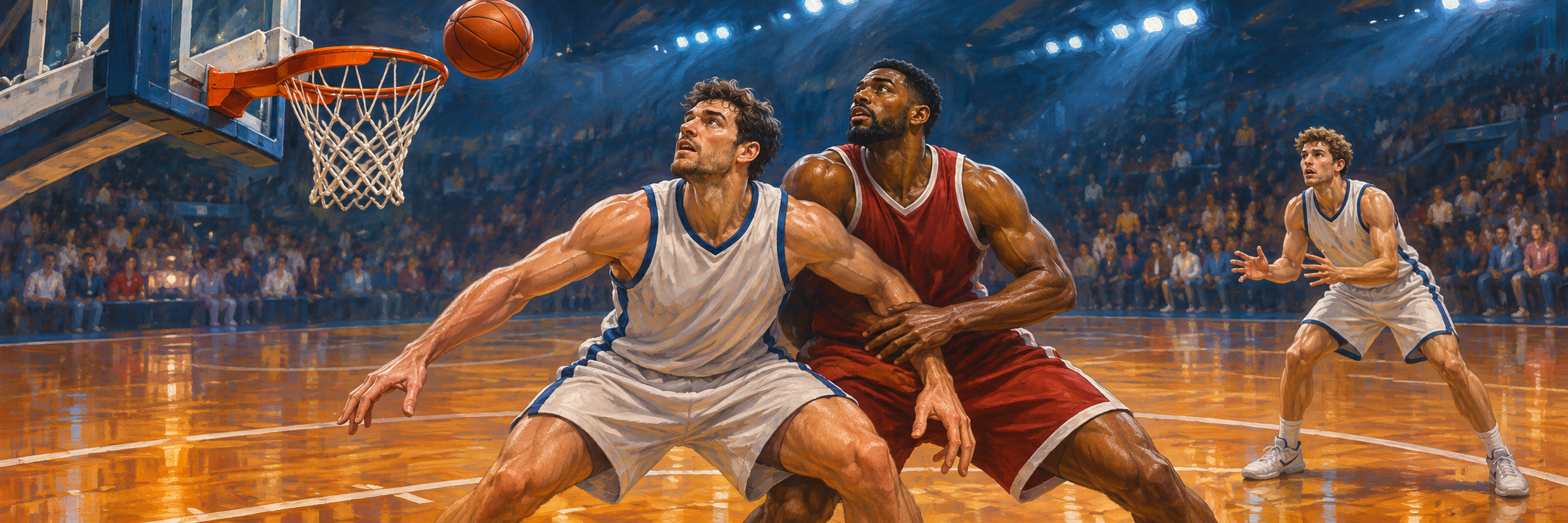
A box-out is useful because it interferes with an opponent's route to the rebound while preserving your own opportunity to pursue it. It is not successful merely because two players make contact. Contact that leaves the defender off balance or unable to find the ball has not completed the job.
The FIBA WABC Level 1 manual teaches finding the offensive player, staying balanced and turning to face the basket after establishing contact. The practical emphasis is on seeing the opponent as well as the ball. A defender who skips that recognition can leave an attacker with a free run into the rebounding space.
Use legal body position rather than a push, hold or extended elbow. Establishing a place on the floor and maintaining balance is different from moving an opponent illegally. When teaching the skill, begin at a controlled intensity so players can understand the positioning before adding a live contest.
Consider a hypothetical smaller defender against a bigger attacker. The smaller player may not win a contest directly above the rim, but can still make the attacker's path less direct. A teammate may then collect the ball. That is valuable defensive work even when it produces no individual rebound statistic.
The final movement matters too. After creating separation, go toward the ball when it becomes available. Remaining attached to an opponent while a reachable rebound drops untouched can turn a sound first action into an incomplete possession. Make contact, maintain awareness and then pursue with purpose.
Guards and wings have rebounding jobs too
Assigning rebounding only to the biggest players ignores where those players may be when a shot goes up. A defensive rotation or switch can move a center away from the basket. A guard can become the player nearest a dangerous offensive rebounder, whether or not that was the original matchup.
In that situation, waiting for the center to return leaves the job unfilled. The guard needs to recognize the immediate responsibility: find a body when necessary, occupy useful space or pursue a loose ball that teammates cannot reach. The assignment follows the play rather than a position listed on the roster.
Wings have similar decisions. If a wing closes out to contest a shooter, the responsibility does not necessarily end when the shot is released. Watch whether that player stays involved, identifies the shooter's movement or helps cover the area a teammate has left.
For an illustrative team defending a drive, several players may collapse toward the ball before a pass produces a shot elsewhere. The rebound then tests the whole rotation. Someone must account for the attacker moving along the baseline; someone must be ready for a ball that comes away from the crowded paint. Five people watching the same spot can leave both tasks unanswered.
Communication helps when assignments become unclear. A short, agreed call can tell a teammate that a player is being contained or that someone is pursuing the ball. The language should be simple enough to use during the action, with the roles established in practice rather than invented during a scramble.
Securing the ball is part of finishing the possession
Winning the first touch is useful, but it may not establish control. A ball tipped toward a teammate, a rebound gathered with two hands and a loose ball still being contested are different outcomes. Follow the sequence until one side can make a deliberate next play.
USA Basketball's defensive rebounding drill connects the rebound with a pivot and an outlet pass. That connection is important: securing the ball creates the chance to begin the next possession, but a rushed or careless first pass can give it straight back.
For players, the immediate task is to control the ball in balance and recognize the pressure around them. Do not assume that landing with the rebound removes nearby opponents. A teammate offering a clear outlet makes the next action easier and can prevent the rebounder from having to solve every part of the transition alone.
The outlet player also has work to do. Move into a useful passing position, show availability and assess what is ahead. Sprinting away without regard to whether the rebounder has a clear pass can turn a hoped-for fast break into a difficult recovery.
When watching a game, include this first pass in the rebounding evaluation. A team that repeatedly wins the ball but struggles to begin its offense may need to improve the connection between its rebounders and its perimeter players, rather than simply demand more jumping or effort.
Offensive rebounding has a transition cost
An offensive rebound can extend an attack and create another scoring opportunity. Pursuing it also places players closer to the opponent's basket when possession changes. A team needs a plan for both possibilities.
USA Basketball's advanced guide discusses offensive rebounding alongside transition defence. That is the essential trade-off. The right choice depends on the team's personnel, the shot and the positions players already occupy, rather than an instruction for everyone to chase every miss.
Imagine a hypothetical shot with two attackers already near the rim and another positioned beyond the ball. The team might send the nearer players to contest the rebound while the farther player protects the most direct transition route. Change the positions, and the sensible responsibilities may change too.
The shooter cannot assume that someone else is always providing that protection. Nor should a player abandon a realistic rebound solely because a role was described too rigidly before the possession. Teams need clear principles that can be applied to the actual spacing when the shot occurs.
On replay, judge both sides of the decision. Did the offensive rebounders create a real chance to keep the ball? Did their teammates leave a credible defensive response if they failed? A second-chance basket does not prove that every crash was wise, just as one fast break does not prove that offensive rebounding should be abandoned.
Practice the entire sequence
Begin with a controlled recognition exercise. Place an attacker and defender near the lane while a coach or teammate shoots from different positions. The defender identifies the attacker, establishes legal position and then pursues the rebound. Reset after the ball is controlled, not after the first contact.
Add an outlet player next. Require the rebounder to find a balanced first pass while the attacker remains involved within the rules. This adds a purpose beyond catching the ball and helps the perimeter player learn where to become available.
Then use a small-sided live game. Begin with a shot, allow a genuine rebound contest and continue into the next possession. Rotate responsibilities so guards and bigger players both experience contact near the basket and decisions farther from it. The aim is to test recognition and teamwork rather than memorize one uncontested bounce.
Coaches can track several useful observations without complicated equipment. Did every attacker have someone accounting for the rebounding threat? Was there an uncovered area? Did the team secure the ball after the first touch? Was the outlet available? Select one problem to improve before adding several instructions at once.
Keep the practice conditions appropriate to the players. Controlled positioning should come before increasingly competitive contact. A player who is learning where to stand does not benefit from being encouraged to collide harder instead of understanding the assignment.
What to follow in the next game
Choose a single shot and watch away from the ball. Identify who makes the first useful movement, who prevents an opponent from entering the space and who collects the rebound. Then follow the first pass. That short sequence reveals contributions that a rebound total can miss.
Repeat the exercise after a defensive switch and after an offensive player decides to chase the miss. Notice how the responsibilities change with the positions people occupy. Height still matters, but the team has several opportunities to influence the contest before reach becomes decisive.
Rebounding becomes more understandable when it is treated as a shared sequence: recognize, position, pursue, control and connect to the next possession. The individual who catches the ball finishes the sequence. The players around that person often make the finish possible.
Sources
FIBA World Association of Basketball Coaches, Level 1 Coaches Manual, section 1.2.4, Blocking out an offensive rebounder: https://assets.fiba.basketball/image/upload/documents-corporate-wabc-coaching-level-manuals-level-1-eng.pdf
USA Basketball, Advanced Rebounding: Secrets From The Pros: https://www.usab.com/news/2014/01/advanced-rebounding-secrets-from-the-pros
USA Basketball, 5 Simple Ways to Improve Your Basketball Rebounding: https://www.usab.com/news/2014/01/5-simple-ways-to-improve-your-basketball-rebounding
USA Basketball, Defensive Rebounding: https://www.usab.com/news/2014/01/defensive-rebounding
The practice progressions and game situations above are illustrative coaching applications, not reported experimental findings.