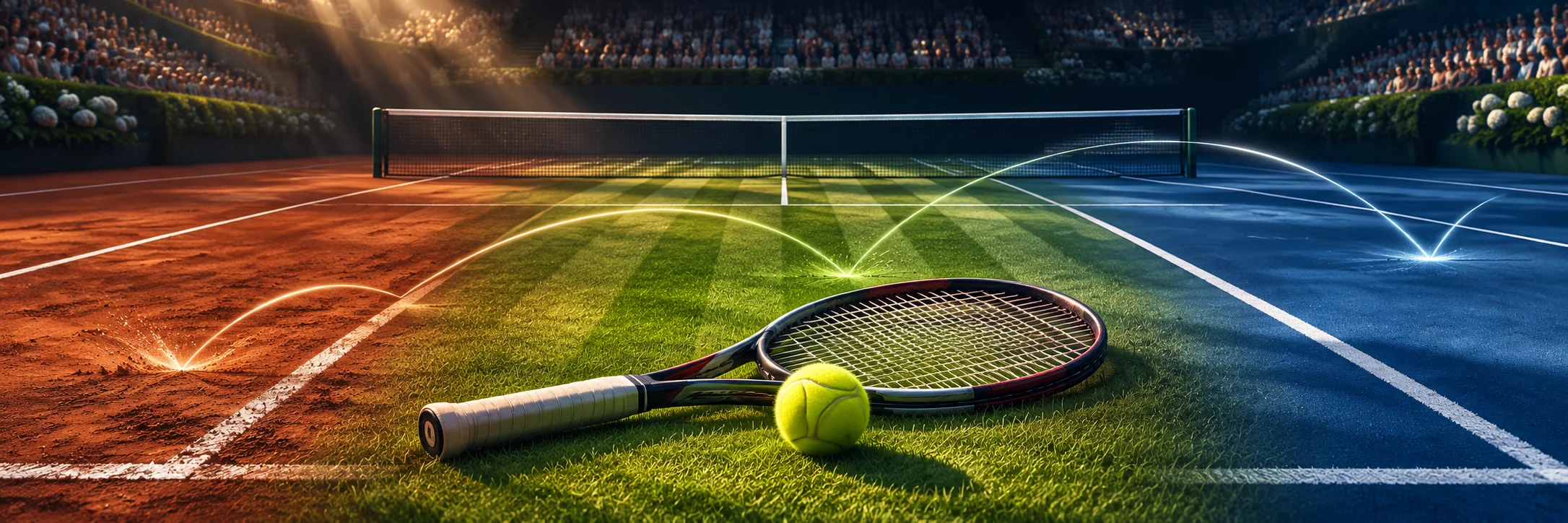
A change of surface can make familiar shots feel unfamiliar. A rally ball that arrives comfortably on a hard court may climb above the strike zone on clay or stay below the knees on grass. The player has not necessarily lost timing. The conditions have changed the problem.
The useful response is to adjust the decisions around your shots: where to stand, how much height to use, when to change direction and what kind of ball justifies an attack. Surface strategy works best when it improves your existing game rather than persuading you to imitate a specialist overnight.
There is also an important qualification. Clay, grass and hard court are broad descriptions, not complete scouting reports. The ITF classifies court pace in five categories, from slow to fast. Its classification concerns the tested pace of a surface product; it does not mean every court carrying that material will feel identical. Tennis Canada likewise describes pace as something measured through the ball's movement before and after the bounce. [1,2]
The following coaching framework combines those distinctions with practical match-planning suggestions. The practice exercises are proposed applications, not a claim that a particular drill has been proven to raise every player's winning percentage.
How court speed and bounce affect tactics
Start by separating pace from bounce height. Ask whether the ball reaches you quickly after landing and whether it rises into a comfortable contact zone. Those answers can point toward different adjustments. You might have enough time to prepare but still need to solve an awkwardly high bounce. On another court, the contact height may be comfortable while the available preparation time feels short.
Use the warm-up as an investigation. Exchange ordinary rally balls, then test a higher topspin ball, a slice and a firmer drive. Notice what happens on both sides of the court. Repeat the observations near the baseline and a little farther back. The aim is to find a reliable starting position, not to decide the entire match from one unusual bounce.
Also test your recovery. A shot can be technically comfortable but tactically poor if it leaves you struggling to stop or change direction. Before increasing rally speed, establish how confidently you can move into the outside ball and return toward a useful position.
The LTA's surface guide describes clay as generally higher-bouncing and slower, and grass as generally lower-bouncing and quicker. It also notes that the composition of a hard court's coating can change its playing speed. Those are useful starting expectations. Your own observations should refine them. [3]
One practical exercise is a three-ball comparison. Feed three similar balls to the same general area: one with height, one driven more directly and one sliced. The receiver identifies which ball caused the most difficult contact, then explains why. Repeat on the other wing. This turns a vague comment such as “the court feels slow” into information you can use.
Do not confuse difficult conditions with permission to aim closer to the lines. If your balance or contact point is uncertain, larger targets usually give you a better way to establish the rally. Once you understand the bounce, you can make a more informed decision about how aggressively to play.
Constructing points on clay
A useful clay-court plan is to build pressure in stages. Establish a ball that holds your opponent behind the baseline. Find out which reply becomes shorter or less accurate. Move forward when that reply gives you a genuine positional advantage.
That sequence is different from simply waiting for an error. You can play with clear attacking intent while allowing several shots to create the right opening. A higher ball to a difficult contact zone, followed by a deeper ball into the same pattern, may do more work than an ambitious change of direction attempted while you are still defending.
Think about the distinction between moving an opponent and moving yourself out of position. A sharp angle is attractive only if you can handle the next ball. Before using it, consider where your opponent will make contact and which replies become available. Your recovery should respond to that geometry, not automatically return you to the painted centre mark.
The WTA's reporting on clay-court adaptation captures how much point construction, movement and acceptance of variable conditions matter to players. Its interviews describe using changes of pace and angles as part of learning the surface. That supports a broader lesson: successful adaptation involves more than hitting every ball with additional topspin. [4]
For practice, play a pattern in which both players begin crosscourt. A player may change direction only after receiving a ball that lands shorter than an agreed target zone. Then play the point out normally. The restriction is a teaching device: it makes players identify an opening before trying to finish.
Next, remove the restriction while retaining the question after each point. Was the change of direction earned? Were you balanced? Did the opponent contact the next ball under pressure? The answer may be yes even when the shot missed. It may be no even when a low-percentage attempt happened to win.
Use the drop shot selectively. It can be valuable when your opponent has retreated and you are balanced inside the court. It is a less convincing solution when you are stretched, late or trying to escape a rally without first creating a favourable position. Prepare a response to the opponent reaching it; the point does not end when the ball leaves your strings.
Movement deserves separate practice. If sliding is unfamiliar, learn the progression with a qualified coach rather than forcing a long slide during a competitive point. You can still improve clay-court positioning through controlled movement, balanced contact and disciplined recovery while developing that skill.
Taking time away on grass
On grass, organize your preparation before trying to add power. A smaller take-back and an earlier readiness position can be more useful than swinging harder. The question is how to make clean contact soon enough to keep control of the next decision.
Begin with the return. Decide whether your first task is to block the serve into play, drive through a comfortable ball or attack a second serve. These are different intentions. Trying to use the same return swing against every delivery can leave you defending with an attacking movement or attacking with no commitment.
A research study of Wimbledon singles matches from 2015 to 2017 found that one-shot points—aces and missed returns—were the most common individual rally length within the short points studied. The authors emphasized the importance of serving and returning. Their results concern elite grass-court matches, not a guaranteed formula for recreational tennis, but they reinforce the value of practising the start of the point. [5]
Make that practical by playing service games in which you assess the serve and return separately from the eventual result. Did the serve create the reply you intended? Did the return give you a playable next ball? A point won through a later opponent error should not hide a poor starting decision.
Slice can change the contact problem, but it still needs purpose. Choose whether you want depth, a lower ball, a change of pace or an approach. A floating slice struck without length or direction may simply give the opponent time to attack.
Coming forward should also follow the quality of the situation. Look for a reply you can approach behind, establish your position and prepare for the passing shot. Rushing toward the net after any short-looking ball can leave you volleying from an awkward position. The right approach is the one that improves the next contact, not the one that merely looks aggressive.
A useful practice game starts each point with a serve and return, then rewards players for making a balanced decision on the next ball. You can discuss the decision after a short group of points rather than interrupting every rally. Keep track of whether lost points began with a return miss, an uncomfortable first groundstroke or a poor approach choice.
Be patient about learning how the court feels underfoot. Surface-appropriate shoes and controlled changes of direction matter. If footing is uncertain, reduce the intensity and investigate the conditions with the venue or coach. Tactical ambition is not a reason to ignore a slippery area.
Adapting on different hard courts
Hard-court planning should begin with the actual court, not the assumption that it is a neutral compromise between clay and grass. Some hard courts let you step in comfortably. Others give an opponent enough time to recover repeatedly. Indoors and outdoors can present different visual and environmental demands even when both courts are described as hard.
The LTA's discussion of hard-court players emphasizes the need to combine attacking and defensive skills. Its account also links a comparatively predictable bounce with the opportunity to take initiative. The useful application is to identify which balls allow your own strengths to operate, rather than treating every rally as an instruction to hit flat and fast. [6]
Choose a reliable rally pattern before choosing a finishing shot. For example, you might use depth through a central area to reduce the opponent's angles, then look to attack a shorter reply. Another player may prefer a crosscourt pattern that produces a familiar forehand. Neither pattern becomes correct simply because the court is hard.
Return position is one of the easiest adjustments to test. If you are consistently jammed, try a small positional change and compare the quality of your contact. If the extra distance lets the server pull you too far off court, reconsider. Change one variable at a time so you know what helped.
Use variety to alter the opponent's decisions, not just to demonstrate that you possess several shots. A higher rally ball can interrupt an opponent's preferred contact height. A lower slice can invite a different response. A body serve can change the space available for the return. Judge these choices by the replies they produce.
For practice, begin a point with a neutral feed and require both players to recognize three situations: defend, maintain or attack. Call the situation after the point and explain it briefly. This exercise is especially valuable when a player treats every comfortable contact as an attacking ball or every deep ball as a reason to retreat permanently.
Your best surface adjustment may be a modest one. A little more height, a slightly earlier preparation or a clearer recovery position can improve the whole pattern. Avoid making several technical changes during a match because a surface has been given a reputation that does not match what you are actually experiencing.
A practical match-preparation checklist
Before a match, write a short plan that answers five questions. Where will you receive serve? What is your safest rally pattern? Which contact height troubles your opponent? What reply will give you permission to attack? Where should you recover after using your preferred shot?
Then test those answers in the warm-up and opening games. They are working hypotheses. If the opponent handles your high ball comfortably, find another problem to present. If an approach that looked sensible in practice produces easy passing shots, examine the approach quality and your position before abandoning net play altogether.
Keep observations specific. “I am too slow for grass” does not suggest a useful adjustment. “My return preparation is late against the serve out wide” does. “I cannot win rallies on clay” is similarly unhelpful beside a clearer observation that you are changing direction while still behind the baseline and off balance.
After the match, identify one decision to retain and one to practise. A surface change should make you a better problem-solver, not leave you rebuilding your game every week. The most adaptable player is often the one who recognizes the conditions early, chooses clear targets and makes adjustments that remain dependable under pressure.
Sources
[1] International Tennis Federation, Classified Surfaces and Court Pace Rating categories. https://www.world.tennis/en/about-us/tennis-tech/classified-surfaces/
[2] Tennis Canada, Tennis Courts and Surfaces. https://www.tenniscanada.com/play/tennis-101/tennis-courts-surfaces
[3] Lawn Tennis Association, Tennis court surface guide: Hard, clay, grass & astroturf. https://www.lta.org.uk/play/tennis-tips-and-techniques/hard-clay-grass-and-astroturf-tennis-court-surface-guide/
[4] WTA, Grind it out: The unique challenges and rewards of clay-court tennis, May 20, 2024. https://www.wtatennis.com/news/4024579/grind-it-out-the-unique-challenges-and-rewards-of-clay-court-tennis
[5] Anna Fitzpatrick, Joseph A. Stone, Simon Choppin and John Kelley, Investigating the most important aspect of elite grass court tennis: Short points, International Journal of Sports Science & Coaching, 2021. https://doi.org/10.1177/1747954121999593
[6] Lawn Tennis Association, What makes a good hard-court tennis player? https://www.lta.org.uk/advantage-home/content/what-makes-a-good-hard-court-tennis-player/