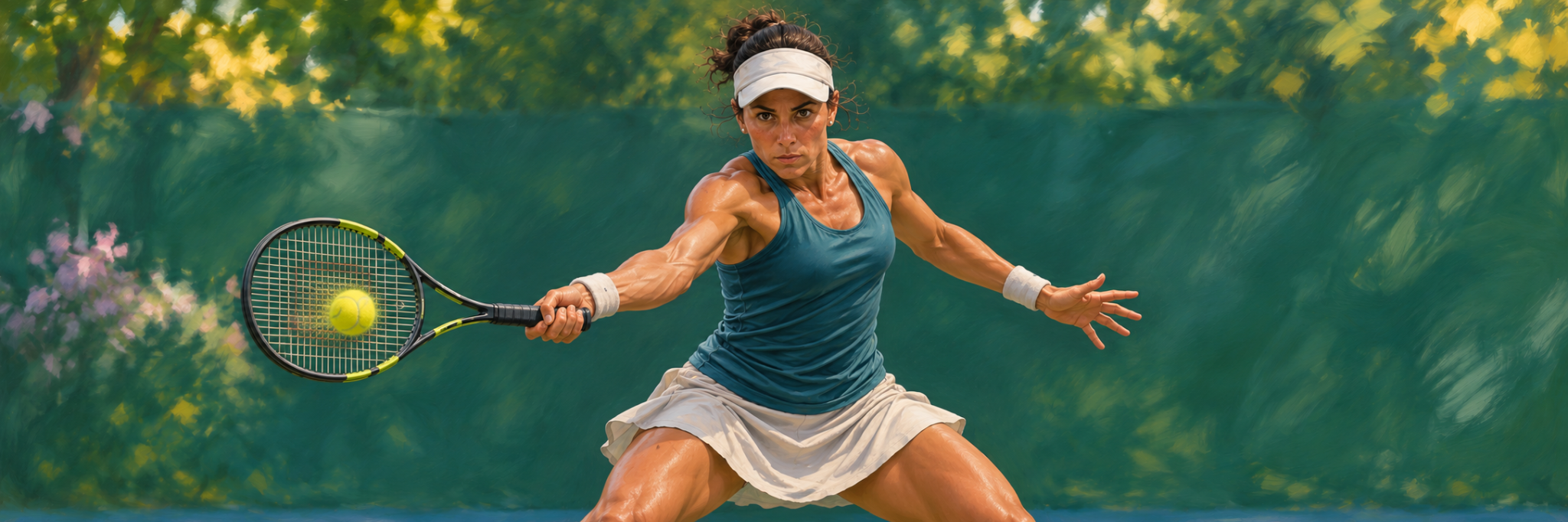
The Return of Serve: How Club Players Take Time Away Without Overhitting
An effective return does not have to look spectacular. A ball met cleanly and directed into a useful part of the court can make the server play under pressure without giving away the point on an ambitious swing. For club players, that is often the most accessible improvement: arrive ready, make a manageable contact and give the return a clear purpose.
Taking time away means changing how soon the server must respond. It does not necessarily mean making the racket move faster. Meeting a suitable serve earlier can produce pressure with a controlled stroke. Trying to do the same thing from an unbalanced position can simply produce an earlier error.
The key distinction is between first-serve survival and second-serve pressure. Against a demanding first serve, a return that starts a neutral rally can be a success. Against a slower second serve, there may be room to move forward and claim a better position. The ball in front of you determines the available action more reliably than the label first or second serve.
Choose a starting position you can use
Begin by watching what the server is actually delivering. Does the ball reach you before you can organize the racket? Are wide serves pulling you beyond a comfortable contact? Are body serves crowding you? A useful starting position addresses the pattern causing difficulty rather than copying where a professional stands.
The LTA's return guide recommends adjusting depth to the serve's pace and covering the available width. That provides a starting principle, not a fixed measurement. Try a small adjustment and observe whether it improves the next several contacts. Change one variable at a time so you know what helped.
Moving back can provide more preparation time, but it can also change the ball's height and the distance you must cover on a wide serve. Moving in can reduce the server's recovery time, but it reduces yours too. The better position is the one from which you can execute the return you intend, against the serve this opponent is producing.
Consider an illustrative club match in which a player repeatedly reaches a quick serve late. Before attempting a more forceful swing, the player could try a slightly deeper starting position and a smaller preparation. If clean contact improves, the returner has created a workable foundation. Forward movement can be tested later against a more suitable ball.
After finding that foundation, check what happens on the other side. A position that helps the forehand but makes the backhand unreachable may require another adjustment. Judge the starting position across the server's realistic choices, not only the ball you hope to receive.
Time the split step to the server
The split step is a small preparatory movement that helps you begin the next movement in balance. It should make you available to react, rather than become a large jump that leaves you airborne while the ball travels toward you. Tennis Resources' coaching guidance identifies split-step timing, compact preparation and recovery as connected return skills.
Use the server's contact as your reference. Begin a small split as the server approaches contact so that you can land and respond as the ball's direction becomes apparent. The exact rhythm will vary with the service motion and your distance from it. A coach watching both players can help determine whether you are consistently early or late.
One useful practice observation is whether your first movement toward the ball starts from balance. If you finish the split and then wait flat-footed, the preparation may be too early. If you are still descending when you need to move, the jump may be too large or too late. Look for a repeatable relationship with the server's action instead of forcing a mechanical count.
Keep the racket available during this movement. A perfectly timed split will not help much if your hands are still making an unnecessary change while the ball approaches. Establish a comfortable ready position before the service motion becomes urgent, then let the first turn organize the racket toward the incoming ball.
Make the preparation fit the time available
The return does not always allow the preparation used for a comfortable baseline groundstroke. The LTA distinguishes blocking a faster serve from taking a fuller swing when more time is available. The adjustment is to the size and timing of the stroke, not to the intention to make a clear contact.
For a fast serve, think about turning into a compact preparation and presenting a stable racket path through the ball. Avoid adding a large loop merely because the incoming pace feels threatening. A bigger movement creates more to complete before contact, often making the rushed feeling worse.
Compact does not mean holding everything rigid. Keep the action coordinated and allow the racket to continue after contact. The objective is a controlled path that can be repeated under the time constraint. A one-handed backhand, two-handed backhand and forehand will not have identical mechanics, so use the principle without forcing every stroke into the same shape.
Body serves deserve separate practice. The problem is often creating enough room for a manageable contact, not generating more speed. Work at a controlled serving pace while learning to organize the body and racket for each side. Increase the challenge only when you can make those decisions without an exaggerated last-second swing.
When the serve is slower, you may have room for a more complete stroke. Keep the same commitment to balance and a realistic target. Extra time is permission to choose a better action; it is not a requirement to hit the hardest return available.
Give the first serve a sensible destination
The USTA's first-serve guidance favors crosscourt on a wide delivery and the middle on body or T serves. Those directions offer a useful initial plan for singles. You can adapt them to the opponent and ball, but having a default reduces the number of decisions required during a rushed contact.
Think in areas rather than lines. A return intended to land in a generous central area can still make the server play the next ball. Aiming for a narrow sideline target while stretched introduces a demand that the situation may not support. Choose the size of the target to match the quality of your position.
Depth also needs judgment. Aiming deeper can make the next attack less comfortable for the server, but forcing depth from a very difficult contact can produce repeated long errors. First establish a return that clears the net reliably and begins the point. Then work on landing it farther from the service line without increasing the swing beyond your control.
In doubles, account for the net player. The singles middle target does not automatically carry the same meaning when someone is positioned to intercept it. A coach can help develop a dependable crosscourt return and identify when a change of direction or height is appropriate. Start with the shot you can produce while seeing the actual court arrangement.
Pressure a second serve through position and purpose
The USTA recommends stepping in on a second serve and using depth and spin. Treat that as an opportunity when the ball permits it, rather than an order to charge every second delivery. A high, kicking serve can remain awkward even without first-serve speed.
Move forward early enough to arrive in a position from which you can control contact. If the forward step turns into a late lunge, you have traded useful time for instability. The goal is to meet the ball in a favorable place and leave the server less time to recover, while retaining a swing you can reproduce.
Choose the intended effect before the toss. You might want a firm return toward a weaker side, a deeper ball that prevents an immediate attack or a controlled angle that makes the next shot more demanding. None requires a winner. The quality of the server's next contact is a useful measure of pressure.
Recover after the stroke. An attacking return followed by a pause can leave you poorly positioned for an ordinary reply. Move toward a sensible recovery position and prepare for the server's next shot. The return's value belongs to the point it creates, not only to the first impression it makes.
Practice the decisions as well as the contact
Use a simple first-serve game with a partner. The server delivers at a pace that is challenging but manageable; the receiver chooses a broad target and plays the return plus one more shot. Score a return error separately from losing the later rally. That distinction helps reveal whether the main problem is starting the point or handling the next ball.
For a second-serve game, allow the receiver to begin slightly farther forward if that produces balanced contact. Play points normally, but record whether the return achieved its chosen purpose: depth, direction or an uncomfortable next contact for the server. Keep this as an observation rather than inventing a bonus for reckless pace.
A third exercise is a position comparison. Receive a short group of serves from one starting depth, then try a small adjustment. Record clean contacts and the errors you actually made. Repeat before declaring a winner. One excellent return from the new position is encouraging, but several manageable contacts are more useful evidence.
Finally, mix first and second serves so that the receiver must recognize the available time. Cooperative repetition builds the movement; realistic variation tests the decision. Finish with ordinary service games, where the target and technique have to survive score pressure and the possibility of a different delivery.
The practical aim is a return you can trust. Prepare on time, use a stroke that fits the incoming ball and select a destination that your balance allows. Taking time away then becomes a consequence of good position and clean contact, rather than a demand to swing harder whenever the point begins.
Sources
USTA, Tennis strategy: Returning first and second serves, October 6, 2021: https://www.usta.com/en/home/improve/tips-and-instruction/national/tennis-strategy--returning-first-and-second-serves.html
LTA, Simple steps to improve your return of serve: https://www.lta.org.uk/advantage-home/content/simple-steps-to-improving-your-return-of-serve/
Tennis Resources / USPTA, Return of serve—Where to stand, featuring Leslie Allen, February 17, 2015: https://www.tennisresources.com/return-of-serve-where-to-stand/
USTA, Tennis techniques: The return game, April 1, 2022: https://www.usta.com/en/home/improve/tips-and-instruction/national/tennis-techniques--the-return-game.html
The practice games and illustrative match situation above are original applications of the coaching principles, not reported experimental results.