

Baseball Pitches Explained
Baseball in 60 ·
A baseball pitcher has two connected jobs: deliver a ball the hitter cannot square up, and remain effective enough to do it again.
A technical guide to grips spin movement speed and the decisions that shape a game
A baseball pitcher has two connected jobs: deliver a ball the hitter cannot square up, and remain effective enough to do it again. The first job involves speed, spin, movement, location and deception. The second involves preparation, command, workload, recovery and a manager who recognises when the next batter presents a different problem from the previous one.
The names can make pitching sound like an inventory of separate tricks. There are four seamers, sinkers, cutters, sliders, sweepers, curveballs, changeups, splitters and knuckleballs. There are also hybrids, older names and descriptions that overlap. Yet every pitch begins with the same physical questions. How fast does the ball leave the hand? In which direction is it spinning? How do the seams meet the air? Where is it released? And how does its path compare with what the hitter expects?
This guide explains those questions in ordinary language before examining the details. It covers how different pitches are commonly created, how their flight differs, their approximate professional speeds, the size of a useful repertoire, pitcher roles and the decision to make a pitching change. It also examines the fastest tracked pitch and why modern velocity comparisons require care.
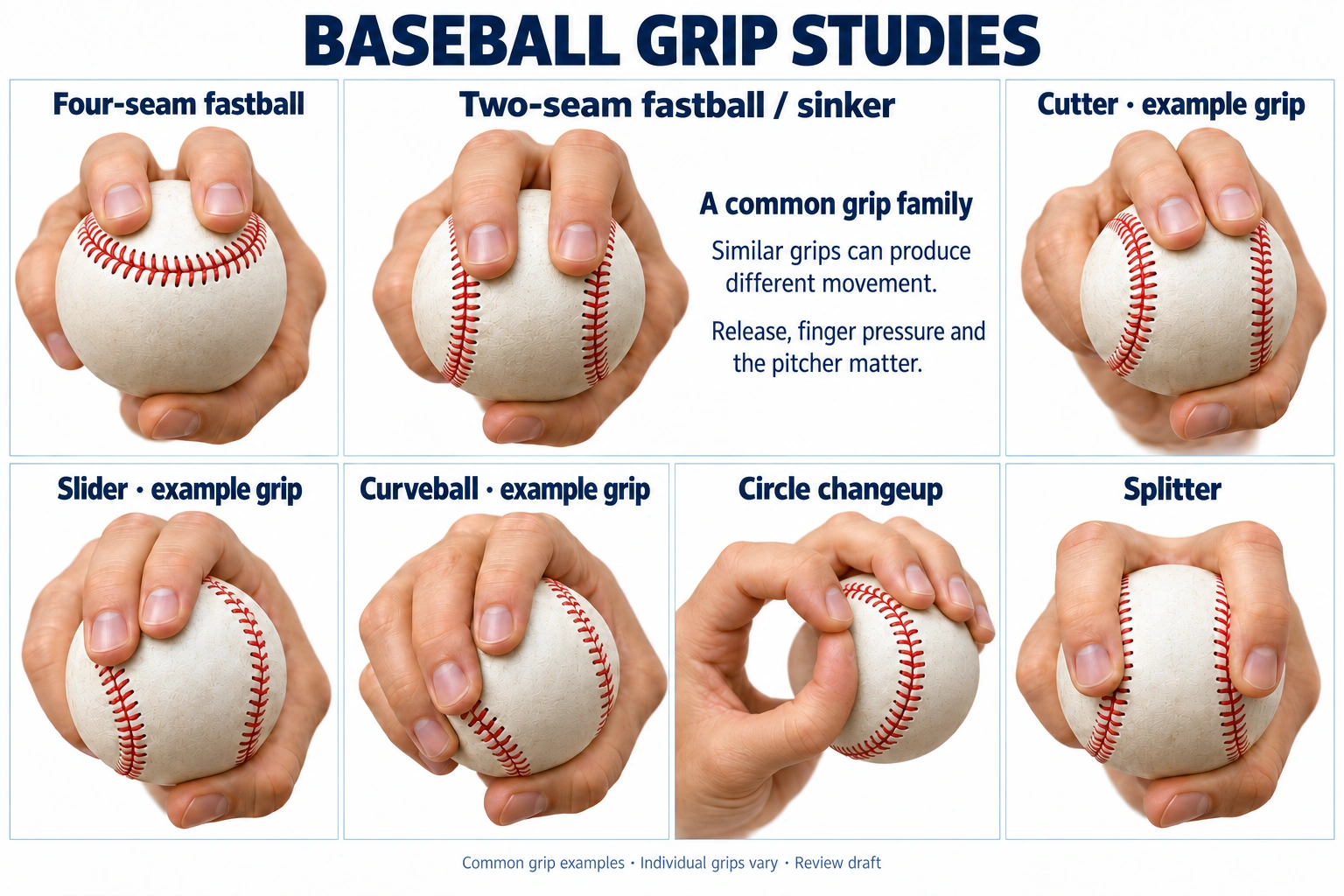
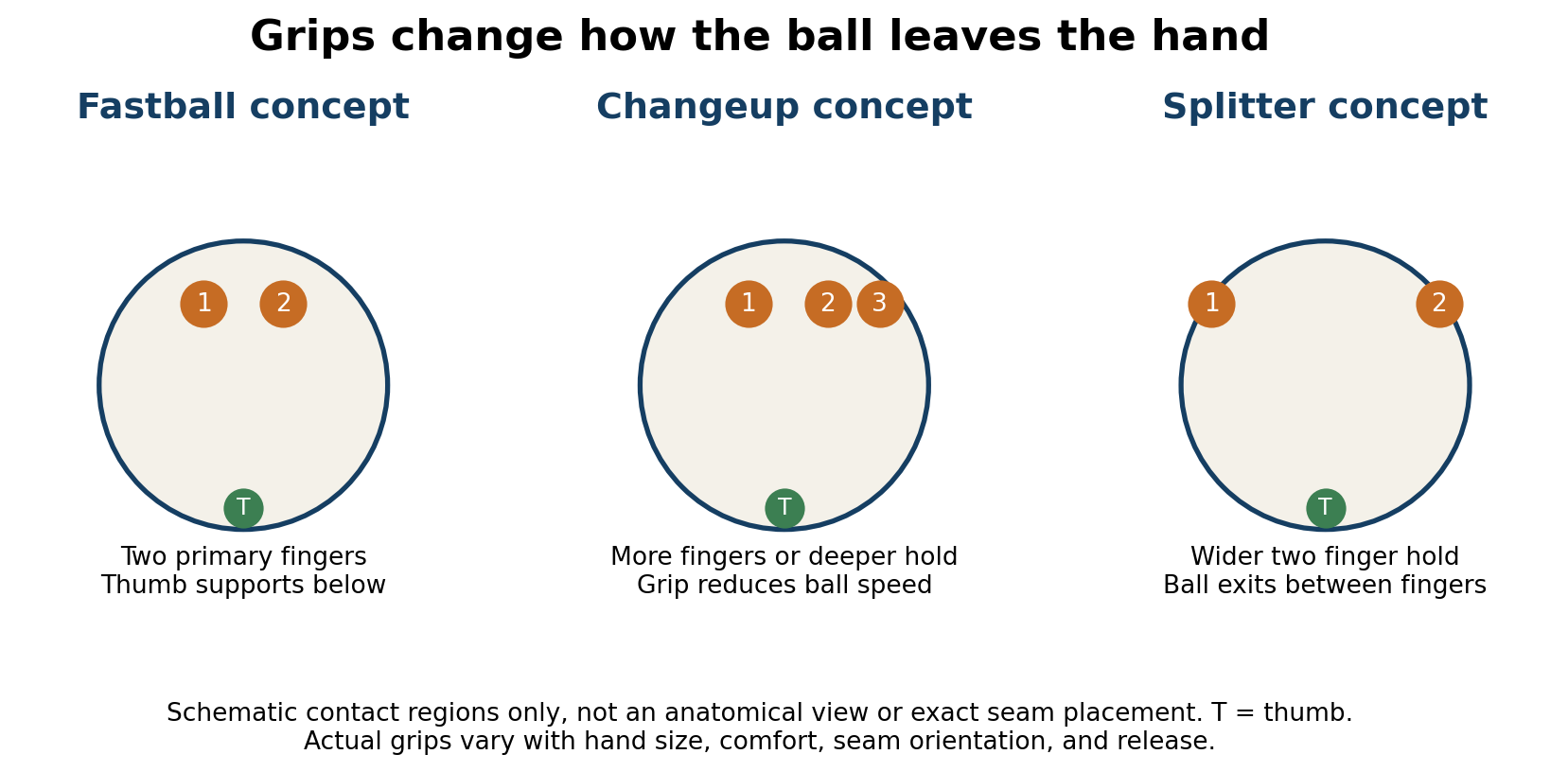
Figure 1 Grip concepts and contact regions
The grip descriptions are starting points, not prescriptions for every hand. Unless otherwise stated, movement is described from the pitcher's perspective for a right handed thrower. Arm side means to that pitcher's right; glove side means left. Reverse the horizontal directions for a left hander. The technical descriptions concern overhand baseball pitching, not softball pitching.
Educational and health note: understanding a pitch is different from being ready to throw it. Young players should build basic throwing, fastball control and a changeup before advanced pitch design. Do not force a wrist position or finger spread, and do not throw through shoulder or elbow pain. Pitch counts and rest rules are limits, not assurances against injury; individual medical and coaching guidance still matters. [1]
The quickest way to understand a pitch
A fastball challenges the hitter's time. A changeup borrows the appearance of the fastball but arrives later. A breaking ball changes the expected path. A knuckleball removes much of the predictable spin pattern and introduces unusually variable flight. These are useful first definitions, although a good pitch often does more than one of these things.
Consider an illustrative pitcher with a 95 mph fastball, an 86 mph changeup and an 82 mph curveball. The hitter cannot simply identify three speeds after they arrive. The hitter must decide early enough to move the bat into the ball's future position. A pitch that looks like the fastball during that decision can be effective even if its eventual speed is ordinary by professional standards.
Location changes the challenge. A breaking ball that finishes below the strike zone can produce a swing over it, but a breaking ball left at comfortable hitting height can be dangerous. A fastball above the barrel can miss bats, while the same speed through the middle may be hit hard. Pitch quality includes where it goes and how reliably it gets there.
The word movement also needs a reference. A ball can finish lower than a fastball because it has less upward aerodynamic support, because it is slower and spends longer falling, or because its spin produces an additional downward force. Those explanations can overlap. Saying that two pitches both drop does not mean they drop for identical reasons.
Finally, the catcher is part of the system. A pitch that produces wonderful movement but cannot be received or blocked in a crucial situation has a practical cost. Pitch selection asks what the pitcher can execute, what the hitter might do, and what happens if the pitch misses.
Why a spinning baseball moves
Gravity drag and the Magnus effect
Gravity pulls every pitch downward. Air resistance, or drag, slows its forward travel. A spinning ball can also experience an aerodynamic force sideways or vertically, commonly called the Magnus effect. For a conventional backspinning fastball, that force has an upward component. For a topspin curveball, it has a downward component. [2]
A normal overhand fastball does not climb toward the plate because of backspin. It generally falls less than it would without that lift. The hitter's experience of a rising fastball is usually a mismatch between the path anticipated and the path actually taken. A ball arriving above the expected barrel position can look as though it jumped.
For a simple original analogy, imagine two balls launched horizontally from the same height. Give one upward aerodynamic support while leaving the other without it. Both can end lower than they started, but the supported one finishes higher. Calling the first ball higher is accurate; calling it physically rising throughout the flight is not.
Real pitching adds a downward release angle, different release heights and different flight times. That is why a televised movement number cannot be read without knowing what has been subtracted. Actual vertical drop and induced vertical break describe different things. Induced vertical break estimates the vertical movement attributable to aerodynamic effects relative to a gravity-only reference; it is not a claim that the pitch rose that many inches above the hand.
Spin rate and spin direction
Spin rate is measured in revolutions per minute, or rpm. A ball at 2,400 rpm rotates 40 times per second. If its flight lasts 0.40 seconds, it makes approximately 16 rotations. This arithmetic explains why high speed video, rather than ordinary television footage, is needed to see release details clearly.
The spin axis is the imaginary line through the ball around which it rotates. Backspin, topspin and sidespin describe components of that rotation relative to travel. They are not three separate engines inside the baseball. A tilted axis can produce a mixture, so a pitch can have both vertical and horizontal aerodynamic movement.
Gyro spin is rotation around an axis pointing approximately along the ball's direction of travel, like the spiral of an American football. In the idealised pure gyro case, it contributes little conventional Magnus movement. A hard slider can therefore drop substantially relative to a riding fastball without needing enormous downward Magnus force. It has less upward support and is also slower.
This is why more rpm is not automatically better. Extra transverse spin may support a particular fastball shape. Reduced spin can help a splitter separate vertically from that fastball. A knuckleball needs very little rotation. A total rpm number without pitch type, axis, speed and movement is an incomplete description. [3]
Seams and the air behind the ball
The raised seams can influence where air separates from the baseball. If that separation is asymmetric, the wake can be deflected and the ball can experience an additional force. Researchers call a sustained version of this effect a seam shifted wake. It helps explain why movement is not always predicted completely by measured spin direction. [4]
That does not mean the seams become tiny wings or that a pitcher can make arbitrary turns in flight. Seam orientation, spin and airflow have to interact in a useful way. Two releases that look similar to the naked eye may differ enough to produce different movement. Repeating the orientation is part of the skill.
Optical tracking has made this easier to investigate because it can measure a spin axis directly rather than inferring it only from the observed path. A disagreement between spin-based expectations and actual movement can reveal seam effects. It should not automatically be described as the spin axis suddenly changing halfway to the plate. [5]
For a fan, the practical lesson is straightforward: judge the resulting pitch, not a single attractive metric. A sinker with useful arm side movement and low vertical support may be more valuable to its owner than another pitch with a higher spin rate. The best combination is the one that fits the release, the rest of the arsenal and the intended location.
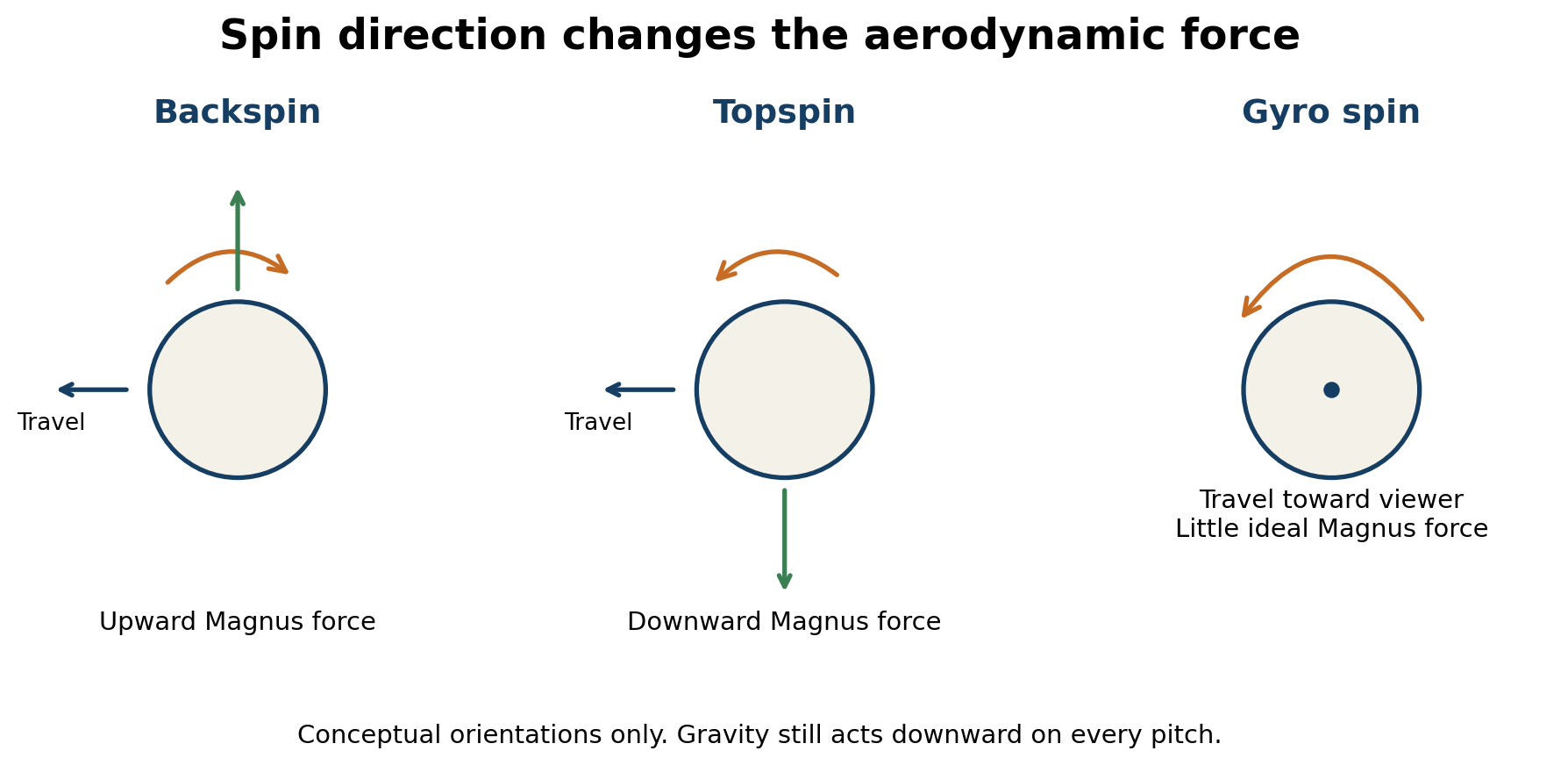
Figure 2 Spin and aerodynamic force
Reading speed ranges without misleading yourself
The ranges below are broad editorial orientation bands for adult major league style pitching, not calculated 2026 league averages or development targets. Individual professionals can sit outside them. A teenager, recreational adult or pitcher returning from injury should not use them as a throwing goal. Rare pitches have especially small and variable samples.
Pitch names also have fuzzy boundaries. One tracking system may label a pitch a slider where another calls it a cutter. A pitcher may use one grip to create two shapes, or two grips that produce nearly identical results. A classification is useful shorthand rather than a law of nature. [6]
| Pitch | mph | km/h | Main identifying feature |
|---|---|---|---|
| Four seam fastball | 90–100 | 145–161 | Backspin and carry |
| Two seamer or sinker | 89–98 | 143–158 | Arm side run and less lift |
| Cutter | 85–95 | 137–153 | Firm glove side cut |
| Slider | 82–91 | 132–146 | Glove side and depth |
| Sweeper | 76–86 | 122–138 | Broader glove side movement |
| Curveball | 72–85 | 116–137 | Topspin and downward break |
| Knuckle curve | 76–86 | 122–138 | Curve shape with altered grip |
| Slurve | 77–87 | 124–140 | Diagonal curve slider shape |
| Changeup | 78–89 | 126–143 | Slower with fade or drop |
| Splitter | 82–92 | 132–148 | Reduced spin and lift |
| Forkball | 75–87 | 121–140 | Deep downward separation |
| Screwball | 65–82 | 105–132 | Rare arm side breaker |
| Palm ball or straight change | 70–85 | 113–137 | Timing contrast |
| Knuckleball | 60–80 | 97–129 | Very low spin variable flight |
| Slow curve | 60–75 | 97–121 | Slow topspin contrast |
| Eephus | 40–65 | 64–105 | Very slow high arc |
For Canadian readers, multiply mph by 1.609 to estimate km/h. A 95 mph pitch is approximately 153 km/h; 100 mph is approximately 161 km/h. When comparing teammates, look at each pitch relative to that pitcher's own fastball. An 86 mph changeup can provide a meaningful gap from 96 mph, but little timing separation from an 88 mph fastball.
Four seam fastball
Basic definition: the relatively straight, hard fastball that usually provides the clearest baseline for understanding the rest of a pitcher's arsenal.
A common grip places the index and middle fingers across the broad horseshoe of the seam, with the thumb supporting underneath. The ball rests toward the fingers rather than being buried tightly in the palm. Finger spacing, thumb position and seam contact can vary. The thrower delivers through the ball with familiar throwing action rather than manufacturing a separate wrist twist. [7, 32]
Typical professional orientation range: about 90–100 mph, with exceptions below and above. Its spin usually includes substantial backspin and often some arm side tilt. A four seamer with strong vertical support can travel above a hitter's expected path. Another four seamer may have more run and less carry. The shared name does not mean identical flight.
An illustrative use is a fastball at the upper edge followed by a lower breaking ball. The fastball invites a swing path aimed high; the next pitch asks the hitter to recognise both a different speed and a lower destination. However, simply throwing high is not a universal plan. A pitcher whose fastball lacks the required characteristics may expose a hittable pitch there.
The most common conceptual mistake is confusing straight with motionless. The ball still falls, slows and can move sideways. Another is treating velocity as forgiveness. A hard fastball in an anticipated location is easier to time than an equally hard pitch the hitter has not seen clearly.
For dependable execution, the useful question is whether the pitcher can repeat the desired lane. Can the ball be sent to the outer third without repeatedly leaking over the centre? Can an elevated target be reached without sailing far above it? A fastball becomes a foundation when its location is as repeatable as its speed.
Two seam fastball and sinker
Basic definition: a hard pitch that generally runs toward the throwing arm side and often has less vertical support than a four seamer. The names two seamer and sinker overlap heavily in modern usage.
A familiar starting grip places the index and middle fingers along the two narrow, approximately parallel seams, with the thumb below. Some pitchers move a finger to one seam or change the ball's orientation. Grip pressure and the way the ball leaves the fingers influence the resulting spin and seam presentation. There is no single grip that guarantees sink. [8]
Typical professional orientation range: about 89–98 mph. Backspin is commonly tilted toward sidespin, and seam effects can add movement. The pitch often falls more than the same pitcher's four seamer because it receives less upward support. It does not need pure topspin to earn the name sinker. [9]
For a right hander, the arm side direction can run into a right handed hitter or away from a left handed hitter, depending on starting location. The pitcher's actual target determines whether that movement is useful. A ball running inward from outside the zone may produce a strike; a ball starting in the middle may run into the barrel or the hitter.
An illustrative ground ball plan uses the lower part of the zone and a location that encourages contact below the ball's centre. That is an intention, not a guaranteed outcome. A sinker can be hit in the air, and a poorly located sinker can be hit very hard.
The development test should compare a group of pitches, not the most spectacular one. If a revised seam position creates extra movement but makes strike throwing unreliable, the coach and pitcher must decide whether that trade is useful. A modest, repeatable sinker can be more valuable than an occasional exceptional one surrounded by misses.
Cutter
Basic definition: a firm fastball variation with glove side movement, usually smaller and faster than a slider's break.
The starting grip often resembles a four seamer, with the index and middle fingers close together and shifted slightly off centre. The release changes the spin enough to create cut rather than ordinary arm side run. Small changes can matter; forcing the wrist sideways is not the objective. Published coaching descriptions offer several grip variants rather than one required finger position. [10]
Typical professional orientation range: about 85–95 mph. The ball often has tilted backspin with a gyro component, depending on the particular cutter. Some versions remain relatively firm and level; others show more depth. A cutter that becomes slower and more rounded may be approaching slider territory, although the boundary is not absolute.
The intuitive picture is a fastball that fails to arrive exactly where the hitter's fastball swing expects. For a right handed pitcher facing a left handed batter, glove side movement can move the ball toward the hands. Against a right handed batter, it can move away. Starting location and the hitter's swing determine whether that produces weak contact.
A cutter is not automatically a strikeout pitch. Its value may be making otherwise solid contact less solid, changing a fastball lane or creating a third look without an enormous velocity reduction. It can also be a pitch that the thrower trusts in a count where a less controllable breaking ball would be risky.
A useful original comparison is to imagine two fastballs aimed through a narrow doorway. One tracks nearly through the centre; the other finishes a few inches to the side. The second need not sweep across the whole doorway to miss the expected contact point. Precision, not dramatic television movement, can be its main advantage.
Slider and gyro slider
Basic definition: a hard breaking pitch that usually moves glove side and finishes lower than the fastball. Some sliders emphasise sideways movement; gyro sliders emphasise depth and a compact shape.
A common slider grip keeps the index and middle fingers close, with the middle finger gaining useful seam contact and the ball slightly off centre. The hand is positioned so the ball leaves differently from a fastball. A football spiral can be a useful description of the gyro component, but it is a feel cue rather than an instruction to twist the elbow. [11]
Typical professional orientation range: about 82–91 mph. A gyro slider can have substantial total spin while relatively little of that spin produces conventional sideways or upward Magnus force. The ball still follows gravity and may show some transverse spin and seam effects. A slider is not required to have zero lift or to travel in a perfectly vertical plane. [12]
The hitter's problem is that an initially firm-looking pitch can arrive under or beside the expected barrel. A right hander's slider commonly works away from a right handed hitter, but it can be used against left handers too. Whether it crosses the zone, runs toward the back foot or finishes outside depends on the intended route.
A hanging slider is usually a disappointing combination of location and shape. It may remain in a comfortable hitting area at a speed that gives the batter time. Describing every hard-hit slider as hanging is too simple, however. A good pitch can lose a confrontation, and a bad pitch can survive one.
In an illustrative two strike situation, a pitcher may aim for a slider that begins on a strike-like path and finishes below the zone. At three balls, the same chase plan may be less attractive if hitters are refusing it. The pitch's tactical value changes with the count even when its physical quality is unchanged.
Sweeper
Basic definition: a slider-family pitch designed for greater horizontal glove side movement, usually with a broader, slower shape than a hard gyro slider.
There is no universal sweeper grip. Pitchers commonly experiment with seam orientation and finger position from a slider or two seam style starting point. The aim is a release that produces repeatable sideways movement, sometimes assisted substantially by seam effects. Copying a photograph without reproducing the release may produce a different pitch. [13]
Typical professional orientation range: about 76–86 mph. A sweeper generally trades some velocity and compactness for lateral separation. Its exact spin axis and amount of drop depend on release and design. It should not be defined simply as a conventional slider with more rpm.
For a right hander against a right handed hitter, the pitch can move away from the bat across a substantial horizontal distance. That can be useful when the hitter has to protect against a fastball closer to the body or above the hands. The same shape may interact differently with an opposite handed batter's swing and view.
The risk of chasing maximum sweep is losing the intended destination. A ball that starts too far outside may be easy to take. A ball that starts too centrally can move through a hittable area. The best version is not necessarily the largest measured horizontal number; it is the shape that reaches useful locations from a believable starting path.
Think of the sweeper as another option on a map rather than an upgrade that makes other sliders obsolete. A pitcher might need a harder, shorter slider against one matchup and a broader sweeper against another. If the two pitches cannot be distinguished reliably by the thrower, adding a label has not yet created an extra weapon.
Curveball and the twelve to six curve
Basic definition: a breaking pitch that usually travels more slowly than a slider and has prominent downward movement. A twelve to six curve describes a predominantly vertical shape, like the downward line on a clock face.
A common grip gives the middle finger leverage along a seam, with the thumb underneath or slightly to the side and the index finger supporting. At release the hand is oriented to create topspin or a tilted topspin axis. The fingers apply force over the ball rather than delivering ordinary fastball backspin. Arm slot affects which shape can be repeated naturally. [14]
Typical professional orientation range: about 72–85 mph. Topspin can add downward aerodynamic force to gravity; a tilted axis also produces glove side movement. A curve from a lower slot may travel diagonally rather than straight down. Calling that pitch less pure does not establish that it is less effective.
The curve can serve two different jobs. A strike version enters the zone and makes the hitter respect the slower speed. A chase version follows a strike-like initial path and finishes below it. The latter is useful only if the hitter believes it might be a strike long enough to commit.
An original example illustrates the distinction. With no strikes, a visibly high curve that drops into the upper zone may steal a called strike. With two strikes, a pitcher might prefer a trajectory that ends near the dirt. Asking one identical target to perform both jobs can lead to unnecessary misses or hittable pitches.
A common misunderstanding is that maximum visible loop means maximum quality. A very slow, obvious curve can be recognised early. A firmer curve with less theatrical arc may create a more difficult decision. What matters is the relationship between release, early path, speed and final location.
Knuckle curve spike curve and slurve
Basic definition: a knuckle curve is still a spinning curveball. It is not a knuckleball with a small amount of extra break. The bent or spiked index finger changes the grip and release rather than removing rotation.
One common arrangement raises the index knuckle while placing the fingertip or nail against the ball. The middle finger provides the main leverage. Other versions differ. The pitcher is seeking a repeatable curve shape; the presence of a raised knuckle does not promise more movement or better control. [15]
Typical professional orientation range: about 76–86 mph, with considerable overlap with ordinary curves. Spin and travel follow the curveball family: topspin with a possible sideways component. A spike grip can feel more natural to one hand and awkward to another. It should be selected because of the resulting pitch, not because its name sounds advanced.
Slurve describes a pitch between a slider and curveball, usually with diagonal glove side break. It is often an observation about shape rather than a completely separate teaching method. Its broad orientation range, roughly 77–87 mph, overlaps both families. A pitcher may call it a curve while a tracking model labels it a slider.
For readers, this is a helpful warning against memorising names too rigidly. If a pitch is slower than the fastball, spins toward a diagonal breaking direction and arrives below the expected path, its exact label is secondary to understanding that behaviour. For the pitcher, repeatability and fit within the arsenal matter more than winning an argument over classification.
Changeup
Basic definition: a pitch delivered with fastball-like intent and presentation but reduced ball speed, often with additional arm side movement and drop.
The grip is the principal starting difference. The ball may sit deeper in the hand or be carried more by the middle and ring fingers. A circle change brings the thumb and index finger together or near each other at the side. Other pitchers use a three finger or modified split grip. Grip comfort matters because the delivery must remain convincing. [16]
Typical professional orientation range: about 78–89 mph. Many effective versions sit approximately 7–12 mph below their owner's fastball, but there is no required gap. A harder changeup may work through unusual movement; a slower one may work through timing. The comparison is individual rather than a universal number.
Changeups often have tilted backspin, lower spin or less upward support than the fastball, and arm side fade. Some releases involve earlier pronation, meaning rotation of the forearm toward a palm-down orientation. That is a description of the release pattern, not a demand to force a late wrist turn. Different grips can produce different movement. [17]
The central deception is maintaining the hitter's fastball expectation. Deliberately slowing the visible arm or changing the whole delivery can advertise the pitch. A changeup that looks slower before release gives the hitter extra information. The grip should help produce the speed change while the overall presentation remains familiar.
In an illustrative fastball-changeup pairing, the fastball establishes urgency at 95 mph. An 85 mph changeup then asks the hitter to wait while the body is already prepared to accelerate. If the ball also fades away from the expected contact point, the hitter faces both a timing and a location error. Neither feature alone guarantees success.
Splitter and split change
Basic definition: a fastball-looking offspeed pitch that generally loses height relative to the fastball, often through reduced spin and reduced upward aerodynamic support.
A typical grip spreads the index and middle fingers around opposite sides of the ball, with the thumb providing support. The ball leaves between the fingers differently from a conventional fastball. Hand size and finger flexibility affect what is comfortable. A wider grip is not automatically better, and discomfort is a reason to stop experimenting rather than stretch harder. [18]
Typical professional orientation range: about 82–92 mph. Many splitters have comparatively low spin, although the amount varies substantially. Their movement is not simply a miniature curveball: the downward separation may largely come from having less lift than the fastball, combined with a slower flight. Some versions also move sideways.
A split change blends features of a changeup and splitter. The name can reflect grip, shape or the pitcher's preference. Similarly, splinker is an informal hybrid label for a particularly hard splitter or sinker-like offering; it should not be treated as a universally standardised pitch with a single mandatory grip.
The practical challenge is controlling the bottom of the zone. A splitter that is too low too early can be easy to take. A splitter left up may become a relatively straight, slower pitch in a dangerous place. Useful execution makes the hitter believe in the fastball lane before the ball separates from it.
With a runner on third, the catcher's ability to block becomes part of the decision. That does not mean abandoning the pitch whenever a runner advances. It means evaluating the expected benefit against the particular miss and the receiving conditions. Pitch selection is shared problem solving, not simply choosing the most dramatic movement.
Forkball screwball and other less common offerings
Forkball
Basic definition: a splitter relative, traditionally associated with a deeper hold between widely separated fingers and substantial downward separation from the fastball. The modern naming boundary is inconsistent; a pitch called a forkball by its owner may be classified as a splitter by a tracking system.
The conceptual difference is where and how the ball is supported. A deeper fork-style hold can change how it exits the hand and reduce its fastball-like characteristics. Because comfortable finger spread varies, the description should not become an instruction to wedge the ball painfully between the fingers. Its broad professional orientation range is approximately 75–87 mph, with individual exceptions.
A viewer should ask the same questions as for a splitter: how much slower is it than that pitcher's fastball, how much lower does it finish, and can it be presented as a plausible strike? A name associated with dramatic drop does not make a pitch useful if hitters immediately recognise it as a ball. The rare pitch still has to solve an ordinary baseball problem.
Screwball
Basic definition: a breaking pitch associated with arm side movement, opposite the usual horizontal direction of a conventional curveball. It is rare in modern professional baseball, and the distinction between a screwball and a strongly moving changeup can be debated.
Descriptions traditionally involve a release with pronounced pronation that creates the desired spin direction. There is no sensible reason for a beginner to force an extreme hand turn merely to reproduce the name. In a technical classification exercise, spin, velocity, seam presentation and observed movement are more informative than an exaggerated demonstration of wrist action.
An approximate historical-style orientation band is 65–82 mph, not a measured current league distribution. Its rarity makes a single typical speed especially unreliable. A pitch's direction also depends on the thrower's handedness: the mirror image rule still applies. Arm side movement is not synonymous with movement away from every hitter.
Palm ball and straight change
A palm ball or straight change aims to take speed off while preserving enough of the fastball's presentation to disrupt timing. Holding the ball deeper or using more fingers can reduce the speed imparted at release. It need not show spectacular sideways movement to be useful.
These are better understood as changeup variations than guaranteed additional arsenal categories. Their approximate orientation band, around 70–85 mph, is intentionally broad. The important measurement is the separation from the owner's fastball and the ability to repeat the delivery without advertising a slower pitch. Trying to slow the entire body visibly can defeat the intended deception.
Eephus and slow curve
An eephus is an exceptionally slow, high-arcing surprise pitch. A slow curve may also create a dramatic timing contrast but retains a clearer breaking-ball identity. Neither is a routine substitute for a dependable primary pitch.
The eephus may fall in a rough 40–65 mph orientation band, with examples outside it. At such low speeds, time in the air becomes a major feature of the flight. The pitcher must launch on an appropriate arc to reach the zone. The hitter's unusual challenge is waiting, although a recognised pitch in a comfortable location can be hit forcefully.
A slow curve might sit around 60–75 mph. Its grip can resemble a normal curve with an altered speed and trajectory, but the precise method is individual. These offerings are useful reminders that speed is relative: changing the hitter's expectation can matter as much as simply adding another mile per hour.
Knuckleball
Basic definition: a pitch released with very little spin so that seam-related aerodynamic forces can produce unusually variable movement. A knuckleball is not a slowly spinning curveball and is not the same thing as a knuckle curve.
A common modern grip uses bent fingertips or fingernails pressing into the leather, with the thumb and another finger stabilising the ball. Some grips use different numbers of contact points. The release tries to avoid rolling the ball off the fingertips in the familiar spinning manner. Individual knuckleballers describe different sensations, so one universal push-the-ball instruction can be misleading. [19]
Typical orientation range: about 60–80 mph, with harder and softer specialists. Its defining feature is very low rotation, not one precise speed. A useful practice observation is whether the logo or seam pattern remains relatively stable rather than rapidly turning. Measuring very low spin accurately can itself be difficult.
The erratic flight comes from airflow and the changing exposure of seams, not from a mysterious force that switches on at the last instant. A slowly rotating ball can present different seam configurations during travel, changing the aerodynamic force. It may move differently from one pitch to the next even when the thrower believes the release felt similar. [20]
That variability explains both its appeal and its difficulty. The batter cannot rely on the usual spin-based expectation, but the pitcher and catcher also lose some predictability. The catcher may need a different receiving approach. Runners can make a pitch that is difficult to handle even more consequential.
Imagine an original practice test with twenty knuckleballs. Five dance dramatically, five behave like slow fastballs and ten miss the useful area. The spectacular five do not yet establish a game-ready pitch. The real achievement would be increasing the proportion that combine disruptive flight with a playable destination. That distinction separates an entertaining experiment from a professional skill.
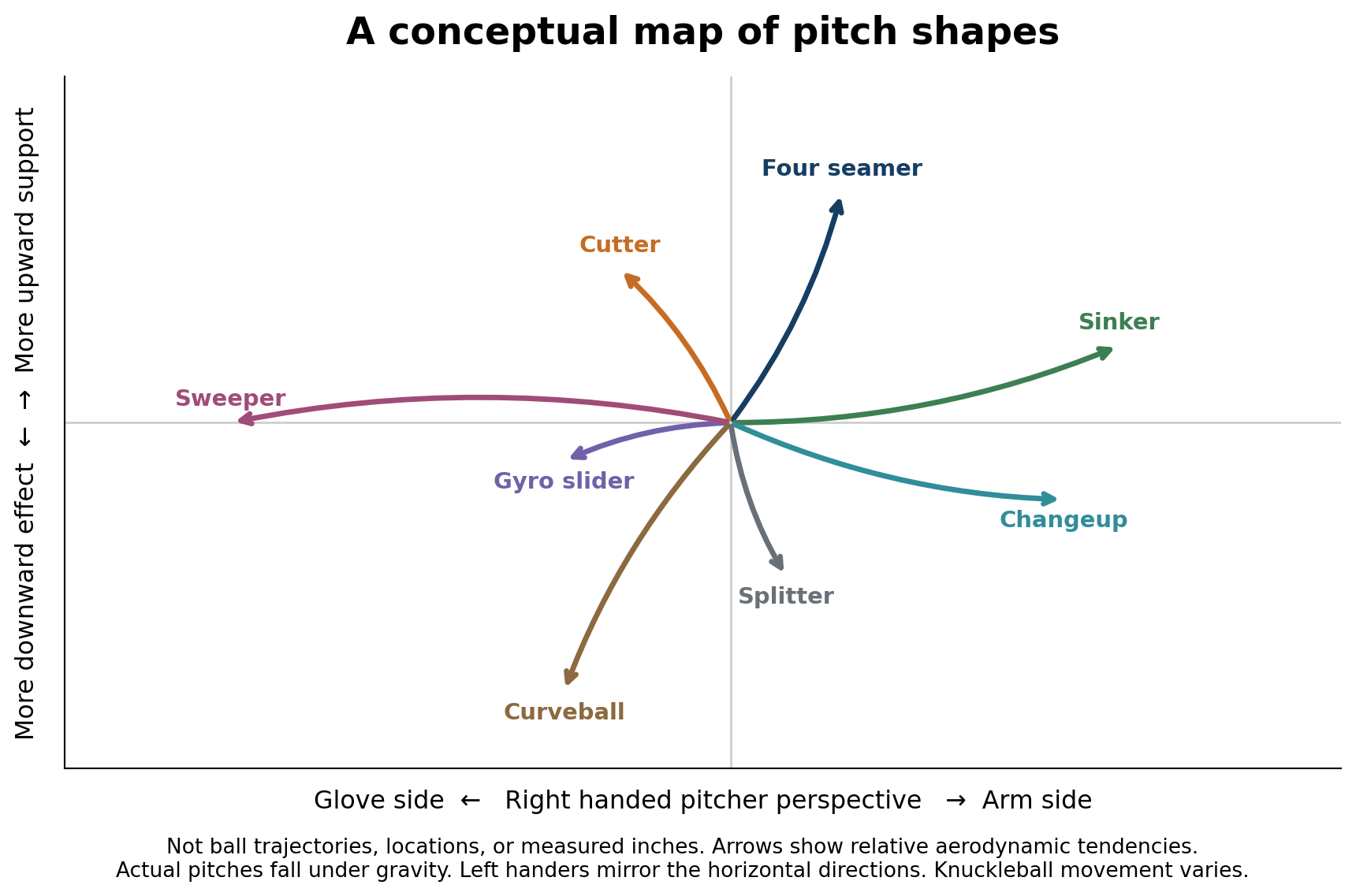
Figure 3 Relative pitch shape tendencies
How many pitches do most pitchers actually have
A useful working answer is that many starters depend on three to five meaningful offerings, while many short relievers rely mainly on two or three. Exceptions include specialists with one dominant pitch family and sophisticated arsenals with six or more classifications. These are descriptive ranges, not a newly calculated league median.
The word have needs definition. A pitcher may possess six grips in a bullpen but trust only three in an important game. Another may show four tracking labels but obtain nearly all meaningful results from two. A fifth pitch thrown twice in a season is different from a fifth pitch used against both sides of the plate in difficult counts.
For analysis, separate the catalogue from the game arsenal. The catalogue includes every named offering. The game arsenal includes pitches the thrower can deploy at useful frequencies and locations. A third category is the daily arsenal: the offerings that are actually working that evening. Managers and catchers must operate with the third category, not a preseason scouting description.
Starters need ways to confront the same lineup repeatedly and handle both right and left handed hitters. A fastball, a glove side breaker and an arm side offspeed pitch can create three distinct decisions. Additional pitches may cover gaps in speed or shape, but they also consume practice time and can complicate execution.
Short relievers may succeed with a narrower mix because each batter often gets only one look in that game. A very good fastball and slider can be enough if the hitter must respect both. Yet a two pitch repertoire is not automatically a reason to move someone to the bullpen, and five pitches are not automatic evidence of starting quality.
Modern technology has made pitch variations easier to identify and refine. MLB described increasingly diverse pitch mixes in 2025. [21] That development should encourage better questions rather than a race to collect names. Does the new pitch challenge a different swing? Can it be thrown for a strike? Does it make the best existing pitch more difficult to anticipate?
An original example illustrates useful diversity. Pitcher A throws a four seamer, cutter and slider that all arrive within a narrow speed band and travel through similar lanes. Pitcher B throws only a fastball and changeup but creates a substantial timing and vertical separation. Counting three against two does not decide which arsenal is more difficult. The actual separation does.
Which pitch is hardest and which is most reliable
The knuckleball is a strong candidate for hardest to master consistently because tiny release differences can change both spin and destination. That is a reasoned assessment, not a universal scientific ranking. For a particular pitcher, a useful changeup might be harder to develop than a curveball, while another player may immediately feel comfortable with the changeup and struggle to spin anything glove side.
Hardest to hit is a separate question. A particular fastball at the right location can be more difficult than an exotic breaking ball. A splitter may dominate one group of hitters and be recognised by another. Any ranking must specify the pitcher, season, batter population, count and outcome: swings and misses, quality of contact, runs prevented or something else.
Reliability has at least three meanings. Strike reliability concerns getting into the zone. Location reliability concerns hitting the intended region. Outcome reliability concerns limiting damage. They overlap but are not interchangeable. A very straight strike thrown repeatedly through the middle can be reliable in the first sense and poor in the third.
For many developing pitchers, a conventional fastball is the simplest foundation for repeatable strike throwing because its grip resembles ordinary throwing. That does not mean a four seamer is every professional's best pitch. Some professionals trust a sinker, cutter or changeup more in a critical count. The correct answer belongs to the individual arsenal and the situation.
An illustrative bases-loaded example makes the distinction clear. A pitcher with poor curveball command needs a strike at three balls. A dependable fastball to a less damaging lane may offer a better chance than an impressive curve that frequently misses. Another pitcher with excellent changeup command may reasonably choose the change. Calling for a universal fastball would ignore the actual skill available.
Reliability should be tested over a representative sample. One bullpen with no hitter present does not establish game command. Include the stretch, runners, both target sides, variable counts and normal competitive pressure. The aim is not to create artificial stress for its own sake, but to learn whether the pitch can be executed in the conditions where it will be needed.
How pitchers build sequences rather than throw random pitches
A sequence is a series of connected decisions. One pitch establishes information that influences the next: speed, expected location, willingness to chase or the hitter's preparation. Good sequencing does not require a rigid rule that every fastball must be followed by a breaking ball. Predictable alternation can become information for the hitter.
Tunnelling describes pitches that share a similar early path before separating. The hitter has limited time to distinguish them before committing the swing. Two pitches can finish far apart yet fail to tunnel if their initial routes are obviously different. Conversely, modest late separation can matter if the early presentation is convincing.
The following examples are invented teaching scenarios, not accounts of specific players. A right hander might begin with an outer-edge fastball for a strike against a right handed batter. If the batter is late and protecting away, a slider that initially resembles that lane can create a decision about whether to follow it outside. If the batter refuses the slider, the next choice must respond to that evidence.
Against a left handed batter, the same pitcher might pair an inside fastball with a changeup fading away. The point is not that opposite-handed batters always need changeups. The point is covering different expected contact areas while keeping the delivery believable. A cutter or curve could solve the matchup better for another pitcher.
Count leverage changes the plan. At no balls and two strikes, a chase pitch can be attractive if the hitter is likely to protect. At three balls and no strikes, a pitch that is usually taken may simply concede a walk. Yet the better response is not always a middle fastball: a predictable hittable strike can be more damaging than a walk in some situations.
The catcher needs a plan for the miss. If the intended slider is low and away, does a small error leave it safely below the barrel or centrally at the belt? Some targets have a more forgiving miss pattern than others. That is an important part of command: knowing where the unsuccessful version tends to go.
Repeated pitches can be good sequencing. If a hitter cannot handle a particular fastball lane and shows no adjustment, switching merely for variety may help the hitter. Equally, stubbornly repeating a pitch after the batter has made a clear adjustment can be costly. Sequence quality comes from purposeful choice and execution, not from looking clever after the result.
The different jobs on a pitching staff
Starting pitcher
A conventional starter opens the game and is prepared for multiple innings. A common modern rotation gives several pitchers scheduled turns rather than asking one to pitch every day. Actual rest and rotation size vary with the team, schedule and competition.
The starter's skill set combines enough effective pitches for repeated encounters with command, stamina, preparation and recovery. Stamina does not mean trying to preserve the exact same maximal effort indefinitely. It means remaining mechanically and competitively effective through the planned workload. A starter also has to work from the stretch, field the position and manage the running game.
Middle reliever and setup reliever
A middle reliever bridges the starter and later innings. The role can involve a clean inning, inherited runners or a sudden exit by the preceding pitcher. Preparation is less predictable than a starter's schedule, and the ability to become ready appropriately matters.
A setup reliever commonly handles important late innings before the pitcher designated to finish. The inning number is a convention rather than a description of difficulty. Facing the heart of the order with runners aboard in the seventh may be a more important assignment than beginning the ninth with a comfortable lead.
Closer and high leverage reliever
The closer usually takes responsibility for protecting late leads, often in the final inning. Familiar preparation and a dependable pair of pitches can suit that role. However, the best pitcher for the next three batters is not always the pitcher whose title is closer.
A high leverage reliever is used where the result can swing sharply. A flexible manager may use that pitcher before the ninth if the game is likely to be decided earlier. This is a tactical description, not a separate species of thrower. The same player can be both the club's closer and its most important matchup option.
Long reliever swingman and emergency cover
A long reliever can absorb several innings when a starter leaves early, a game runs long or the planned pitching arrangement changes. A swingman moves between starting and relief responsibilities. These jobs demand preparation for different workloads and may prioritise a broader mix than a one-inning specialist needs.
An emergency or lower-leverage assignment still requires genuine pitching skill. The practical objective may be preserving other pitchers for subsequent games while keeping the current contest manageable. That does not remove health limits or make unlimited pitches sensible. Staff depth is useful precisely because one pitcher cannot safely solve every inning.
Opener bulk pitcher and bullpen game
An opener is a short first pitcher, often chosen to confront the top of the lineup. A bulk pitcher follows and supplies the longer assignment. [22] In a bullpen game, several pitchers may share the innings without a traditional long starter outing. A piggyback plan pairs two pitchers with deliberately divided workloads, often for development or workload management.
These labels describe deployment. A bulk pitcher can possess starter-like stamina even though the scorebook records a relief appearance. An opener can be excellent without being expected to complete five innings. Evaluating the job requires knowing what the team intended, not just who threw the first pitch.
Pitching style is different from pitching role
Power pitcher, command pitcher, ground ball pitcher, sidearmer, submarine pitcher and knuckleballer describe characteristics rather than inning assignments. A hard thrower can be a starter or reliever. A pitcher who succeeds through command still needs sufficient pitch quality to challenge hitters.
Arm slot changes the release angle and the movement that can be produced comfortably. A low-slot delivery may create a view unfamiliar to a hitter, but it is not automatically deceptive or safe. Nor does an overhand delivery guarantee a twelve to six curve. Each pitch must be understood in the context of the actual release.
What a pitch count tells you
The game pitch count records pitches delivered to batters. It is a useful workload indicator because outs and innings alone can hide substantial differences. A five-inning outing could require relatively few pitches or several long confrontations. The number of innings does not tell the whole story.
However, the displayed count is not total throwing exposure. Warmups, bullpen preparation, throws between innings, fielding throws, pickoff attempts and throwing on other days all contribute work. They should not all be converted into identical units without evidence, but they should not be forgotten because they do not appear beside the score.
One hundred pitches is a familiar professional reference point, not a universal medical limit and not an MLB requirement to remove a pitcher. A particular adult professional may be planned for substantially fewer because of preparation or recent history. Another may exceed it under an individual plan. Youth baseball uses separate age-based rules that must not be replaced by professional custom.
The shape of the outing matters. Three demanding innings with traffic and repeated maximum effort can feel different from the same number of pitches spread across quick innings. Heat, recovery, illness, interrupted preparation and previous outings can change readiness. None of those factors can be assessed fully from a television graphic.
Pitch count should prompt a question, not dictate a diagnosis. Is the pitcher still producing the intended speed, movement and location? Is the current workload appropriate for that person today? What is the next matchup? Is there a prepared alternative? These questions make the count useful rather than ceremonial.
When a pitcher should be relieved
Health comes before tactics. New shoulder or elbow pain, obvious distress or an injury concern requires stopping and appropriate assessment. A manager should not wait for a round number or a decisive mistake to acknowledge a problem. A player's willingness to continue is not evidence that continuing is appropriate.
Performance changes deserve context. A fall in velocity can be a warning, but one slow fastball is not a diagnosis. Look for a sustained change from that pitcher's normal pattern, especially alongside loss of location, altered delivery, reduced movement or the pitcher's own report. A pitcher can also remain fast while losing command, so a radar reading is not clearance to continue.
Familiarity is another consideration. Hitters generally gain information from repeated encounters, and research examines how performance changes as games progress. The third trip through the order is a useful review point, but the evidence does not mean every pitcher suddenly becomes ineffective at exactly batter nineteen. Fatigue, matchup, selection effects and continuous changes complicate the analysis. [23]
The available replacement matters. Removing a solid starter for a rested reliever whose pitches suit the next hitters can be sensible. Removing the same starter for an exhausted or poorly matched alternative may not improve the immediate outlook. A pitching change compares two options; it does not evaluate the starter in isolation.
Managers must prepare early. If the next dangerous group is due in two batters, a reliever cannot be treated as instantly ready only after the starter struggles. Preparation itself carries workload, so repeatedly warming someone without using them also needs management. Good decisions involve communication among the dugout, bullpen, catcher and pitcher.
MLB's three-batter minimum generally requires a pitcher to face three batters or finish the half-inning, subject to injury and illness provisions. [24] That makes the next group of hitters relevant, not just the first one. Other competitions may have different substitution and workload rules, which should be checked directly.
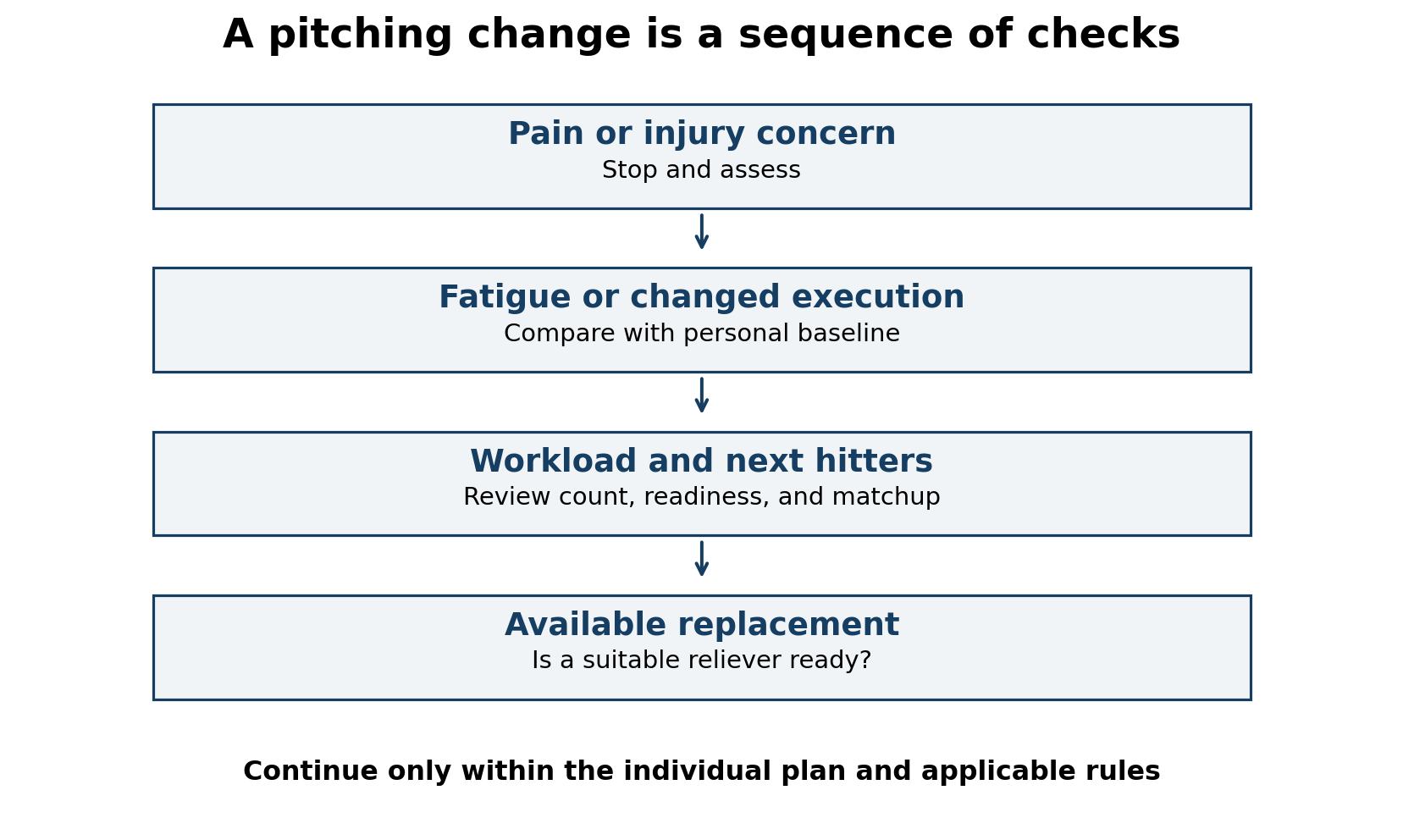
Figure 4 Reviewing a pitching change
Three illustrative pitching change decisions
Scenario one: a healthy starter has thrown 78 pitches through six innings, with stable movement and useful command. The bottom of the lineup is due, and the bullpen's key pitchers worked heavily the previous day. Continuing may be reasonable. A manager should still have a plan for traffic, an unexpected change in execution or the arrival of the top hitters.
Scenario two: a starter has thrown 68 pitches but has lost the ability to locate the fastball. Several pitches are leaking into the middle, the secondary pitch is being taken and the next three batters match up well against the remaining offering. An early change can be justified despite the modest total. The number has not made the pitcher effective.
Scenario three: a starter has thrown 94 pitches and is one out from a milestone, but reports unusual elbow pain. The milestone has no place in deciding whether to continue. Stop and obtain medical assessment. The same principle applies at a lower count and at every level of the sport.
These scenarios are intentionally simple. Actual teams possess information unavailable to viewers, including preparation, medical history and bullpen readiness. Fans can still evaluate the logic: what was known before the decision, which alternatives existed, and whether the chosen plan addressed the next challenge. Judging only by the eventual hit or strikeout confuses decision quality with one uncertain outcome.
Youth pitching requires a separate workload framework
A professional's outing should never become a child's target. Little League's regular-season daily maximums are 50 pitches for league ages 6–8, 75 for 9–10, 85 for 11–12, 95 for 13–16. These are organisation-specific ceilings, and league age is a defined eligibility category. Competition rules, tournament provisions and local requirements must be checked directly. [25]
Rest is a separate requirement rather than an optional recovery preference. For Little League pitchers aged 14 and under, the published bands are 1–20 pitches for zero required rest days, 21–35 for one, 36–50 for two, 51–65 for three and 66 or more for four. For league ages 15–16, the respective bands are 1–30, 31–45, 46–60, 61–75 and 76 or more. The daily maximum still applies. [26]
Zero required days does not mean unlimited throwing is sensible or that fatigue can be ignored. Nor does permission under one organisation mean permission under every competition. A player participating for more than one team needs a shared record so that each coach knows what has already been thrown elsewhere.
The American Sports Medicine Institute recommends responding to fatigue, taking substantial annual breaks from throwing, avoiding overlapping team workloads and stopping shoulder or elbow pain pending assessment. It also recommends that adolescent pitchers not double as catchers. These recommendations address cumulative exposure rather than a single headline pitch. [1]
The useful development question is not how soon a child can copy a professional slider. It is whether the player can throw comfortably, repeat basic mechanics, locate a fastball, change speed and recover appropriately. A smaller repertoire executed well offers a better learning environment than collecting advanced grips without command or adequate rest.
The fastest pitch ever recorded
MLB's current tracked leaderboard credits Aroldis Chapman with 105.8 mph on September 24, 2010. That is approximately 170.3 km/h. [27] The familiar 105.1 mph associated with the same pitch reflects the original reporting convention; modern leaderboards use a release-speed standard. It is important to identify the convention rather than present the two figures as two different record pitches. [28]
The careful wording is fastest pitch in MLB's modern tracking record. That statement does not prove that no unmeasured throw in baseball history was faster. Famous earlier pitchers were measured with different equipment, at different points in flight and sometimes in exhibitions rather than a continuously tracked major league season.
The ball slows on its way to the plate. A reading taken near release should therefore not be compared directly with one taken much nearer the hitter. Historical adjustments depend on assumptions about the original equipment, distance and drag. They can be interesting estimates, but they are not equivalent to having modern calibrated tracking data for the original pitch.
That distinction preserves the achievement of earlier hard throwers without manufacturing a definitive cross-era ranking. Nolan Ryan and Bob Feller belong in the history of exceptional velocity. It is unnecessary to claim a precise modern-equivalent speed for either to explain why they were remarkable.
One record pitch also differs from sustainable game velocity. A maximum answers how fast a pitcher threw once under the recorded conditions. A season average answers how fast a defined set of pitches was delivered across many situations. The ability to repeat high velocity with command and recovery is a different achievement from touching a spectacular peak.
How pitching speeds have increased
The strongest comparisons use consistent pitch definitions and measurement standards. Full major league pitch tracking began in 2008, with subsequent changes in systems and reporting. [29] Four seamers should be compared with four seamers, not an undefined mixture of fastballs in one year and only four seamers in another.
Starter four seamers averaged 91.8 mph in 2012 versus 94.6 in MLB's 2026 in-season report. [30] Those are a specific population and reporting point, not a final all-pitcher season average. The comparison illustrates the direction of change without claiming that every starter gained the same amount.
The arithmetic is revealing. A 2.8 mph increase from 91.8 mph is about three per cent. That may sound modest in ordinary travel, but a hitter is making a decision during a flight lasting only a fraction of a second. Less time can make it harder to recognise movement and still complete the swing.
An original simplified calculation uses a 54-foot release-to-contact distance and ignores deceleration. At 90 mph, flight would take about 0.409 seconds; at 95 mph, about 0.388; at 100 mph, about 0.368. Actual travel times differ because release position, contact position and drag vary. The example is intended to show scale, not reproduce a measured pitch.
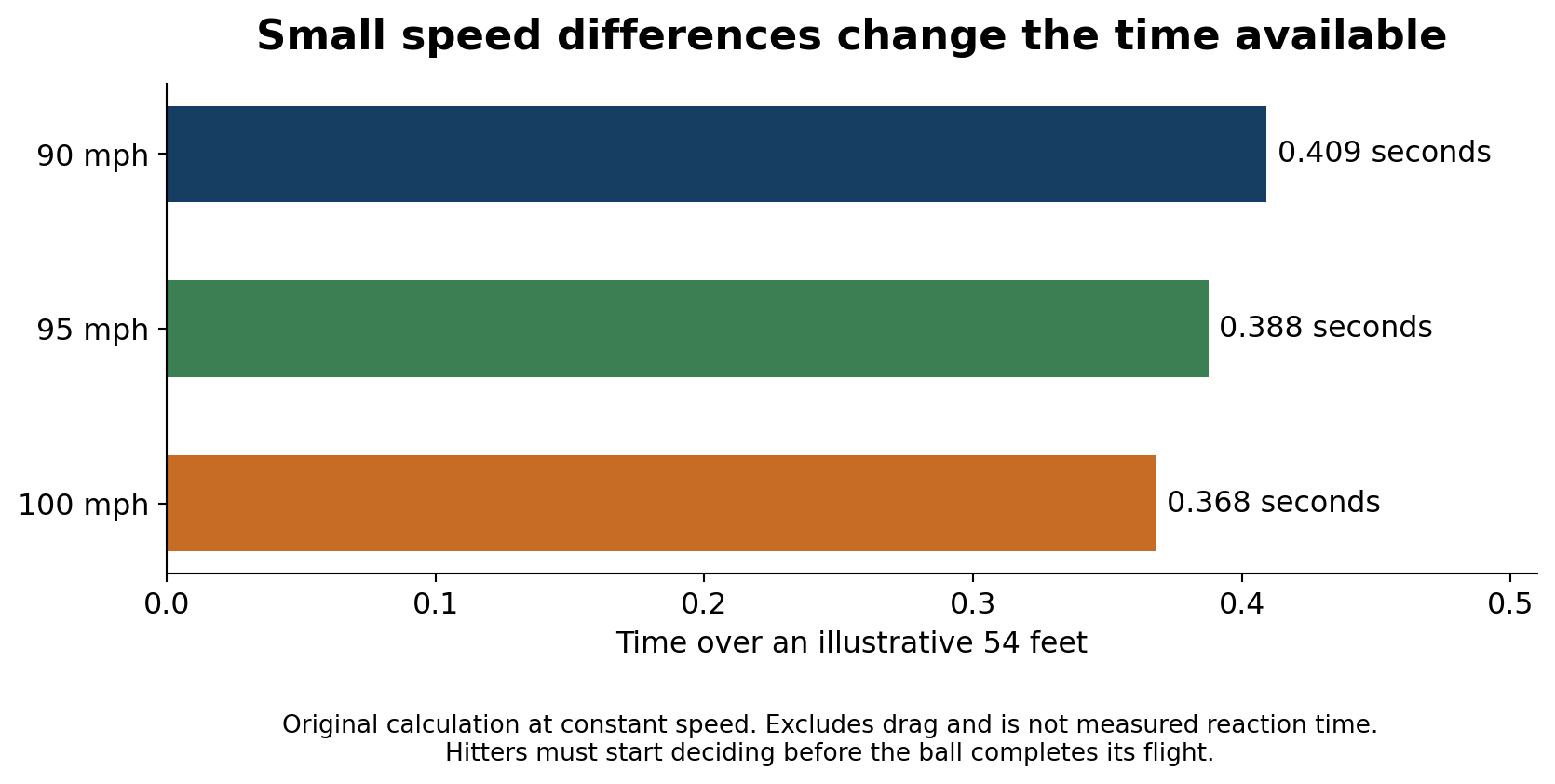
Figure 5 Speed and illustrative flight time
Velocity growth has several plausible contributors: player selection, physical preparation, mechanics work, more precise feedback and tactical demand for harder pitches. Modern teams can identify release and movement differences that were difficult to observe previously. These factors interact; a trend chart alone cannot assign a percentage of the increase to each one.
Deployment matters too. A pitcher preparing for a brief outing may use effort differently from someone expected to face a lineup repeatedly. A staff built around short assignments can expose hitters to a succession of fresh arms. That does not imply all relievers throw harder than all starters, or that every starter would gain a fixed amount by changing jobs.
The pursuit of speed also has costs. MLB's 2024 injury review identified concern about maximum effort, velocity and pitch-design demands. [31] That is a warning to investigate and manage the whole system, not proof that one grip alone causes an injury or that a particular velocity is safe for everyone.
There is an additional statistical trap: the population changes. Today's major leaguers are not simply yesterday's pitchers with a few extra miles per hour. Teams select, train, promote and deploy different athletes under different competitive conditions. The league average describes those selected pitches; it does not predict how much any individual can or should improve.
A sensible fan comparison therefore reports the year, pitch type, population and measurement basis together. A sensible coaching comparison starts with the athlete's readiness and repeatable execution. The radar gun can describe a result, but it cannot explain the whole process or determine a safe training plan by itself.
How to assess a pitch without expensive equipment
The first observation is the intended result. Ask the pitcher and catcher what the target was before deciding whether the pitch was good. A ball just below the zone may be an excellent chase pitch or a missed attempt at a called strike. The same physical destination can mean different execution.
Record a small set of useful outcomes consistently: pitch type, target region, actual region, count and broad contact result. Do not pretend that a short session establishes a permanent true talent level. The purpose is to reveal patterns worth discussing, such as a changeup that repeatedly misses high or a slider that only reaches the glove side from the windup.
Ordinary video can help show whether the presentation changes visibly between pitch types. It cannot reliably measure every spin axis or movement quantity from a convenient camera angle. A centre-field broadcast also compresses depth and can distort lateral impressions. Avoid assigning precise inches of movement from a single perspective without calibration.
When technology is available, keep the test conditions comparable. Record the baseball, mound, distance, measurement system and whether readings come from a bullpen or game. A meaningful improvement should persist over multiple pitches and remain useful at the intended target. One unusually large movement reading should invite verification rather than an immediate announcement of a new elite pitch.
The simplest evaluation remains demanding: can the pitcher deliver the intended offering comfortably, repeatedly and without giving away the choice? Can the catcher handle it? Does it make the hitter's task harder? Those questions connect the physics to the game.
Watching the next game with a better understanding
Start by identifying the pitcher's fastball baseline. Then look for the slower pitch, the glove side movement and the arm side movement. Notice whether pitches share an early route, whether the hitter is late or early, and whether the catcher is repeatedly moving away from the intended target.
As the game develops, watch the arsenal rather than only the radar gun. Is the breaking ball still reaching its useful location? Is the changeup still convincing? Is the pitcher relying on one offering because the others have disappeared? When a reliever starts warming, consider the next group of hitters and the alternatives available.
Pitching becomes easier to understand when its names are connected to decisions. A cutter does not need enormous break to matter. A splitter can drop without curveball topspin. A fastball can defeat a hitter through its path as well as its speed. The craft lies in making those features repeatable, combining them intelligently and recognising when the next pitch should belong to someone else.
Research notes
Research checked October 27 2026. Numbered references identify source material for the technical discussion and exact factual claims. Broad speed bands are explanatory approximations, not computed league distributions. Illustrative scenarios, diagrams and arithmetic are original and are labelled accordingly. Grip descriptions synthesise coaching principles; exact ball positions differ by athlete. Rare pitch descriptions should be read with the MLB pitch glossary alongside the grip sources.
Additional reference MLB Pitch Smart age-specific recommendations and MLB pitch-type definitions for forkball screwball and eephus. Follow the governing competition rulebook for eligibility, rest, batter-completion exceptions and tournament variations.
Sources and further reading
- [1] American Sports Medicine Institute Position Statement for Adolescent Baseball Pitchers
- [2] Alan Nathan University of Illinois Dissecting a Mystery Pitch
- [3] Driveline Baseball Ultimate Guide to Baseball Pitch Grips
- [4] Barton Smith Baseball Aerodynamics Cliff Notes Seam Shifted Wake
- [5] Alan Nathan University of Illinois What Is the Hawkeye Spin Data Teaching Us III
- [6] FanGraphs Sabermetrics Library Pitch Type Abbreviations and Classifications
- [7] Driveline Baseball How to Throw a Four Seam Fastball
- [8] Driveline Baseball How to Throw a Sinker or Two Seam Fastball
- [9] Driveline Baseball An Introduction to Seam Shifted Wakes and Their Effect on Sinkers
- [10] Driveline Baseball Pitch Grips Cut Fastballs
- [11] Driveline Baseball Pitch Grips Sliders
- [12] Driveline Baseball How to Throw a Slider
- [13] Pitching Coach U Three Sweeper Grips for Crazy Movement
- [14] Driveline Baseball How to Throw a Curveball and Pitch Grips Curveballs
- [15] MLB Glossary Knuckle Curve
- [16] Driveline Baseball How to Throw a Changeup
- [17] Driveline Baseball Pitch Grips Changeups
- [18] Driveline Baseball Pitch Grips Splitters
- [19] Driveline Baseball How to Throw a Knuckleball
- [20] Barton Smith Baseball Aerodynamics PIV on Knuckleball Pitches
- [21] MLB Pitch Arsenals Are Bigger Than Ever in 2025
- [22] MLB Glossary Opener
- [23] Research paper A Bayesian Analysis of the Time Through the Order Penalty in Baseball
- [24] Official Baseball Rules 2026 Rule 5 10 Pitcher Substitution
- [25] Little League Regular Season Pitching Rules
- [26] Little League Pitcher Rest Requirements
- [27] Baseball Savant Statcast Release Speed Leaderboard
- [28] Baseball Savant Statcast Search Velocity Measurement Notes
- [29] MLB Glossary Pitch Tracking Era
- [30] MLB Pitchers Throwing Faster Than Ever in 2026
- [31] MLB Report on Pitcher Injuries 2024
- [32] Baseball Canada Pitching Mechanics