

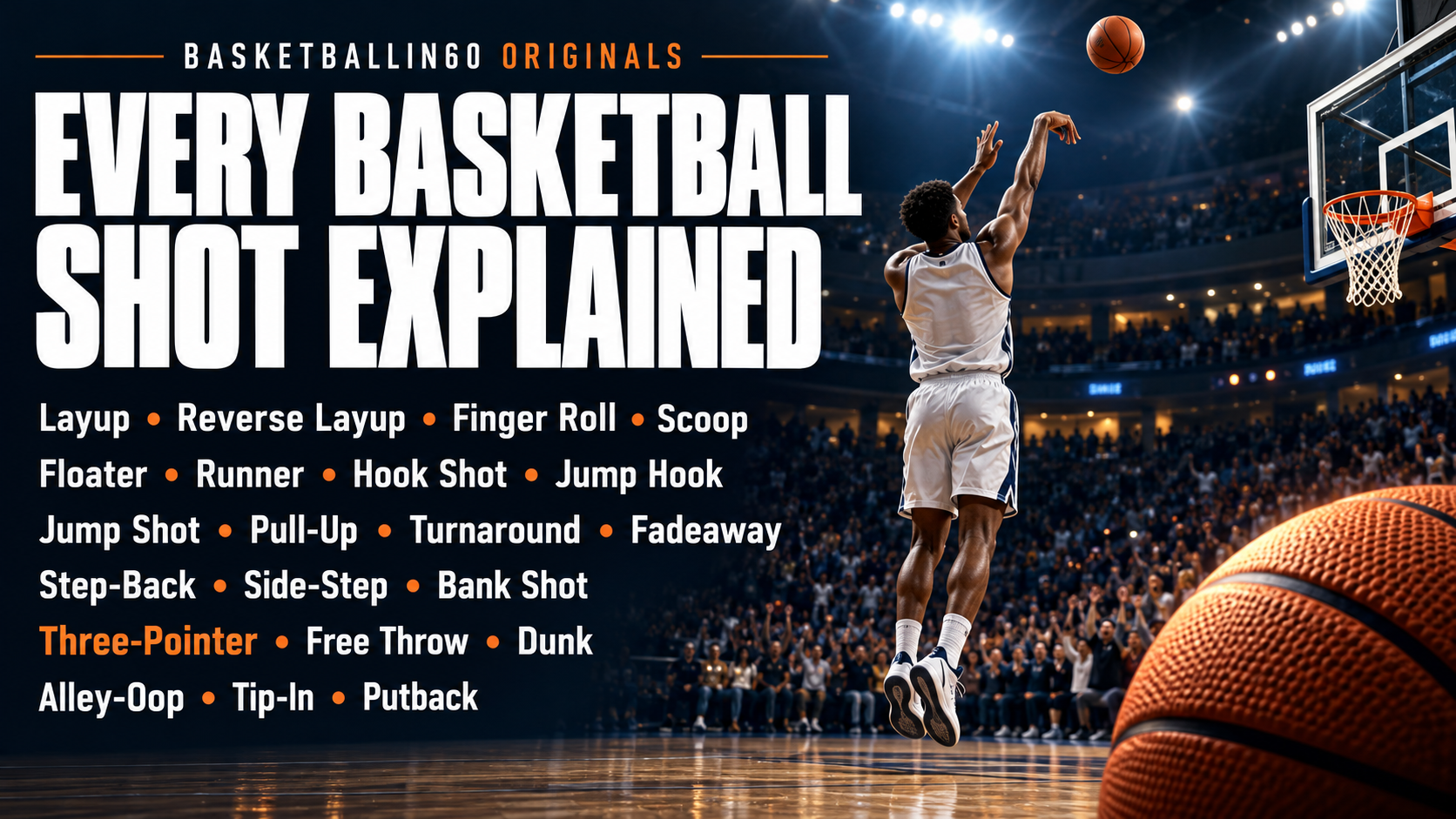
Every Basketball Shot Explained
Basketball in 60 ·
A basketball shot is an answer to a particular problem.
The technique behind finishing jump shooting and scoring from three point range
A basketball shot is an answer to a particular problem. Sometimes the problem is a clear path to the rim. Sometimes it is a taller defender waiting in the paint, a hand closing toward the ball, or a pass arriving with only a moment available. Good scorers do not merely know more moves. They recognise which shot gives them a controllable attempt before the opportunity disappears.
That is why a layup, floater, hook and three pointer can all belong in the same conversation. Each changes the ball's release position, timing, flight or protection. A layup moves the release closer to the target. A hook places the body between the defender and the shooting hand. A fadeaway buys separation while making the shot more demanding. A three pointer rewards distance but asks for more precise coordination and enough usable power.
This guide explains the major shot families and the variations fans encounter in games. Each begins with a basic definition, then considers technique, purpose and common problems. A substantial section examines three point shooting, from the feet and shooting hand to release angle, backspin, movement shooting and practice design.
No article can catalogue every improvised finish or every player's private name for a move. The useful aim is to understand the mechanics beneath the names. A turnaround fadeaway bank shot combines three descriptions of one attempt. It is not three separate skills performed in isolation.
Unless stated otherwise, the technique descriptions use a right handed shooter; reverse the hands and sides for a left hander. They are coaching starting points rather than rigid positions every body must copy. Players differ in height, mobility, hand size, strength, experience and the competition they play. The objective is a legal, repeatable shot that works under the relevant conditions.
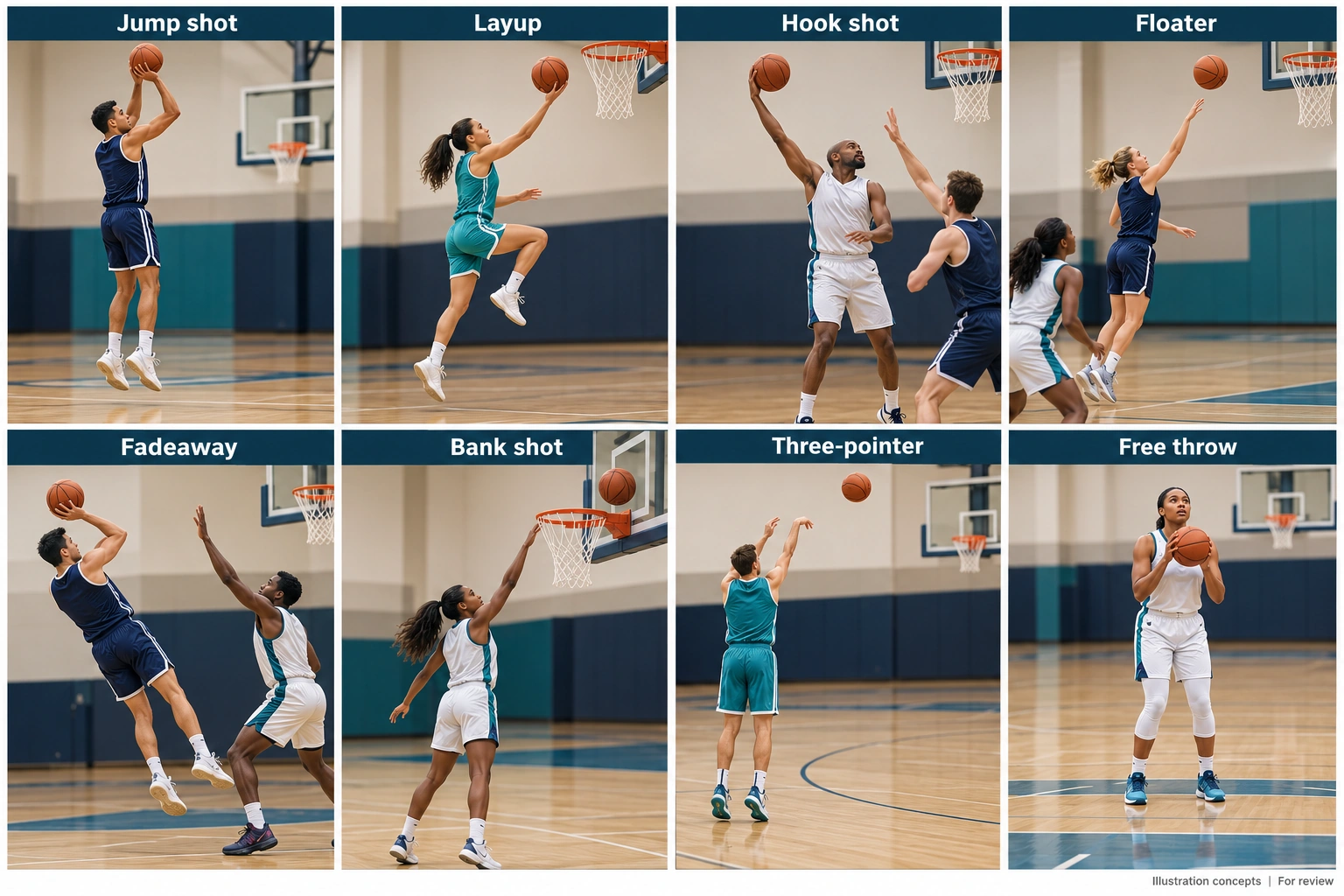
Four ways to describe the same shot
Shot labels often refer to different features. Distance describes where the attempt begins: at the rim, in the midrange or outside the three point line. Preparation describes how the player arrives: a catch, dribble, pivot, rebound or cut. Release describes how the ball leaves: a conventional jumper, underhand finish, hook, scoop or dunk. Movement describes what the body does: rising vertically, running, turning, fading or stepping away.
Consider a player who catches in the corner, jumps, and sends the ball straight through the hoop without using the backboard. That is a catch and shoot three point jump shot. Another player may create a three pointer with a dribble and step back. Both receive the same scoring value when legal and successful, but they require different preparation and balance.
Similarly, a bank shot is not a fixed distance or footwork pattern. A layup can bank. A midrange jumper can bank. A hook can bank. The backboard is a chosen route to the basket rather than a completely separate scoring territory.
This distinction also matters when reading statistics. A tracking provider's categories may prioritise one feature over another. Do not assume every table divides shots using the same definitions. The coaching and viewing question remains what the player was trying to accomplish and how the ball was delivered. Synergy's shot descriptions provide one example of an organised classification system. [1]
| Shot family | Examples | Main purpose |
|---|---|---|
| At the rim | Layup, reverse, scoop, finger roll | Reach a protected close release |
| Above the rim | Dunk, alley oop dunk | Finish over the basket |
| Paint touch | Floater, runner, push shot | Clear a nearby rim protector |
| Post | Hook, jump hook, turnaround | Use body position and release angle |
| Jump shooting | Catch, pull up, fadeaway, step back | Create a repeatable release window |
| Long range | Catch, pull up, movement three | Combine range with readiness |
| Uncontested | Free throw | Repeat a controlled routine |
| Second chance | Tip in, putback | Convert the rebound legally |
Figure 1 Shot locations on an NBA half court
The common foundation beneath different shots
Balance means controlling movement
Balance does not require the feet to remain motionless or the body to stay perfectly upright. A driving finish uses forward momentum. A fadeaway deliberately moves away from the basket. In both cases, the player needs enough control to deliver the intended release and land without colliding unnecessarily with others.
For a beginning stationary jumper, a comfortable stance around shoulder width is a useful starting point. The knees and hips flex sufficiently to prepare the upward movement. The shooter should be able to rise without falling sideways or needing a rescue step. Exact foot width and toe direction should be adjusted to the individual rather than imposed as identical measurements.
A slight stagger or turn can help some players position the shooting arm comfortably. That does not justify accepting a stance that repeatedly twists the ball away from the target. Test the result over a series of attempts, including misses. A position is useful when it supports the required delivery, not simply because it resembles a photograph of a professional.
One hand delivers and the other supports
In a conventional one handed shot, the shooting hand provides the main propulsive action and direction. The other hand stabilises the ball during preparation and should avoid adding a sideways shove at release. The shooting fingers spread comfortably, the wrist is set without strain, and the ball is controlled rather than squeezed. Jr. NBA and USA Basketball teach this division between the shooting and guide hands. [2, 3]
The ball does not need to balance on the extreme fingertips with an exaggerated empty space above the palm. Hand size and shot style affect contact. The practical issue is whether the ball can rise and leave smoothly without slipping, being pinched or needing a last moment correction from the guide hand.
The body supplies a sequence
The shot links lower body extension, upward ball movement, shoulder and elbow action, and the final hand release. Those actions overlap; they are not a series of completely separate stops. A player who bends, stands, pauses and then pushes with the arms may find long shots particularly difficult.
Follow through is a useful sign of the action that produced the release. Once the ball has left, the hand cannot steer it into the basket. Holding a comfortable finish can help the player avoid cutting the action short and can make the movement easier to review. It should not become a demand to freeze an awkward joint position.
Layups and finishes at the rim
The conventional layup
Basic definition: a close-range shot taken while approaching or standing beside the basket, usually by extending one arm toward the target.
For a conventional right side, right handed running layup, the familiar final foot contacts are right then left, followed by a jump from the left foot and a right handed release. The right knee commonly rises with the shooting arm. The ball is lifted toward a high, reachable release and guided either directly to the hoop or through the backboard. FIBA's introductory coaching workbook uses this opposite-foot foundation. [4]
A useful first progression removes the dribble and begins close enough that the player can learn the final rhythm. The next progression adds a controlled approach, then the dribble or pass. Otherwise a beginner may spend all their attention counting feet and lose the basket entirely.
The backboard target changes with angle and approach. The painted square gives a helpful reference from suitable positions, but a single corner is not a correct target for every possible layup. At an unusual angle, the player must adjust touch, height and direction. The nearer shot can still require considerable skill.
The common mistake is carrying too much forward speed into a hard push. A player who arrives quickly does not need to add the same force that would be needed from farther away. Learn to distinguish the speed of the body from the amount of force required at the fingertips.
Figure 2 Conventional layup teaching rhythm
The finger roll
Basic definition: an underhand or partly underhand finish in which the ball rolls from the hand toward the fingertips as it is released.
The hand supports the ball from beneath and lifts it toward the target. The last part of the movement delivers touch rather than a hard overhand push. A finger roll can finish directly over the front rim or use the board, depending on the angle. Spin may differ from the backspin of a conventional jump shot; the important requirement is controlled flight into the available space.
The appeal is reach and delicacy. The limitation is exposure: extending the ball early can give a defender a clear block opportunity. A player should learn when the rim is open enough for the finish and when a protected alternative is better. Soft touch does not make an unprotected ball invisible to the defence.
The scoop and inside hand finish
Basic definition: a finish delivered from a lower or more sideways release, often reaching around a defender rather than over them.
The player changes the release window while keeping enough control to direct the ball. An inside hand finish uses the hand closer to the middle of the court on a particular approach; depending on the side, that may be the player's stronger or weaker hand. It can surprise a defender expecting the outside hand, but it is not automatically better protected in every situation.
The coaching challenge is separating deliberate adaptation from a desperate fling. Practise an unobstructed version before adding a defender's arm. The player should understand which part of the body or rim protects the release and where the landing space is. Extra sidespin should be purposeful, not an accidental consequence of losing control.
The reverse layup
Basic definition: a finish on the far side of the basket after approaching from the other side or moving underneath it.
The rim and backboard can obstruct a trailing defender's route to the ball. The shooter must locate the far-side target early enough and manage the remaining momentum. Simply running beneath the hoop and hoping to discover the angle while airborne is unreliable.
A useful progression begins without a defender at modest speed. The player learns to extend toward the far-side window and use the appropriate touch off the board. Then the practice adds a passer, an approaching defender or a restriction on the finish. Keep the space beneath the basket clear; reverse finishes can bring several players into the same landing area.
The power finish and two foot takeoff
Basic definition: a close-range finish made after gathering under control and rising from two feet.
Two feet can provide a useful platform when the player has time to gather and needs to finish through crowding or change the release side. It is not a guarantee of greater jump height or contact tolerance. The player still has to manage the gather legally and maintain a clear route to the basket.
The ball can be kept protected until the extension becomes necessary. A pump fake may encourage a defender to commit, but the shooter must preserve legal pivot and takeoff options. Turning a controlled stop into repeated unnecessary fakes can allow the rest of the defence to recover.
Wrong foot and same foot finishes
Basic definition: a layup variation that changes the familiar relationship between shooting hand and takeoff foot, such as a right handed release from the right foot.
The main tactical benefit is altered timing. A defender expecting the conventional two-step rhythm may leave the floor at the wrong moment. The shooter can also avoid an extra step that would carry the body into a blocker.
This is an advanced option after basic approaches are comfortable, not evidence that beginners should abandon the usual progression. The finish still needs enough height, protection and directional control. Variation helps only if the player can select it intentionally.
Floaters runners and touch shots in the paint
The floater
Basic definition: a relatively high, soft shot released before reaching the rim, often over a defender protecting the basket.
The shooter lifts the ball into an arc that clears the immediate contest and descends toward the hoop. A floater may come from one foot or two. Its release can look more like a short push than a full jump shot, although individual methods vary.
The key decision is distance. Release too late and the rim protector may reach the ball. Release too early and the attempt becomes an unnecessarily difficult long touch shot. The shooter needs to recognise the defender's depth while maintaining awareness of a possible pass.
A high arc alone does not create a good floater. The ball must still carry enough forward speed to reach the hoop without becoming a hard line drive. Practice should include a small number of recognisable approach speeds and distances before expanding the range. USA Basketball's performance shooting resources include a floater progression. [5]
The runner and push shot
A runner is generally a shot taken while the player continues a running approach rather than settling into a stationary jump. A push shot describes a compact delivery that sends the ball upward and forward, often from one hand. The terms overlap with floater depending on the coach or data provider.
The body's forward velocity contributes to the ball's starting motion. The player therefore has to calibrate touch against approach speed. A release that works from a slow walk may overshoot after a fast dribble. That is a reason to vary realistic approaches in practice, not merely stand at one spot and make a series of soft tosses.
The short turnaround touch shot
A player receiving the ball in the paint may use a pivot and compact jumper or push shot without executing a full hook. The challenge is locating the basket during the turn while keeping the ball away from the defender. Establish the feet and release route before adding speed.
A short shot is not automatically an easy shot. The surrounding bodies may remove space for the normal shooting motion. Successful finishers learn to preserve a controlled hand action even when their preparation is compact. If no controllable window exists, the pass can be the better scoring decision.
Hooks post shots and the use of the backboard
The hook shot
Basic definition: a one handed shot released on the far side of the body from the defender, with the arm rising in a hook-like path.
The shooter turns partly sideways and uses the body as a barrier. The ball is lifted to a release above and outside the shoulder. The exact arm path varies between a compact jump hook and a longer, more sweeping hook. The non-shooting arm can help with balance and normal protection but cannot simply shove the defender away.
Distance control becomes harder when the player swings the ball broadly without directing the final release. A coach can begin with short hooks from both sides of the hoop, asking the player to establish a clear target and controlled hand finish. The goal is a usable protected shot, not the largest possible arm circle.
The jump hook
Basic definition: a compact hook released during a jump, often from a two foot base in the post.
The player gathers, turns enough to protect the ball and rises into a short shooting action. The shoulders need not become fully square to the basket. The separation comes from body position and the outside release rather than from leaning dramatically away.
USA Basketball presents the jump hook as an option when the defender takes away a layup. [6] In practice, train it from useful receiving positions and both turning directions. A right hander who can only turn toward the right shoulder's preferred lane gives the defence information. The weak-side version need not be perfect immediately, but it deserves structured practice.
The skyhook and running hook
The skyhook name is associated with a high, extended hook release, while a running hook adds an approach or moving takeoff. Both can create a difficult blocking angle. Both also require considerable coordination of body travel and ball direction.
These are variations within the hook family rather than mandatory skills for every player. A guard may gain more from a dependable floater; a post player may use a short jump hook far more often than a long sweeping version. Skill selection should follow the situations the player actually encounters.
The bank shot
Basic definition: a shot intentionally aimed off the backboard before entering the basket.
The board changes the route and the way speed and spin interact before the ball reaches the hoop. The appropriate target depends on the shooter's position, release and trajectory. Physics modelling of bank shots examines those variables together rather than treating the painted square as one universal aiming point. [7]
A useful practice starts at an angle where the target is easy to see, then moves gradually to other positions. Compare direct and banked attempts from the same location. The better choice is the one that gives that player a reliable route in the situation, not a blanket rule that using the glass is always more accurate.
The up and under
Basic definition: a move that uses an initial shot presentation to draw a defender upward, then creates a different finishing route.
The eventual attempt may be a layup, scoop or short push. The fake must resemble a believable shot while preserving legal footwork. The shooter then steps or pivots into the available space without illegally returning a lifted pivot foot to the floor before release.
An up and under is a decision sequence rather than a single release shape. It works when the defender commits enough to open a route. If the defender stays grounded, repeating the fake does not create space by magic. The player must retain a pass or another legal option.
Jump shots and the ways players create separation
The set shot and basic jump shot
Basic definition: a set shot is delivered without a conventional airborne jump; a jump shot releases the ball while the shooter is off the floor.
A set shot can be useful for learning the hand action or making a free throw. A jump shot adds upward movement and a higher or more timely release window. The basic skill is coordinating that lift with the ball rather than jumping first and then trying to assemble the shot in the air.
Jr. NBA uses a controlled vertical jump as an introductory reference. [8] That is a useful way to reduce unnecessary sideways drift. It should not be interpreted as proof that every successful player must land on the exact marks where they began. Modest, controlled forward movement can be part of an effective shot.
The catch and shoot jumper
Basic definition: a jumper taken after receiving a pass, without using a dribble to create it.
The shot begins before the catch. The player finds space, presents ready hands and prepares the feet for the pass location. A good pass allows the receiver to move into the shot; a poor one may require a safe adjustment rather than an automatic release.
The danger is treating quickness as a command to skip preparation. A player who catches upright, fumbles the hand placement and then rushes upward has not created an efficient release. Earlier readiness can make the actual shooting movement calmer. USA Basketball's preparation guidance emphasises ready hands and early organisation. [9]
The pull up jumper
Basic definition: a jump shot taken after the player stops or substantially checks a dribble attack.
The feet and lower body reduce the approach momentum while the ball moves into the shooting path. The player can use different legal stopping patterns depending on direction and the gather. A balanced final position is an outcome of effective braking, not merely an instruction to bend the knees after arriving too fast.
Pull-ups should be learned going both directions. Moving toward the shooting hand and moving across it create different ball pickups and body turns. A shot that works after a rightward dribble may need different preparation after a leftward one. Practice the problem actually faced, rather than assuming one stationary technique transfers unchanged.
The turnaround jumper
Basic definition: a jumper created by turning from a position partly or fully away from the basket.
The shooter locates the rim, organises the feet and brings the ball into a protected release as the turn finishes. The turn can be toward either shoulder. A player who turns too far may carry rotation into the release; one who turns too little may leave an awkward arm route.
The advantage is using body position to begin the attempt away from the defender's preferred view. The cost is a more complex preparation than an open stationary jumper. Train the turn without a defender first, then add realistic pressure that encourages a particular shoulder or pass.
The fadeaway
Basic definition: a jumper released while the shooter moves backward or away from the defender.
The movement buys separation but changes the release position and the velocity the hand must impart to the ball. A player accustomed to a vertical jumper may shoot short when moving backward because the usual delivery no longer produces the same forward flight.
A controlled fade is different from losing balance. The player needs a chosen landing area and a repeatable release. It is usually sensible to establish the ordinary jumper before relying heavily on this variation. A difficult made fadeaway is not evidence that it was a better choice than an available open pass.
The step back and side step
A step back creates space mainly away from the defender and often away from the basket. A side step shifts the release laterally, which can move it outside the defender's closing path. Either can lead to a two pointer or three pointer.
The shooter uses the feet to create the space, then controls the remaining momentum before release. Jr. NBA includes the step back as a space-creation skill. [10] The essential constraint is legal footwork: the timing of ball control and the allowed steps matters. A move seen in professional basketball should not be assumed legal under every local interpretation without checking the applicable rules.
A large backward hop is not automatically better. It may create more distance from both the defender and the rim, increasing the shooting demand. A smaller move with a cleaner release can be more useful. The successful variation creates enough space while leaving a shot the player can actually make.
The leaner and emergency release
A leaner deliberately shifts the body around a contest, while an emergency release is an improvised attempt when time or space has almost disappeared. These categories include many unusual angles and one-foot jumpers. They should be understood without turning every successful improvisation into a recommended default.
Players benefit from adapting, but adaptation works best on top of reliable basic skills. In practice, first establish a controllable shot. Then introduce constraints that require a modest adjustment. Starting with extreme contortions can produce a player who can attempt anything and repeat very little.
Free throws dunks and second chance finishes
The free throw
Basic definition: an uncontested attempt from the free throw line awarded under the rules, worth one point when successful.
The absence of a defender creates an opportunity for a repeatable routine. The player can establish the feet, settle the ball, locate the target and deliver a familiar action. The routine's purpose is to organise attention and timing; it does not need a particular number of dribbles or a theatrical pause.
The free throw usually uses a smaller lower-body contribution than a long jumper, but the body should still work together. Excessive stillness can leave the player pushing only with the arm. At the other extreme, a complicated rocking routine may introduce unnecessary variability. Test whether the preparation helps the release remain stable.
Models of free throw flight show that release height, speed and angle interact. An optimum calculated under one model's assumptions is not a universal angle every shooter should copy. [11] Use the model to understand tradeoffs, then evaluate the individual shot.
An underhand free throw is a legitimate alternative release style. It uses a different coordinated swing and release from the conventional overhand version. Its appearance should not decide whether it is useful. A player considering a substantial change should compare repeatable outcomes over enough practice rather than judge a few attempts or social reactions.
The dunk
Basic definition: a finish that places or forcefully sends the ball downward through the hoop from above.
A dunk can reduce uncertainty about the final flight when the player reaches the basket under control. The approach, gather, takeoff, grip and landing still require skill. One hand, two hands, one foot and two feet offer different reach and control options.
The useful question is whether the player has a safe, unobstructed route and sufficient control for that finish. Attempting to dunk through crowding without a stable landing plan can create unnecessary risk. In development, touch finishes remain important even for players who can dunk because not every game situation offers the required space.
The alley oop
Basic definition: a finish made by catching or redirecting a pass in the air near the basket before landing.
It can end in a dunk or a softer layup-style release. The passer and finisher must coordinate location and timing. A pass that looks spectacular but forces the receiver into the backboard or another player is not a good delivery.
The finisher needs to see the pass early, prepare the jump and make an appropriate decision if the ball is not reachable. Learn the connection through controlled passes before adding traffic. The aim is a playable target above the defence, not simply the highest possible lob.
The tip in and putback
A tip-in redirects a rebound into the hoop, often without bringing the ball into a full shooting grip. A putback is a second-chance attempt after an offensive rebound and may involve a gather and another jump.
These attempts reward anticipation, position and touch. The player must know where the ball and rim are relative to the applicable basket-interference rules. A rebound cannot be treated as freely playable in every position above the hoop. At younger levels, secure possession and a controlled finish can be a better first objective than attempting an airborne tip through several hands.
The three point shot in detail
What makes a shot worth three
Basic definition: a successful field goal from outside the competition's three point boundary, with the shooter's floor position satisfying the relevant rule.
In the NBA, the arc is 23 feet 9 inches from the basket centre, while the straight corner portions are 22 feet away. A foot touching the line is in the two point area. The shooter may land inside after releasing a legal three point attempt. [12, 13] These are NBA dimensions and rules; check the court and competition rather than assuming every line has the same distance.
The shorter NBA corner distance is one reason that location deserves separate practice. It also has less usable floor beyond the shooter before the sideline or baseline becomes a problem. A corner attempt is not automatically easy simply because it is closer. Pass angle, space, defensive approach and familiarity all matter.
A three pointer is not a completely different hand skill from the jump shot. It is the same broad scoring task performed farther away, often with less time to prepare. The extra distance changes the required release conditions and can expose weaknesses that remain hidden close to the hoop.
Why extra distance changes the body movement
To reach the basket from farther away, the ball generally needs greater release speed, with the exact requirement depending on release height and angle. A shooter can produce that speed through different combinations of lower-body motion, timing and upper-body action. Simply telling every player to flick the wrist harder misses most of the task.
Studies comparing distances have observed changes in release speed, height, angle and movement timing. These are descriptions of particular samples, not instructions that every player should reproduce the same change. Research in experienced male players and separate work in female players also warns against treating one small group as the complete model for basketball shooting. [14, 15]
For a practical self-check, move progressively away from the basket. At the distance where the body begins lunging, the guide hand starts pushing or the ball needs a separate heave, the current shot is being stretched beyond its reliable range. That is useful information. It is not a reason to practise the compensations until they become the only familiar movement.
A strong long-distance shot should still resemble a controlled scoring action. The lower body contributes to the rise, the ball follows a repeatable path and the hand delivers without a panicked final shove. Usable range is the range at which that organisation survives, not the farthest distance from which one attempt can reach the rim.
Feet and alignment
Begin with a stance that allows the shooting side to organise comfortably. A modest foot stagger and slight toe turn may help, particularly when trying to avoid forcing the shoulder and elbow into an artificial straight line. Another player may be comfortable closer to square. Neither arrangement is automatically correct without considering the release.
The key is repeatability under realistic preparation. If the preferred stance works only when the player can arrange each toe for several seconds, it is incomplete for game shooting. The feet must arrive through a catch, a relocation or a dribble stop. Practise entering the stance, not merely standing in it.
Watch whether the hips and chest rotate during the final release. Some rotation is part of normal movement, but an uncontrolled late turn can change direction. A useful cue is to finish toward the target without forcing a rigid pose. Video from the front can help reveal repeated sideways movement that is hard to feel while shooting.
Do not demand identical landings from every shot. A small forward displacement can occur as the player rises and delivers. The relevant problem is uncontrolled travel that changes the release or carries the player into a defender. A landing pattern is something to observe and understand, not a moral judgement about whether the shot looks textbook.
Knees hips and the source of range
The legs do not launch the ball directly: they accelerate the body and help create a coordinated platform for the upper limbs. The shot succeeds when that contribution is timed usefully. A deep crouch followed by a long pause can be less effective than a shallower, well-connected rise.
The player needs enough knee and hip flexion to load comfortably without collapsing the torso. More flexion is not automatically more power, and more power is not automatically more accuracy. The task is producing the required ball speed with a repeatable sequence.
A common error is using almost no lower-body contribution until the distance becomes difficult, then suddenly jumping much harder and pushing with the arms. That changes several variables at once. A more useful progression is to preserve a recognisable rhythm as the distance increases gradually.
Research comparing proficient and less proficient long-range shooters has examined preparation as well as release. Findings suggest that how the player arrives at release can matter even when a final still image looks similar. [16] That supports reviewing the whole movement rather than copying only the position of the hand after the ball has gone.
The ball path and shooting pocket
The shooting pocket is the region where the ball is organised before rising into the release. It is not a universally fixed point on the body. A player may bring the ball from the hip, waist or a higher catch into a useful path depending on the pass and shot.
The objective is avoiding unnecessary detours. A ball carried far across the body may require a correction before reaching the release. A low dip that works with time may become vulnerable against a close defender. A very high catch can reduce preparation time but may leave a developing shooter without enough comfortable power.
Teach the player to receive into an action they can repeat. That may mean adjusting the feet to a pass, bringing the ball through a compact dip, or delaying the shot when the catch is poor. The fastest successful shot is not always the attempt with the shortest visible ball movement.
Should a shooter dip the ball
A dip is a downward movement of the ball before the upward shooting action, commonly after a catch. It can help coordinate the ball with the body and create a familiar rhythm. It also takes time and can bring the ball within reach of a defender.
An experimental study involving high-school and university shooters found better accuracy with a dip under its tested conditions. [17] That does not prove every player should use the same dip depth on every shot or that removing a dip always causes worse shooting. Pass height, available time, distance and the player's established coordination matter.
A practical comparison is to test a modest dip and a more direct lift from the same pass location. Record accuracy and whether the player can release before a realistic closeout. The outcome may favour one preparation for an open three and another for a hurried catch. Preserve useful rhythm while reducing unnecessary movement.
Shooting hand and guide hand
The shooting hand should support and direct the ball through a comfortable release. Spread the fingers enough for control without straining them. Let the wrist set naturally so the ball can rise above the hand rather than needing to be pushed from a rigid flat palm.
The guide hand stabilises the ball during preparation, then allows the shooting hand to complete the delivery. A repeated sideways thumb push can create unwanted direction or spin. However, do not diagnose every missed shot as a guide-hand problem merely because the hand remains visible near the ball. Slow video and a pattern of attempts are more informative than one frame.
A close-range shooting-hand-only drill can help the player feel the final direction, but it is a diagnostic exercise rather than the complete game shot. Restore the guide hand and the normal preparation once the purpose is understood. A player who can make an isolated one-handed toss still needs to coordinate the real catch and release.
Elbow and shoulder organisation
The familiar instruction to put the elbow under the ball aims to establish a useful upward shooting path. It should not force every shoulder, forearm and hand into one identical geometry. Body proportions influence how the arm can be organised comfortably.
Look for a delivery that does not require a late sideways sweep to find the target. Some visible elbow flare during preparation may reduce as the ball rises; another player may struggle because the elbow stays displaced and the forearm cuts across the release. The path and outcome matter more than a single preparatory angle.
Trying to repair every body segment at once can make a familiar shot feel impossible. Choose the clearest repeatable problem, introduce one practical cue and observe enough attempts to judge it. A coach should be able to explain what the adjustment is intended to change and what evidence would suggest it is helping.
Release timing and the jump
Some shooters release in a relatively continuous motion as they rise. Others create a more noticeable set point and release later in the jump. The informal labels one-motion and two-motion describe this difference, but real shots exist along a continuum.
A continuous rise can help transfer the movement into a long shot without a pronounced pause. A later, higher release can be useful over a contest or from a shorter pull-up. Neither description establishes a universally superior method for every distance and defender.
Releasing at the exact peak is not a requirement for every three pointer. A player who waits until upward momentum has ended may have to add more with the upper body. Research on increasing shooting distance has found changes in the relationship between takeoff and release. [18] The coaching task is finding timing the player can repeat, not teaching a slogan as a physical law.
Release angle and entry angle
Release angle is the direction of the ball's initial velocity relative to the horizontal. Entry angle is the direction of travel as the ball descends toward the hoop. They are related, but they are not the same measurement.
A higher entry angle can provide a more favourable geometric opening than a very flat descent. However, raising the arc also changes the required speed, flight time and sensitivity to release errors. An extremely high shot is not automatically easier to make.
The suitable combination depends on distance, release height and the shooter's control. Studies of basketball trajectories and release variability address these interacting conditions rather than prescribing a single angle independent of the person. [11, 19] Be careful with a coaching video that identifies one degree value as the answer for every adult, child, layup and three pointer.
The practical aim is a repeatable arc with sufficient clearance, not a ball that barely reaches the rim or climbs dramatically without consistent distance. If changing the arc, begin close enough to preserve control. Observe the pattern over several sessions before calling it an improvement.
Figure 3 Release angle and ball flight
Backspin and what it can and cannot do
A conventional jumper normally has backspin: viewed from the shooting side, the ball rotates backward relative to its forward travel. The final interaction between the hand and ball creates that rotation. Backspin also changes how the ball interacts with the rim or backboard on contact.
It does not pull a poorly aimed ball sideways into the hoop. Nor does a beautiful seam pattern prove the shot had the correct speed and direction. A ball can spin neatly and still miss badly. Spin is one part of release quality.
A study measuring collegiate players' shots found relationships between variation in spin-axis alignment and lateral accuracy. [20] Its practical value is encouraging consistency and careful observation. It does not justify diagnosing every sideways miss from the appearance of the seams in an ordinary television replay.
A player should seek a comfortable release that sends the ball cleanly toward the target with repeatable rotation. Trying to manufacture extreme spin by snapping harder can disrupt the rest of the action. Spin should emerge from a useful delivery rather than become a separate contest.
Figure 4 A connected shooting sequence
Catch and shoot threes
The simplest game three is often created by someone else's advantage: a drive, post touch or extra pass forces the defence to move. The receiver should be ready before the pass arrives, with awareness of the boundary and the defender's approach.
Two common preparations are a one-two step into the shot and a small hop into a two-foot landing. Each can work. A one-two can organise a directional approach, while a hop can allow a compact reset from a suitable pass. Neither should be taught as an unconditional rule for every catch angle.
Begin with passes to a predictable location, then vary the location modestly. The player learns whether to shoot, adjust or move the ball. A catch that pulls the body beyond the sideline or into a defender is not a demand to complete the planned shot. Good shooting preparation includes the ability to decline a poor attempt.
Pull up threes
A pull-up three adds the problem of stopping a dribble approach. The player must organise the pickup without carrying the ball across the body unnecessarily and reduce horizontal movement enough for a controllable release.
Start with one dribble at a manageable speed, then increase the realism of the approach. Going left and right deserve separate attention. A player who consistently misses after one direction may have a pickup or braking issue rather than a general failure of shooting touch.
In games, pulling up from deep is useful when the defender's position creates a genuine window and the shot is within the player's demonstrated range. It is not automatically justified because the dribble sequence looks similar to a professional highlight. Difficulty should be earned through repeatable execution and sound selection.
Movement relocation and transition threes
A movement three begins after a cut, curl, flare or relocation. The player has to manage incoming body motion and the arriving pass together. A transition three adds the speed and uncertainty of a changing court.
The key is preparing the body without losing awareness. A shooter leaving a screen needs to know where the defender is, where the pass will arrive and whether the next action should be a shot or a drive. Practise the route and pass timing together; a series of stationary makes does not fully prepare the player for it.
Relocation can be a small adjustment after passing. Move into a clear passing lane and arrive ready, rather than drifting behind a defender or toward a boundary. A useful relocation produces a better catch, not simply more running. Once the shot is taken, the team still needs an appropriate rebounding and transition plan.
Step back threes and extra distance
A step back can turn a contested release into an open one, but it may also move the shooter beyond reliable range. The distance created from the defender should be evaluated alongside the distance added to the basket.
The same applies to very deep threes. They can stretch a defence when a player has genuinely established that threat. For many developing players, they mostly encourage a different, less controllable delivery. Learn to recognise the difference between a repeatable skill and a single fortunate make.
A practical test is to compare a normal three and a deeper attempt using the same preparation over several sessions. Track not only makes but also miss direction, release control and decision speed. If the deeper attempt repeatedly changes the hand action or requires a forward lunge, the range has not yet become dependable.
Vision attention and pressure
The shooter needs enough information about the target to organise the release. Choose a consistent visual reference on or within the hoop rather than chasing the ball with the eyes while the shot is being delivered. Coaches use different aiming references; no single reference is established here as universally best.
Research on gaze and exertion has found differences between stationary free throws and dynamic jump shots. One small study of skilled players linked shooting performance with patterns of visual fixation and examined how exertion altered them. [21] It supports taking vision and fatigue seriously, not requiring every player to stare for an identical number of milliseconds.
Under pressure, use one clear task cue rather than a running list of body instructions. That cue might concern the target or finishing the familiar movement. A player trying to calculate toe angle, elbow angle, wrist action and arc during a closing defender's approach is unlikely to preserve normal fluency.
Diagnosing misses without inventing certainty
A short miss does not automatically mean insufficient leg power. It can reflect altered release timing, a poor catch, lower ball speed, a different angle or an attempt beyond the player's current range. A long miss does not automatically mean too much wrist. The outcome is evidence, not a complete diagnosis.
Look for clusters. If most misses after a leftward dribble are right of the target, compare those attempts with the stationary shot. Does the body keep rotating? Is the ball gathered across the chest? Does the guide hand contribute differently? Change one plausible variable and see whether the pattern improves.
An occasional ugly make can still conceal a repeatability problem, while a controlled rim-out can follow a reasonable delivery. Count outcomes over enough attempts and inspect the preparation. The purpose is to discover a useful adjustment, not to attach a confident explanation to every miss.
| Observed pattern | What to investigate | A useful next test |
|---|---|---|
| Repeatedly short | Timing, catch, usable range, ball speed | Move closer and compare the same preparation |
| Repeatedly sideways | Body rotation, pickup, hand contribution | Compare front-view video across several attempts |
| Rushed after the catch | Late hands or foot preparation | Prepare earlier and practise the pass |
| Poor after one dribble direction | Braking or ball pickup | Practise each direction separately |
| Long-range heave | Distance beyond controlled technique | Rebuild outward from a manageable range |
| Inconsistent with a closeout | Preparation time or decision quality | Use controlled defence and allow a pass |
Footwork variations are not separate releases
The Eurostep changes direction across successive legal steps to move around a defender. A spin gather turns the body to find or protect a finishing route. A hop gather reorganises the approach with a jump into the final base. Each can lead to several shot types.
The finish might be a layup, scoop, floater or short jumper. Understanding that distinction makes practice more useful. If the player can perform a Eurostep but cannot control the final touch, adding more dramatic steps will not solve the scoring problem. Train the final release alongside the movement that makes it available.
Footwork legality depends on when control is established, which foot becomes the pivot and how the player takes off. The NBA rulebook addresses those situations in its travelling provisions. [22] Do not reduce a complex moving gather to a rule that a player can always take a particular number of extra steps after holding the ball.
Choosing the shot that helps the possession
A shot is not good merely because it has a fashionable name or high scoring value. Selection should consider the player's actual ability, the defender, time remaining, passing options and the likely consequences of a miss.
A basic calculation explains the appeal of the three. A player making 36 per cent of threes produces 1.08 points per attempt from those makes alone. Making 50 per cent of twos produces 1.00. This arithmetic excludes fouls, rebounds, turnovers and game situation; it is an illustration, not a complete offensive strategy.
An open layup may be better than either example. A particular player may be highly effective from the midrange and unreliable from three. A late-clock possession may require a difficult attempt that would have been unnecessary earlier. Team averages cannot replace the circumstances of the next shot.
The defence is trying to influence the choice. A hard closeout may invite a drive. A rim protector stepping forward may expose a pass to a teammate. A defender sitting under a screen may offer a jumper. Good scorers read those invitations rather than arriving with one move they intend to execute regardless of the response.
The best finishing option may also depend on where help is coming from. A reverse can protect against a trailing defender but expose the ball to a second defender on the far side. A floater can clear the first contest but ignore a teammate open under the basket. The shot family explains a possible answer, not a guarantee that it is the right answer today.
Figure 5 Choosing a controllable shot
Building a useful shooting practice
Start with a purpose and a manageable range
The following practice framework is an editorial example, not a validated prescription for every age or training programme. Adjust duration, difficulty and repetitions to the player, coaching plan and physical readiness. Stop or modify activity that produces pain or causes the movement to deteriorate substantially.
Begin close enough to make a controlled release. Use a few attempts to feel the shooting-hand direction, then restore the guide hand and normal rhythm. The aim is a useful starting pattern, not accumulating hundreds of repetitions without attention.
Move outward in small stages. At each stage, check whether the shot remains recognisable. If reaching the basket requires a different heave, return to a manageable distance and work on the limiting part of the sequence. Range should expand with control rather than replace it.
Separate learning from testing
During learning, a player may repeat the same shot to explore a cue. During testing, vary the location or preparation and observe whether the change survives. Both have value. A practice made entirely of one spot can overestimate game readiness, while constant variation may prevent a beginner from finding the movement in the first place.
For example, a player refining the guide hand might use a short block of consistent catches. Later, the passer changes the location and the shooter must prepare the feet. The test asks whether the hand adjustment remains useful once the rest of the task becomes less predictable.
Practise finishes as decisions
Place a coach or passive defender near the rim to indicate which release window is available. The player chooses a conventional layup, reverse or floater. Begin with a clear, slow signal, then increase realism only when the player can finish without losing control.
The defender must behave safely and predictably enough for the stage of learning. Reckless late contact does not make a drill more authentic. The useful constraint encourages recognition and appropriate technique, not survival of an avoidable collision.
Add realistic passes and closeouts
For catch and shoot threes, make the pass part of the drill. The passer should sometimes deliver a slightly imperfect but playable ball. The shooter decides whether there is enough time to organise the attempt or whether a pass or drive is better.
A controlled closeout introduces a decision deadline. The defender approaches without entering the landing space or making dangerous contact. If the shooter cannot produce a controlled attempt, moving the ball is a successful decision rather than a failed shooting repetition.
Measure more than a favourite streak
Record makes and attempts by location and preparation: stationary catch, relocation, pull-up right, pull-up left and free throw. Avoid turning a small sample into a permanent rating. Twenty attempts can contain considerable randomness.
Also record the issue being tested. If the purpose is reducing sideways drift after a leftward dribble, a single overall percentage may conceal useful progress. Note whether the miss pattern narrowed and whether the intended movement remained available under pressure.
A best streak can motivate, but it should not be the only evidence. Players naturally remember the run when everything went in. A complete record includes ordinary sessions, difficult catches and the return after a break. Improvement is the ability to reproduce useful execution more often.
Include fatigue without making exhaustion the objective
Games include exertion, so some practice should include realistic movement before the shot. That does not require a player to be exhausted for every repetition. Technique learning and conditioning are connected tasks, but one should not automatically consume the other.
A short game-like movement followed by a decision and shot can be more informative than a long sprint followed by a desperate attempt. Observe whether the player still prepares the feet, locates the target and chooses an appropriate release. If those disappear, reduce the demand and rebuild the sequence.
A balanced progression for developing players
Young players should learn with equipment and distances appropriate to their stage. USA Basketball and the NBA recommend age-appropriate ball sizes and lower baskets for younger groups to support skill development. [23] Check the actual local competition requirements, particularly when a player participates in more than one programme.
A smaller player should not be judged against an adult professional three point line simply because it is painted on the floor. Begin with close finishes, basic hand control, free-throw-style touch and a manageable jump shot. Add distance when the body can preserve a useful delivery.
Both hands deserve finishing practice. That does not mean dividing every drill equally regardless of readiness. It means avoiding a development pattern in which the player repeatedly turns an open weak-side layup into a difficult strong-hand scoop because the simpler skill was never learned.
Advanced finishes, step backs and deep range can remain enjoyable goals. Place them after the foundational control that makes them usable. A player with a dependable layup, a controlled short jumper and sensible selection can help a team while continuing to add more specialised shots.
How to watch shooting with a better eye
Watch what happens before the ball leaves the hand. Did the player arrive balanced? Was the catch comfortable? Was the release protected? Did the defender force a different angle or timing? These observations often explain more than whether the follow through looked attractive.
For a three pointer, separate the decision from the outcome. An open attempt within an established range can miss. A hurried, difficult attempt can go in. Evaluate whether the player created a controllable shot and whether a better option was available before judging the possession solely by the scoreboard.
For a finish at the rim, notice how the scorer uses the body, backboard and timing to change the defender's problem. For a hook, look at the protected release. For a floater, watch the distance at which the ball is sent above the rim protector. For a pull-up, notice the braking before the upward action.
The variety becomes easier to understand when every label returns to the same questions: where is the scoring window, how can the ball reach it, and can this player deliver that shot under control? Learning the names is useful. Recognising those relationships explains the craft.
Sources and research notes
Research checked October 27 2026. This article combines established coaching principles, primary research and original explanatory examples. Numbered sources support specific rules, teaching references and research findings. Research samples and experimental conditions differ; findings are not universal technique prescriptions. Diagrams are original schematics and are labelled where simplified. NBA measurements apply to NBA courts, not every competition. The practice framework and arithmetic examples are explanatory rather than individual training programmes.
[1] Synergy Sports FIBA Shot Types Definition. Read source
[2] Jr NBA How to Shoot a Basketball. Read source
[3] USA Basketball Seven Tips to Improve Your Shooting Mechanics. Read source
[4] FIBA WABC Start Coaching Coach Workbook. Read source
[5] USA Basketball Performance Shooting Resources. Read source
[6] USA Basketball The Jump Hook. Read source
[7] Research chapter Strategies for Bank Shots and Direct Shots in Basketball. Read source
[8] Jr NBA How to Shoot a Jump Shot. Read source
[9] USA Basketball Five Ways to Prepare for the Perfect Shot. Read source
[10] Jr NBA Use a Step Back Jumper to Create Open Shots. Read source
[11] Research paper Optimal Trajectory for the Basketball Free Throw. Read source
[12] NBA Official Rules Rule One Court Dimensions and Equipment. Read source
[13] NBA Official Rules Rule Five Scoring and Timing. Read source
[14] Research paper The Relationship Between Basketball Shooting Kinematics Distance and Playing Position. Read source
[15] Research paper Kinematic Differences Based on Shooting Proficiency and Distance in Female Basketball Players. Read source
[16] Research paper Biomechanical Determinants of Proficient Three Point Shooters. Read source
[17] Research paper Mechanics of the Jump Shot The Dip Increases the Accuracy of Elite Basketball Shooters. Read source
[18] Research paper Increased Distance of Shooting on Basketball Jump Shot. Read source
[19] Research paper The Relationship of Intra Individual Release Variability with Distance and Shooting Performance in Basketball. Read source
[20] Research paper The Role of Ball Backspin Alignment and Variability in Basketball Shooting Accuracy. Read source
[21] Research paper Visual Control in Basketball Shooting Under Exertion Conditions. Read source
[22] NBA Official Rules Rule Ten Violations and Penalties Travelling. Read source
[23] USA Basketball and NBA Youth Basketball Guidelines. Read source
Coaching note Use a qualified coach to adapt technique and progressions to the player. Choose an appropriate ball, basket height and practice distance. Persistent pain, an injury concern or a substantial change in physical function warrants appropriate professional assessment.