

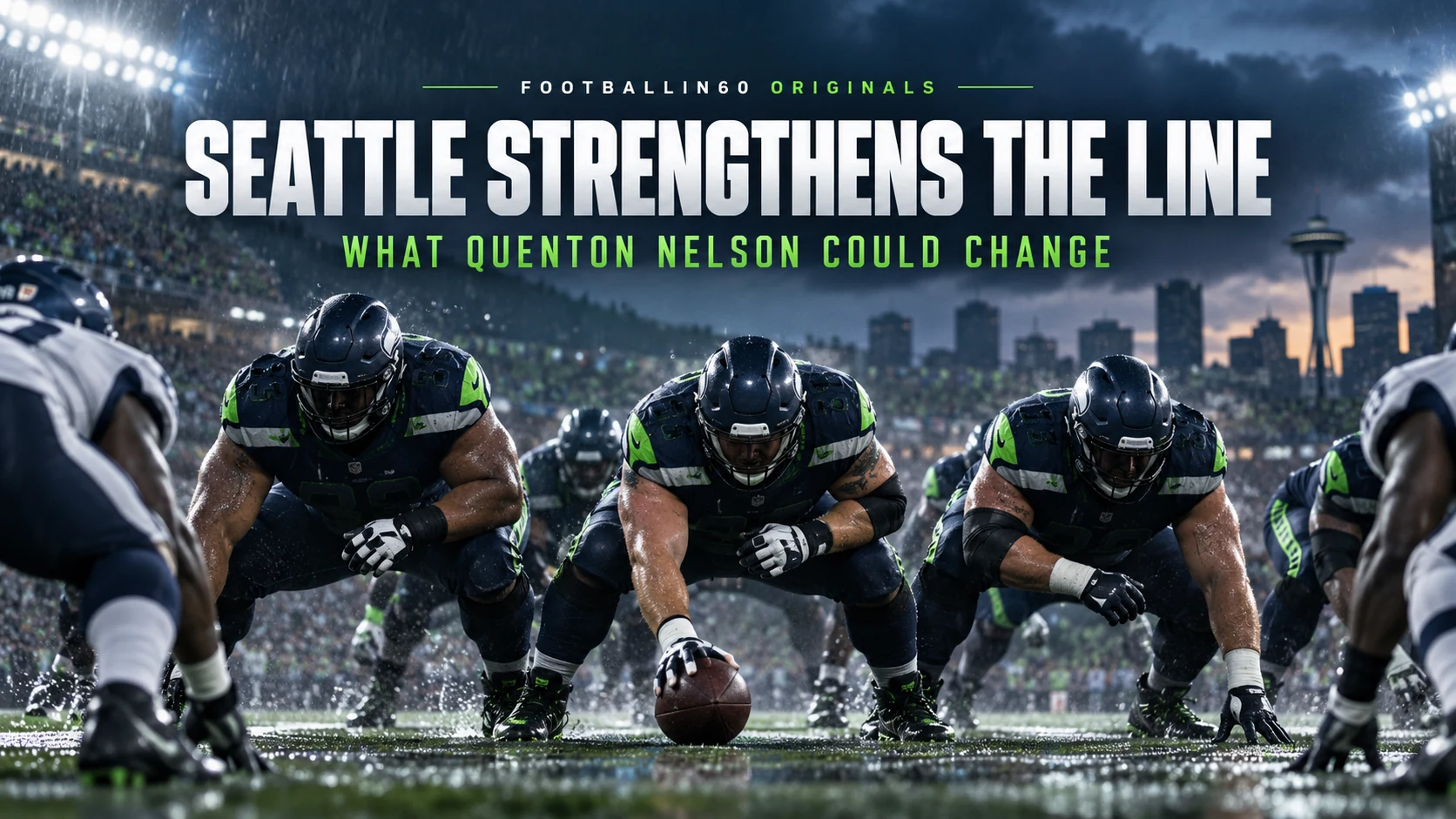
Why Seattle Traded for Quenton Nelson—and What It Means for the Seahawks’ Playoff Hopes
Sportsin60 Originals ·
Seattle’s move for Quenton Nelson addresses the offensive line. What the trade could change—and what it cannot guarantee—for the Seahawks.
Footballin60 Original | October 27, 2026
Seattle is investing in the part of its offence that touches every play. Quenton Nelson could improve protection, strengthen the running game and give the Seahawks more dependable options—but the return will depend on how the entire line works together.
The Seattle Seahawks have announced a trade for Indianapolis Colts guard Quenton Nelson, pending a physical. Seattle is sending a 2027 third-round draft pick and a 2028 fifth-round pick to Indianapolis. [1–2]
It is a significant decision for a team trying to improve its position during the season. The Seahawks are spending future draft capital on an established player whose contribution will be measured in the space other players receive: room for a runner, time for a quarterback and a cleaner route through a difficult down.
The reasoning is straightforward. Improving the offensive line can influence a much larger portion of the playbook than a single highlight suggests.
What Seattle is acquiring
| Part of the deal | Detail |
|---|---|
| Incoming player | Quenton Nelson, a 30-year-old guard |
| Previous team | Indianapolis Colts |
| Compensation | Seattle’s 2027 third-round pick and 2028 fifth-round pick |
| Announcement status | Seattle lists the deal as pending a physical |
| Established position | Left guard during his Indianapolis career |
| Major honours | Three first-team AP All-Pro selections and Pro Bowl honours in each of his first eight seasons |
Sources: the Seahawks, Colts and PFF. [1–3]
Nelson brings an extensive record of starting experience. Indianapolis says he started 136 games during his time with the club. [2]
Experience matters particularly along an offensive line because individual technique operates within a shared assignment. A guard must recognize pressure, communicate with the centre and tackle, and understand when to help a teammate or move to another defender.
Seattle is acquiring a player with a substantial body of work in those responsibilities. The next task is integrating him into a different group.
The pass-protection case
PFF reports that Nelson allowed six pressures in 275 pass-blocking snaps through seven weeks of 2026, with an 81.9 pass-blocking grade. Its analysis places Seattle’s offensive line 19th in team pass-blocking grade over that period. [3]
Those figures explain the attraction, while leaving room for the practical questions that follow any midseason move. Protection also depends on the opposing rush, the quarterback’s decisions, the play design and the communication across the front.
A guard who holds his ground against an inside rush gives the quarterback a more usable pocket. The passer has a better opportunity to step forward, remain balanced and complete the throwing motion.
Pressure through the middle can disrupt those actions quickly. Even when it produces no sack, it can force a hurried release or move the quarterback away from the intended throwing position.
Nelson’s potential value therefore extends beyond preventing a defender from reaching the quarterback. More stable interior protection could help Seattle keep more of its intended passing options available.
A stronger running game could change the shape of a drive
FOX 13 Seattle reports that the Seahawks rank 17th in rushing yards per game and 23rd in yards per carry, averaging 3.9 yards per attempt. [4]
That gives the trade another clear purpose.
A productive run requires coordinated work: the initial block, movement between adjacent linemen, timing at the next level and the runner’s reading of the available lane. Nelson could strengthen one important part of that sequence.
On a double-team block, a guard and teammate must create enough movement while recognizing when one can release toward a linebacker. On a pulling assignment, the blocker needs the right path and timing to meet the defender without closing the runner’s space.
The possible benefit is a more reliable set of rushing options. That matters on ordinary downs as well as obvious short-yardage situations.
An offence that gains useful yards early in a series can reach third down with several credible choices. Repeated unsuccessful runs can leave the passing game facing a defence that knows what is coming.
Seattle should judge the change through the consistency of its rushing plays, alongside the occasional long gain.
Where does Nelson fit?
Nelson’s history at left guard creates an important lineup decision.
PFF identifies moving Grey Zabel to right guard as a possible consequence of the acquisition, with Anthony Bradford’s role also affected. [3] Those are possibilities for the coaching staff to assess, rather than a confirmed starting arrangement.
The best combination will depend on more than identifying the five strongest players individually. Seattle needs players who communicate effectively, pass off pressure and execute the same run concepts together.
A move from one side of the line to the other changes the player’s stance, footwork, visual references and the teammate beside him. An experienced addition can help the group, but the transition still requires preparation.
The staff should use practice to test the combinations it intends to use in games, including responses to movement before the snap and pressure arriving from unfamiliar angles.
The tackle situation still matters
FOX 13 also reports an ankle injury to left tackle Charles Cross. [4] That makes coordination across the left side particularly relevant.
A guard and tackle frequently have connected assignments. They may need to exchange defenders on a stunt, secure an inside threat before moving outward, or recognize when a rushing defender is attempting to create space for someone else.
Stronger guard play can help those exchanges. Seattle still needs sound execution at tackle and a protection plan suited to the available players.
The useful question is how Nelson’s skills change the assignments Seattle can confidently ask the group to perform. His addition should lead to an examination of the whole front, including the help available from tight ends and running backs when a matchup requires it.
Two draft picks purchase an immediate opportunity
A third-round choice has meaningful value. It represents a chance to add a younger player, potentially on a relatively inexpensive contract. The fifth-round selection adds another future opportunity.
Seattle is choosing to exchange those possibilities for help from a known veteran during this season.
That can be a reasonable decision when a team believes a specific weakness is limiting the rest of its roster. It also creates an obligation to make the fit work. The return is smaller if the player cannot settle into a useful role or if the surrounding problems continue to undermine the offence.
Draft-pick compensation is only part of the evaluation. Salary, future contract decisions and the length of the player’s contribution also matter.
The contract question
Associated Press reporting says Nelson can become a free agent in March. [5]
That makes the distinction between a short-term addition and a longer partnership important. Seattle could benefit immediately while retaining a decision about what comes next. A potential extension would require a separate judgment about future performance, health, price and the rest of the roster.
The trade announcement establishes the acquisition and its draft-pick cost. It does not, by itself, establish a new long-term agreement.
For supporters, the questions to watch are whether Seattle pursues an extension, how Nelson fits on the field and how much continuity the club wants to build around that combination.
Why Indianapolis made a different choice
The Colts’ announcement confirms that the organization is converting Nelson into two future selections. NFL.com reports that Indianapolis is 2–5 and recently changed its general manager. [2, 6]
That provides context for a different set of priorities. A team reassessing its direction may place greater value on future flexibility, particularly when an established player is approaching free agency.
Indianapolis also loses the contribution Nelson was supplying. Replacing his snaps and his effectiveness becomes part of the cost on its side of the deal.
Both teams can have a clear rationale. Their eventual results will depend on what Seattle receives from Nelson and how Indianapolis uses the opportunity created by the picks and the roster change.
How to judge the move on the field
The first useful evaluation should cover several games and a range of defensive matchups.
| Area | What improvement would look like |
|---|---|
| Interior protection | A pocket the quarterback can step into more consistently |
| Communication | Cleaner exchanges against stunts and disguised pressure |
| Running game | More usable lanes and fewer plays stopped before they develop |
| Short yardage | Greater confidence in the available blocking combinations |
| Offensive flexibility | More credible options when choosing between a run and pass |
| Lineup stability | A combination Seattle can prepare and use repeatedly |
These are evaluation priorities, not predictions of guaranteed results.
What it means for Seattle’s playoff hopes
The move gives Seattle a plausible way to improve the offence through a position that influences every drive.
Better blocking could support more consistent possession, reduce disruptive pressure and make important downs easier to manage. Those gains can matter in close games, where one failed assignment may end a drive and one successful block may extend it.
Seattle still needs the quarterback to make sound decisions, receivers to finish opportunities, runners to find the available space and the defence to hold up its side of the game.
Nelson’s value will emerge through that larger team performance. If the line becomes more dependable and the offence can use more of its playbook with confidence, Seattle will have a stronger basis for pursuing a playoff place.
That is the opportunity the Seahawks are buying: an experienced player at a foundational position, with the chance to make the players around him more effective.
Sources and further reading
- [1] Seattle Seahawks — Nelson trade announcement, pending physical
- [2] Indianapolis Colts — Trade compensation and Nelson’s career record
- [3] PFF — Nelson’s performance and Seattle’s possible lineup changes
- [4] FOX 13 Seattle — Running-game context and offensive-line considerations
- [5] Associated Press via SeattlePI — Contract and trade context
- [6] NFL Network — The deal and Indianapolis’ position