

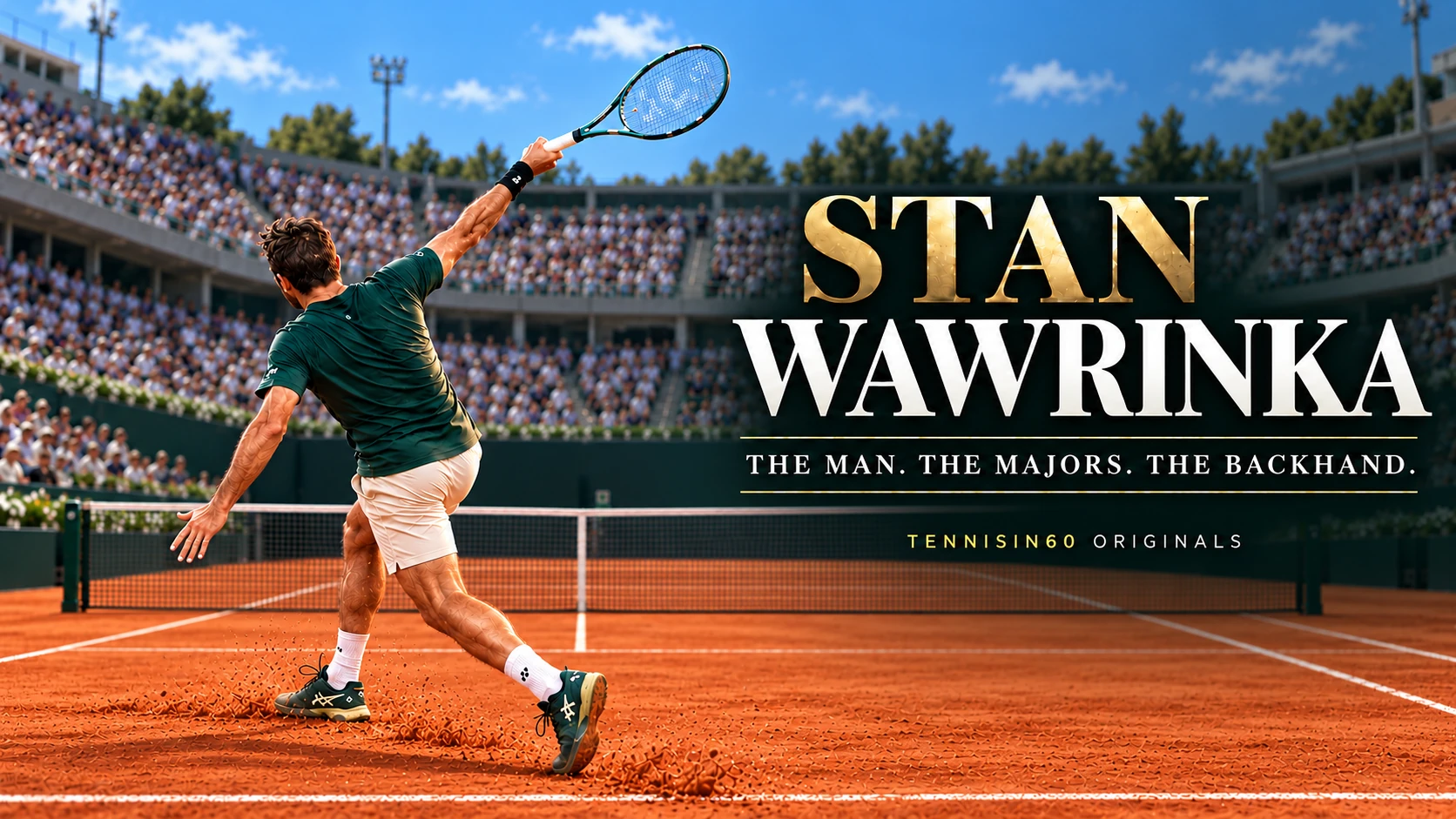
Stan Wawrinka and the Backhand That Helped Beat the Greatest
Tennisin60 Originals ·
A tribute to Stan the Man, his friendship with Roger Federer and a practical coaching guide to the one-handed backhand that helped him win three majors.
Stan Wawrinka’s career will be remembered in two ways: by the championships he won, and by a shot that made people stop watching the score and simply watch the tennis.
Three Grand Slam singles titles. An Olympic doubles gold medal with Roger Federer. A Davis Cup triumph for Switzerland. A career-high ranking of world No. 3. Those achievements place him among the outstanding players of his generation. His one-handed backhand gives him a place in a different conversation: the greatest individual strokes the sport has seen. [1–3]
Fans knew him as Stan the Man, while Stanimal became another enduring nickname. Wawrinka credited Roger Federer with coming up with Stanimal during the 2014 Australian Open. In a 2016 interview, he named it his favourite nickname, saying it captured the attacking, physical character of his game—and that Federer sometimes called him that. [15]
As Wawrinka’s competitive career ends in Basel, the farewell deserves more than a collection of spectacular winners. It is an opportunity to understand the player who built that shot, the friendship that helped shape his journey, and what coaches and players can learn from the way he used it. His separate “One Last Backhand” exhibition farewell is scheduled for December 19 in Geneva. [1][4]
A champion who built his own place in history
Winning major titles during the careers of Federer, Rafael Nadal and Novak Djokovic demanded something exceptional. Wawrinka did it three times, defeating the reigning world No. 1 in every final. [2][4]
| Championship | Final opponent | Why it belongs in his story |
|---|---|---|
| 2014 Australian Open | Rafael Nadal | His first major singles title, at 28 |
| 2015 Roland Garros | Novak Djokovic | A second major, this time on clay |
| 2016 US Open | Novak Djokovic | A third major, confirming his place among the era’s champions |
Sources: US Open and Wawrinka’s official farewell event. [2][4]
The ending of the 2015 Roland Garros final supplied an enduring image: Wawrinka finished the championship with a backhand winner. A stroke that had carried so much of the match became the final expression of it. [9]
These were separate achievements across three seasons and two surfaces. Wawrinka did not need to become the most consistent player of his generation to become one of its most dangerous championship opponents.
The distinction matters. A career should not be judged only by whether someone was better than Federer every week or could match Djokovic’s accumulation of records. Wawrinka found a level of attacking tennis capable of breaking through against those extraordinary standards.
He also won Monte Carlo in 2014, defeating Federer in the final, and accumulated 16 tour-level singles titles. His later years included the difficult work of returning after knee and foot operations. The trophies show his ceiling; the returns to competition show how much playing continued to mean to him. [3]
For developing players, there is encouragement in the timing of his breakthrough. A first major at 28 is a reminder that improvement does not follow one universal schedule. That does not mean every late developer becomes a champion. It means an unfinished game should not be confused with a finished career.
Roger Federer was a rival and a friend
Wawrinka’s relationship with Federer began with an obvious imbalance. One was already setting the standard; the other was learning how to establish himself.
In a 2022 Canal+ interview reported by Tennis365, Wawrinka described Federer’s early support as that of a big brother. Training together, sharing tournaments and representing Switzerland helped turn that relationship into a friendship. Wawrinka’s own summary was simple: “I owe him a lot.” [5]
Their Olympic doubles gold in Beijing in 2008 was a major shared achievement. In an ATP interview years later, Wawrinka still identified it as his first truly big result and emphasized the special experience of being part of the wider Olympic team. [6]
The 2014 Davis Cup added another lasting memory. Wawrinka beat Jo-Wilfried Tsonga in the opening singles, then partnered Federer to beat Richard Gasquet and Julien Benneteau in doubles. Federer secured Switzerland’s first title by defeating Gasquet, completing a 3–1 victory over France. It was a team success to which both men made decisive contributions. [7]
That is the most useful way to understand their connection. Federer helped Wawrinka, but Wawrinka’s greatest achievements were his own. Friendship did not remove rivalry, and admiration did not require accepting defeat.
For coaches, that relationship offers a valuable model. Practising with a better player can raise expectations and expose weaknesses. The objective is eventually to develop enough confidence and understanding to compete on your own terms.
Was his the greatest one-handed backhand ever?
There is a powerful case. Patrick Mouratoglou has ranked Wawrinka’s one-handed backhand above those of Federer, Richard Gasquet, Gastón Gaudio and Gustavo Kuerten. Other assessments place the great one-handers in a different order. There is no unanimous, measurable verdict covering every era and every backhand skill. [8][9]
The strongest argument for Stan is more precise: he has a claim to the greatest attacking one-handed topspin backhand.
That distinction leaves room for other strengths. Slice, return of serve, low-ball handling, transition play and defensive improvisation all belong in a complete assessment. Greatness also depends on what a player needs the shot to do.
Our case for Wawrinka centres on the combination of force and usefulness. His backhand could do more than finish a point. It could sustain pressure, challenge an opponent’s preferred rally pattern and make the supposedly safer side of the court dangerous.
The aesthetic appeal came from the sweep of the stroke. Its competitive value came from what that sweep could produce.
Coaching focus why the shot worked
The following coaching interpretation turns established one-handed-backhand principles into practical applications. The drills are suggested progressions, not a claim to reproduce Wawrinka’s own training programme.
1 Preparation created the time to swing
Top Tennis Training’s analysis identifies Wawrinka’s ready position, early unit turn and prepared hitting position as key strengths. The dramatic acceleration was preceded by organised preparation. [10]
For a player trying to learn from him, the first question is therefore not how hard the racket moves. It is how early the player recognises the incoming ball and begins preparing.
A useful cue is turn while you move. Waiting until the feet have arrived before starting the upper-body turn can leave too much work for the final instant.
Do not interpret “prepare early” as “hold the racket frozen behind you.” The aim is an unhurried sequence that can still adjust to the bounce. If a player appears rushed, examine the beginning of the stroke before changing its finish.
2 The grip supported the intended contact
An eastern backhand grip is a common starting point for a one-handed topspin backhand. For a right-hander, the base knuckle of the index finger sits around the top bevel of the handle. [11]
Wawrinka’s grip is often described as strong or extreme; labels vary between analysts. John Yandell connects that grip style with forward contact and the ability to drive higher balls. [12]
The coaching objective is not to copy a photograph of Stan’s hand. It is to find a grip that lets the player present the strings consistently at a comfortable contact point.
Test it with gentle feeds before adding pace. If the player must make a last-second wrist correction on every ball, the grip, spacing and contact location need to be considered together.
3 Spacing made forward contact possible
The USTA emphasizes that a one-handed backhand meets the ball farther in front of the body, with the hitting shoulder positioned forward. That creates a timing demand: the swing must begin soon enough to reach that contact. [13]
Forward does not mean reaching desperately. A player also needs enough lateral room to extend the arm comfortably.
This is why footwork matters even on a technically beautiful stroke. Too close to the ball, and the swing becomes crowded. Too far away, and balance gives way to a last-second stretch.
For coaching video, use a side view to examine contact relative to the body and a rear view to examine spacing. Judge a series of shots. One attractive frame can conceal a pattern of inconsistent contact.
4 Power came from an organised sequence
A supported base and a coordinated contribution from the legs, trunk and hitting arm help create racket speed. Asking the hand to do everything is a poor substitute for that sequence. [14]
For practice, compare ten comfortable swings with ten harder ones. If extra effort spoils contact and delays recovery, return to the lower speed. The player should earn additional pace while preserving the quality of the ball.
5 The wrist was stable without becoming rigid
Do not confuse racket acceleration with a deliberate wrist flick. A stable hitting structure gives the strings a better chance of meeting the ball predictably. Feel Tennis specifically cautions against flicking the wrist to manufacture topspin. [14]
Stable does not mean a crushing grip. Work at a pace that allows a flowing swing, and avoid forcing the elbow into a locked position to imitate a photograph.
6 The free arm helped organise the finish
The non-hitting hand helps prepare the racket, then releases as the hitting arm accelerates. [11] Its opposite movement can provide counterbalance. A professional’s final pose should not be mistaken for his position through contact: opening up after the hit is different from pulling the chest away early. [14]
The cue is stay organised through contact, then recover. On gentle feeds, check whether the player can finish in balance. In a live rally, follow that balance with readiness for the next ball.
Why the backhand changed the tactics of a point
A backhand becomes a major weapon when an opponent cannot rely on it breaking down.
Our tactical assessment of Wawrinka’s shot begins there. A right-handed opponent may prefer to send repeated crosscourt balls to another right-hander’s backhand. Against an attacking one-hander, that pattern carries a different risk: the rally can become a contest on a side the opponent expected to control.
The next threat is the change down the line. A convincing crosscourt ball can hold an opponent away from the other side. When the player is balanced and the incoming ball allows it, changing direction can take away recovery time.
But the down-the-line shot should be earned. It crosses the higher part of the net and generally offers less court length than the diagonal. Trying it from a stretched, late contact often turns an attacking intention into an unnecessary error.
The lesson from Stan is to develop a backhand strong enough to offer choices. Being able to hit hard is useful. Being able to choose when and where to use that pace is more valuable.
Four drills for a stronger one-handed backhand
These progressions can be adapted to the player’s level. The suggested targets are coaching benchmarks, not universal standards.
Drill 1 Find the contact window
Begin inside the baseline with gentle feeds at a comfortable height. Use a shortened swing and a large central target.
The player’s task is to find repeatable spacing and clean contact without adding speed. Work in sets of ten. When contact becomes inconsistent, simplify the feed rather than demanding a bigger effort.
A coach can occasionally pause the action before the feed and ask the player to show the intended contact position. Then return immediately to a flowing movement.
Drill 2 Build the crosscourt ball
Rally backhand to backhand with a generous target beyond the service line and safely inside the singles sideline.
Count controlled balls reaching that area, rather than counting how hard either player hits. A possible starting target is six successful balls out of ten.
Once that is comfortable, increase depth or pace slightly. Change one demand at a time so the player can identify what caused any loss of control.
Drill 3 Earn the change of direction
Start crosscourt. After three controlled exchanges, the player may change down the line if balanced and comfortably positioned.
Give credit for the decision as well as the outcome. A player who recognises a difficult ball and stays crosscourt has completed the exercise intelligently.
Progress to a live point after the direction change. That exposes another requirement: recovering after an attacking backhand rather than standing to admire it.
Drill 4 Solve the high ball with positioning
Feed a mixture of comfortable and higher-bouncing balls. Ask the player to choose a solution before swinging.
Options include taking the ball earlier with a shorter preparation, moving back to let it descend into a more manageable contact zone, or using a controlled slice when a drive is unsuitable.
Do not reward an attempted winner simply because the feed was difficult. Reward a choice that produces a playable ball and preserves balance. A complete backhand includes knowing when to change the shot.
What to borrow from Stan and what to adapt
Borrow the commitment to preparation, the willingness to build a reliable crosscourt ball and the confidence to attack an appropriate opportunity.
Adapt the size of the swing, the depth of the turn and the amount of pace to the player in front of you. A club player under time pressure may need a more compact preparation than a professional has on a comfortable rally ball.
Nor does admiring Wawrinka mean that every junior should switch to one hand. The right choice depends on the individual’s strength, coordination, comfort and ability to manage incoming pace and bounce.
The coaching goal is a backhand that helps the player compete. A resemblance to Stan is a bonus.
A legacy that will remain on practice courts
Wawrinka leaves a career that stands securely on its own: major championships, a partnership with Federer that produced national triumphs, and years of work beyond his most celebrated period.
Yet his influence will also survive in ordinary moments: a coach asking a player to prepare earlier, a young one-hander learning to trust the crosscourt rally, or a spectator recognising the shape of a backhand before the ball has landed.
Calling it the greatest is a defensible opinion. Understanding why it was great is more useful.
It combined a beautiful movement with a serious competitive purpose. Wawrinka showed what could happen when a player developed that movement far enough—and trusted it when the opponent across the net was one of the greatest in history.
Coaching guidance is general and should be adapted to the player. The greatest-ever assessment is editorial opinion. Banner artwork is an AI-generated illustration, not a photograph of a match.
Sources and further reading
- [1] ATP — Wawrinka retirement career gallery
- [2] US Open — Wawrinka’s three major titles and final opponents
- [3] ATP — Wawrinka career biography and injury comebacks
- [4] One Last Backhand — official Geneva farewell event and career milestones
- [5] Tennis365 — Wawrinka’s Canal+ comments about Federer’s friendship
- [6] ATP — Wawrinka reflects on Olympic gold with Federer
- [7] ITF Davis Cup — Switzerland’s 2014 title victory
- [8] Mouratoglou — Wawrinka and the greatest one-handed-backhand debate
- [9] Tennis.com — ranking great one-handed backhands
- [10] Top Tennis Training — Wawrinka’s preparation and backhand structure
- [11] USTA — high-school coaching manual, one-handed backhand
- [12] John Yandell, Tennisplayer — Wawrinka’s backhand grip, stance and contact
- [13] USTA — one-handed-backhand contact and timing
- [14] Feel Tennis — one-handed-backhand technique
- [15] Tennis.com — Wawrinka credits Federer with the Stanimal nickname