

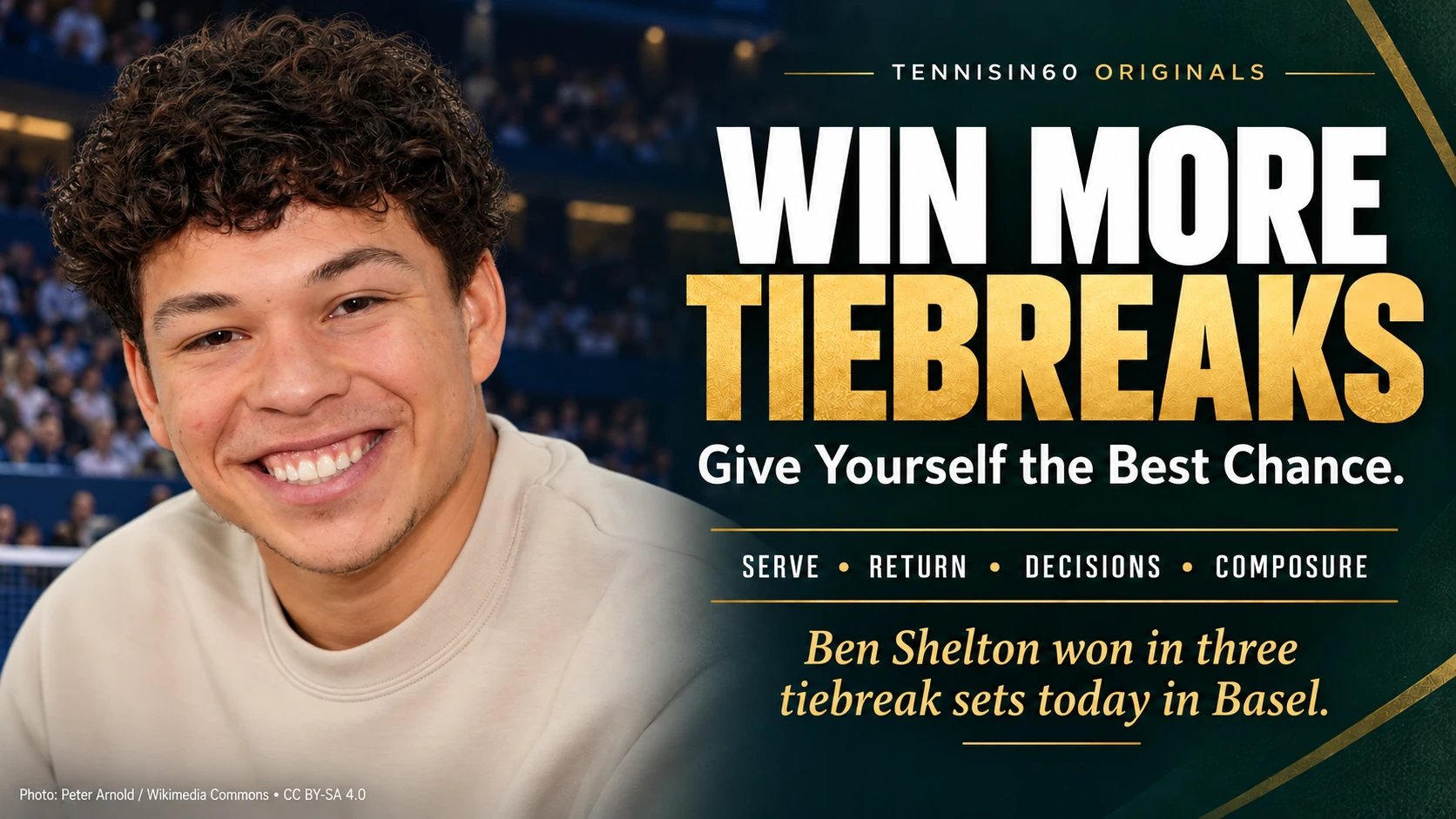
Win More Tiebreaks and Give Yourself the Best Chance
Tennisin60 Originals ·
Ben Shelton’s three-tiebreak victory in Basel opens a coaching guide to serving, returning, decision-making and handling the pressure of decisive points.
Ben Shelton’s first-round win in Basel offered a dramatic example of how little can separate two tennis players. He beat Aleksandar Kovacevic 6–7(4), 7–6(3), 7–6(4): three sets, three tiebreaks and a match decided without a break of serve. TennisNow reported 44 aces from Shelton. [1]
For anyone who has played a nervous tiebreak, the obvious question is what makes the difference. Is it mental strength? A better serve? The ability to win the biggest points?
The most useful answer brings those things together. A successful tiebreak depends on the skills available to you, the decisions you make and your ability to keep executing when the score becomes uncomfortable. There is also uncertainty: even a well-played point can be lost.
How unusual are three tiebreak sets?
One tiebreak is familiar. Having every set of a best-of-three match reach 6–6 is much less common.
Tennis Abstract describes roughly one in five ATP singles sets as reaching a tiebreak, with substantially higher rates for some dominant servers. That is a broad benchmark, not a measured frequency for matches containing exactly three tiebreaks. [2]
There are two requirements: both opening sets must reach tiebreaks and be shared between the players, then the deciding set must reach another. A match can contain two tiebreak sets and still finish in straight sets.
It would be misleading to turn a general per-set average into an exact match frequency. The sets within one match are not independent: the same servers, returners and conditions continue into the next set.
Nor does a 7–6 set necessarily mean nobody broke serve. Players can exchange breaks before reaching 6–6. The absence of breaks was a feature of this particular Shelton–Kovacevic match, not a rule about tiebreak sets. [1]
Winning big points describes the result
Saying that someone won because they played the big points better can be accurate, but it does not explain how they did it.
A coach needs a more useful question: what was different about those points?
Did the server find a reliable location? Did the returner put a difficult serve back into play? Did someone select a sensible attacking ball? Did a player rush a second serve or attempt a change of direction from a poor position?
Those questions identify actions that can be trained. “Be mentally tougher” is much harder to turn into a practice session.
The score does change the consequence of a point. At 5–5, the next point guarantees that one player will have set point. The opening point cannot immediately create that situation. Yet both should receive the same quality of preparation.
The goal is to recognise importance without allowing it to change a dependable stroke into a different movement.
The serve matters but placement comes first
Shelton’s explanation after the match was instructive. He described working on accuracy and targeting locations rather than chasing additional speed. [1]
That is a valuable principle at club level, too. An effective serve does not have to be an ace. It can produce a stretched return, an awkward contact or a predictable reply that lets the server use a stronger next shot.
Before serving, choose both a location and a likely follow-up. Against a particular opponent, that might mean a body serve followed by a forehand into space. In another matchup, a wide serve may create the better first ball.
The pattern must fit the opponent and the serve you actually possess. Copying a professional’s target is of limited use if you cannot deliver that ball with reasonable reliability.
Avoid two common reactions to pressure: swinging harder than usual to escape the rally, and slowing down so much that the serve becomes easy to attack. Use the rhythm and action you have practised.
A return in play can be a valuable attack
When both players are serving well, the returner may receive very few comfortable opportunities.
The USTA recommends distinguishing first-serve and second-serve returns. Against a strong first serve, use higher-percentage targets: crosscourt off a wide delivery, or toward the middle against a body or T serve. A second serve can offer a chance to take ground and return with controlled aggression, depth and spin. [3]
For a tiebreak, this becomes a practical decision: what return gives you the best chance of competing in the next shot?
A blocked return that lands deep can achieve more than a spectacular attempt that misses. But simply floating every return short can leave the server in control.
Choose a clear target and a manageable swing. When a genuine opportunity arrives, be ready to take it.
Is it mainly mental?
The mental side is important because pressure can interfere with familiar skills.
A player may tighten the grip, rush the preparation, become preoccupied with the outcome or start consciously controlling movements that normally flow. The practical aim is to preserve useful attention: the serve target, the incoming ball, the intended pattern and the next action.
A consistent between-point routine gives that attention somewhere to go. The USTA recommends developing a serving ritual and using it regardless of the score. [4]
A simple sequence is to release the previous point, take a comfortable breath, decide on a target and commit. It should fit within the time allowed and remain natural to the player.
You do not need to feel completely calm before you can play a good point. You need a plan you can execute while feeling some tension.
Positive tennis does not mean smaller targets
Some players become passive in tiebreaks and wait for mistakes. Others decide that being brave means aiming closer to the lines.
A better approach is positive intent with appropriate margin.
Use your strengths to create an advantage, but recognise which incoming balls allow an attack. A balanced short-ball opportunity and a stretched defensive contact should not produce the same decision.
If the crosscourt exchange is working, continue using it until a suitable opening appears. A down-the-line change should be chosen because the situation supports it, not because the score has made patience uncomfortable.
Do not confuse a mini-break with the outcome
A mini-break is simply a point won by the receiver.
Its importance depends on the score and the service sequence. Before reacting to a deficit, check who serves next. A player about to serve twice faces a different immediate task from one about to receive twice.
Being behind is information, not an instruction to abandon the game plan.
Likewise, a lead does not require protecting the score with a series of tentative shots. Continue preparing the next point and making decisions appropriate to the ball.
What research can tell us
A study covering 535 US Open tiebreaks and 6,380 points found that winners performed better in first-serve, serve-placement and net-approach measures. Point outcomes also depended on contextual factors, including who was serving and the score situation. [5]
Those findings are associations rather than proof that one tactic causes victory. They certainly do not mean that every player should rush the net on important points.
They do reinforce a useful coaching perspective: tiebreak performance involves observable tennis actions as well as emotional control.
Practise the situation rather than only the strokes
A player who practises relaxed serving all week may be poorly prepared for serving at 5–5 in a tiebreak.
Try these coaching progressions. Adapt the difficulty to the player, and assess the quality of decisions alongside the result.
| Practice | Main purpose |
|---|---|
| Start at 4–4 and play a normal tiebreak to completion | Rehearse an immediately consequential score |
| Alternate who serves the opening point of each practice tiebreak | Experience different service sequences |
| Identify a serve-plus-one plan before serving | Connect placement with the next shot |
| Choose a first-serve or second-serve return plan | Practise recognising the opportunity |
| Replay a difficult point after discussing the decision | Learn from the choice without treating one miss as a diagnosis |
Keep the scoring genuine: first to seven, with a two-point margin. A 4–4 practice start does not mean stopping automatically at seven if the score becomes 7–6.
Record a few useful measures: double faults, returns put in play, whether the intended serve target was attempted, and errors in the opening exchanges. These provide more coaching information than the win-loss record alone.
Over several sessions, ask whether the player is becoming more dependable in the situations they can control.
What Shelton’s win can teach the rest of us
Shelton lost the first tiebreak and still won the match. That matters. One lost breaker does not establish that a player lacks nerve or cannot handle the occasion. [1]
A sound tiebreak plan is built before the pressure arrives: a reliable serve, a realistic return target, a trusted rally pattern and a routine that helps the player prepare again.
Give yourself the best chance by making those actions repeatable. You cannot guarantee the next point, but you can improve the preparation and decisions you bring to it.
Coaching recommendations are general and should be adapted to the player. The banner’s “today” caption refers to October 27, 2026. Its archival player-card portrait was photographed in 2025.
Player-card photo: Peter Arnold / Wikimedia Commons, CC BY-SA 4.0. Archival portrait from October 18, 2025; cropped and adapted into this banner. Banner adaptation shared under CC BY-SA 4.0. Match caption refers to October 27, 2026.
