

A concussion can begin with a spectacular collision that everyone in a stadium sees. It can also begin with a routine-looking fall, an elbow during a rebound, a goalkeeper’s collision with a forward, or a body check that sends the head moving sharply without a direct blow to it. The athlete may stay conscious, stand up and insist on continuing. None of those reactions establishes that the brain is uninjured. The difficult part is often recognizing an injury that has no visible cast, wound or reliable instant test. [1, 2]
For supporters, the question is usually when a player will return. For the athlete, the consequences can extend well beyond the next game: struggling to read a classroom page, tolerating a noisy restaurant, sleeping normally, driving safely or trusting their balance. Most people improve, but some experience prolonged symptoms, and some careers end. Repeated exposure to head impacts also raises separate concerns about brain health years after competition. These are connected subjects, but they are not interchangeable diagnoses. [3, 4]
This article examines the sports in which concussion is most prominent, how major competitions respond, what recovery involves and why experiences differ so widely. It includes athletes who returned and athletes whose playing careers were curtailed, with a dedicated discussion of children and teenagers. The central principle is straightforward: recognize a possible concussion, remove the athlete from risk, obtain medical assessment and use an individualized recovery plan. A league’s minimum absence, a famous player’s comeback or an expensive helmet cannot substitute for that process. [5]
This is an educational feature, not an individual treatment or clearance plan. Protocol summaries refer to the named public documents and seasons below; local rules may be stricter or change. Historical athlete examples describe reported events, not an assessment of anyone’s current health.
What a concussion actually is
Concussion is a traumatic brain injury caused by forces transmitted to the brain. An impact can alter brain function without producing the structural changes that routine imaging is designed to detect. Problems may involve thinking, balance, vision, emotion, sleep and tolerance of exertion. Calling the injury “mild” describes its classification within traumatic brain injury, not a guarantee that its consequences will be mild for the person living with it. [1, 4]
The familiar image of being “knocked out” is therefore misleading. An athlete can have concussion without losing consciousness. Symptoms can emerge or evolve after the incident, so an apparently reassuring first conversation is not the end of observation. A player who initially answers questions correctly but later becomes foggy or dizzy needs reassessment. The injury is a process to monitor, rather than a single moment to pronounce safe. [2]
Concussion assessment is clinical. A qualified professional combines the injury history, symptoms, examination and relevant testing. A CT scan may be needed when there is concern about bleeding or another dangerous injury, but a normal scan does not establish that there is no concussion. Equally, every headache after a collision is not automatically concussion: neck injuries, migraine and other conditions can overlap. The task is to assess the whole person rather than attach a label from one isolated symptom. [4, 6]
Structured tools help organize that assessment. SCAT6 is intended for use by healthcare professionals with athletes aged 13 and older, with a separate child tool for younger athletes. It is not a standalone diagnostic or clearance test. A normal score must not overrule a concerning history or examination, and an athlete should not rehearse answers as if passing a school examination would demonstrate recovery. [7]
For a coach, this distinction defines the job. The coach recognizes a problem and initiates removal and referral. The coach does not need to prove a concussion before acting, and should not attempt to clear a player by asking the score, checking pupil size or watching a short sprint. In an uncertain situation, withholding exposure while arranging assessment is a protective decision, not a final diagnosis. [8]
The signs that should stop participation
Observable warning signs can include appearing dazed, moving awkwardly, losing balance, responding slowly, forgetting instructions or behaving unusually after an impact. The athlete may report headache, nausea, dizziness, light sensitivity, visual disturbance or feeling mentally slowed. Sleep and emotional changes can follow. Symptoms do not need to appear in every category, and a person need not look visibly ill for the problem to interfere with everyday function. [2, 9]
Some findings require emergency care rather than an ordinary sideline assessment. Worsening severe headache, repeated vomiting, seizure, increasing confusion, weakness, slurred speech, unequal pupils or difficulty waking the person can signal a more serious injury. Neck pain after significant trauma also requires caution. Activate emergency services when serious injury is suspected; avoid unnecessary movement if a cervical spine injury is possible. [10]
A suspected concussion means stopping sport immediately. A diagnosed concussion means no same-day return. At a community game without a qualified professional who can assess the athlete, the answer is not to let the athlete “try a shift” and see how it feels. Inform the responsible adult, arrange assessment and follow the instructions given about monitoring and follow-up. A teammate’s willingness to play is useful information about their motivation, not proof that they are safe. [8]
Which sports have the most concussions
There is no single scientifically defensible world league table covering every sport, age and standard of play. “Most” might mean the greatest number of diagnosed cases, the highest risk during one match, the highest rate per hour, or the greatest cumulative exposure to head impacts. These measures answer different questions. A heavily played sport can generate many injuries even if an individual session carries less risk than a session in a smaller collision sport.
A 2024 overview of systematic reviews identified rugby, snowboarding, ice hockey and American football among the sports with the highest concussion incidence when other differences were not separated. That is a broad signal, not permission to place professional rugby players, recreational snowboarders and school football players on one precise numerical scale. The underlying populations, surveillance and exposure measurements differ. [11]
For a more coherent comparison, consider one U.S. high-school surveillance study covering the 2013–14 through 2017–18 school years. Football had 10.40 concussions per 10,000 athlete-exposures, girls’ soccer 8.19 and boys’ ice hockey 7.69. An athlete-exposure means one athlete participating in one practice or competition; it is not an hour of play. These historical figures illustrate relative risk within that dataset, not today’s exact rates everywhere. [12]
| Sport in the same high-school dataset | Concussions per 10,000 athlete-exposures | How to interpret it |
|---|---|---|
| Football | 10.40 | Highest overall rate in this particular surveillance sample |
| Girls’ soccer | 8.19 | Substantial risk in a sport without routine helmet use |
| Boys’ ice hockey | 7.69 | Collision, falls and the playing environment all matter |
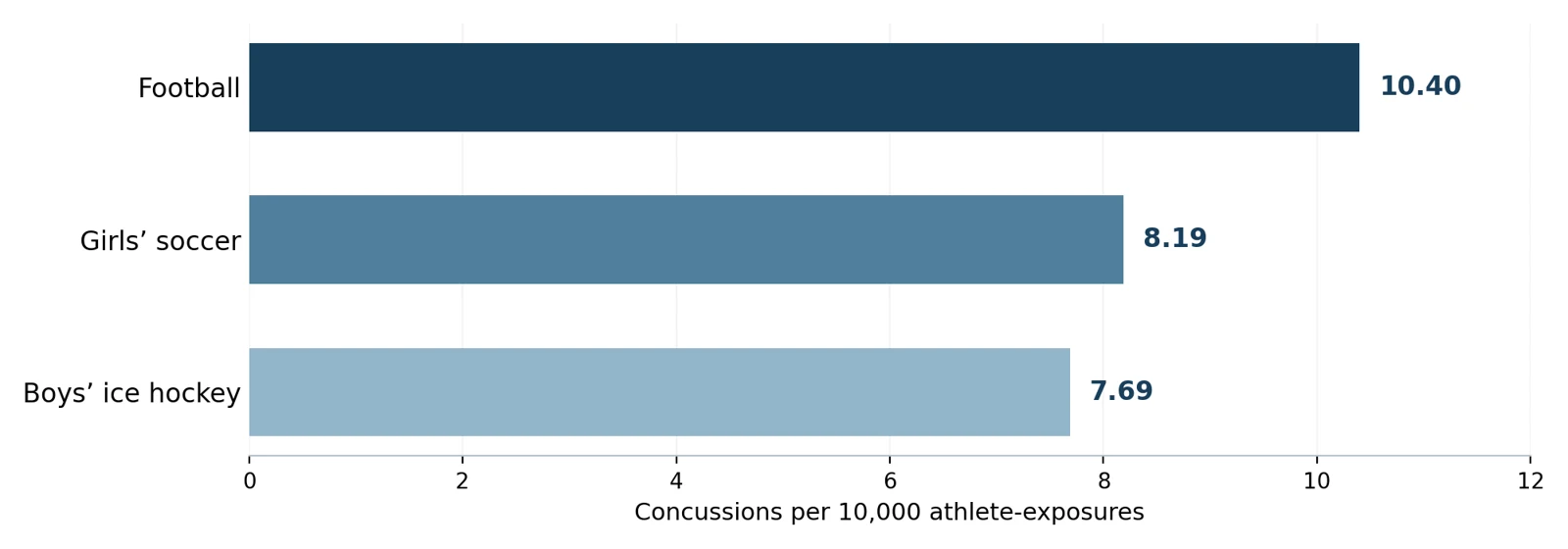
Figure 1. Selected rates from one U.S. high-school study, 2013–14 to 2017–18. One exposure is one athlete in one practice or competition, not one hour. This is not a universal ranking. [12]
A 2025 systematic review of children and adolescents across 28 sports likewise found that collision sports, including rugby, American football and ice hockey, generally carried greater concussion risk than lower-contact sports. Competition risk was markedly higher than practice risk. Yet practices can still contribute substantial total exposure because athletes attend many of them. Reducing unnecessary collisions during training addresses a different part of the problem from improving match-day diagnosis. [13]
Women’s sport must be part of this discussion. In comparable sports in the high-school study, reported concussion rates were higher in girls than boys. A separate review of female youth contact and collision sports identified rugby union as particularly concerning. Differences may involve exposure, rules, biology, reporting and access to assessment; a simple claim that one sex is inherently “fragile” is neither an adequate explanation nor a useful prevention strategy. [12, 14]
Combat sports require special attention because strikes to the head can be part of the contest itself. Counting diagnosed concussions alone may miss the wider burden of repetitive exposure, including sparring. In cycling, equestrian sport, skiing, snowboarding and motorsport, fewer routine athlete collisions do not remove the risk of a high-energy crash. Basketball, baseball, softball, volleyball and tennis also allow falls, balls and accidental collisions to cause concussion. Lower average contact is not zero risk. [15, 16, 17]
The editorial conclusion is therefore to identify high-risk settings and mechanisms rather than publish a misleading universal ranking. For a parent choosing a program, more useful questions are whether body checking or head strikes are allowed, how contact is managed in practice, who notices symptoms and whether medical assessment is accessible. For a league, the relevant question includes whether surveillance is good enough to find injuries that previously went unreported.
What every concussion protocol should accomplish
A protocol is a system of responsibilities, not merely a list of exercises. It should establish who can remove an athlete, who performs assessment, how follow-up occurs, which activities remain prohibited and who authorizes progression. It should also explain how coaches, families and schools receive the information they need. A beautifully worded policy has little protective value if nobody knows who is responsible at an away game. [18, 19]
Across sports, the broad sequence is similar: identify a possible injury, remove exposure, assess, monitor, rehabilitate and authorize a graduated return. Important differences appear in medical resources, substitution rules, mandatory stand-down periods and final clearance authority. A professional athlete may have daily specialist review; a child may wait for a clinic appointment. It is inappropriate to borrow the fastest professional return and apply it to a weekend youth tournament. [20, 5]
The following comparison summarizes major examples. It does not replace any full governing-body document, and a minimum time is a floor, not a recovery prediction. “Evaluation” also differs from “diagnosis”: a player removed for assessment may be found not to have concussion, whereas a player diagnosed with concussion must follow the applicable recovery requirements.
| Sport or setting | Recognition and assessment | Return framework and important qualification |
|---|---|---|
| NFL football | Team medical staff, unaffiliated neurotrauma consultants and spotters help identify and assess suspected injury | Five-phase progression; team physician and independent neurological consultant are involved in final clearance [21] |
| NHL hockey | Removal for suspected concussion, distraction-free assessment and continued evaluation | Individualized rehabilitation and physician-directed clearance; this summary uses the public 2024–25 NHL/NHLPA protocol [22] |
| NBA basketball | Removal, neurological evaluation, video review and monitoring | The public 2025–26 policy prohibits unrestricted participation for at least 48 hours and requires completion of its exertion process [23] |
| MLB baseball | Concussion-specific roster procedures support assessment and time away | Seven-day concussion injured list; seven days does not automatically establish medical recovery [24, 25] |
| Soccer | Recognition, removal and appropriate medical assessment | Graduated return; additional permanent concussion substitutions are permitted where the competition adopts the IFAB procedure [26, 27] |
| Rugby union | Community recognition-and-removal differs from approved elite HIA environments | World Rugby community guidance specifies at least 21 days before return to play; approved advanced-care pathways have distinct requirements [20, 28] |
| Australian football | Removal and clinical management under competition rules | AFL/AFLW advanced-care settings retain a minimum 12-day protocol; community and junior competitions use a minimum 21-day framework [29] |
| Boxing and MMA | Ringside assessment and stopping a contest when concussion is suspected | Medical suspensions and graded recovery; commission rules differ and sparring must be addressed too [15] |
| U.S. college sport | Institution-specific plans within NCAA requirements | Medical management, academic support and documented return procedures; checklist resources were updated in June 2026 [18] |
| Canadian community hockey | Recognition, removal, assessment and communication | Hockey Canada’s policy effective May 6, 2025 supports staged return; confirm the applicable member-association implementation [19] |
How the rules work in different sporting environments
Football and the need for independent decisions
The NFL’s published protocol uses a five-phase return process: symptom-limited activity, aerobic exercise, football-specific exercise, non-contact training and full football activity/clearance. Progression is individualized. The game-day system includes personnel who are not simply the coaching staff’s advisers, and final clearance includes an independent neurological review. The objective is to make identifying injury and authorizing return medical decisions rather than tactical ones. [21]
For readers, the crucial point is that being “in protocol” is not a diagnosis of a particular severity. Nor does leaving protocol mean the athlete has acquired protection against future concussion. It means the specified assessment and return requirements have been satisfied at that time. Fans should avoid treating the number of missed games as a reliable measurement of how badly someone was hurt.
Canadian football also has its own governance. The CFL and CFLPA have previously announced concussion-related measures including access, on request, to an independent second opinion following diagnosis. That historical example should not be mistaken for a complete statement of the current CFL medical manual. A Canadian club needs to apply its actual league and local requirements, rather than assume that an NFL television explanation covers its players. [30]
Hockey and injuries that unfold after the first shift
The public NHL/NHLPA 2024–25 document requires education, baseline testing and removal when concussion is suspected. Its assessment system includes neurological and vestibular/ocular considerations, while diagnosis and return decisions remain the club physician’s responsibility. It recognizes individualized management rather than a universal fixed number of days away. Readers should check the applicable season’s protocol before treating a detailed procedural point as current. [22]
At recreational and junior levels, the practical lesson is to be prepared before the incident. The person running the bench should know who contacts the parent, where the nearest appropriate medical service is and how the next coach receives the participation restriction. A player should not be removed on Saturday and unknowingly placed in contact practice by another team on Sunday. The injury record must travel across those environments. [19]
Basketball and baseball
The NBA’s 2025–26 summary specifies a minimum 48-hour restriction on unrestricted participation following diagnosis, together with an exertion process that progresses through activities such as cycling, jogging, agility work and non-contact drills. Completion is not automatic when the clock reaches 48 hours. The team physician’s clearance must align with the league program’s review requirements, including a process for resolving disagreement. [23]
That distinction matters in a sport with frequent games. Missing one contest, two contests or a week can reflect scheduling as well as clinical progress. A back-to-back series makes games missed an especially poor biological clock. The meaningful milestones are symptoms, examination, activity tolerance and clearance, not the number of ticketed events that occurred while a player was absent.
Baseball’s seven-day concussion injured list is similarly easy to misread. It is a roster mechanism, not a statement that the brain heals in seven days. Public MLBPA paperwork documents the diagnostic information needed for placement. Catchers, hitters and fielders face different exposure situations, so protecting the athlete also requires attention to foul tips, pitches, slides and collisions. A concussion is not less important because baseball is not usually classified alongside football as a collision sport. [25, 31]
Soccer and rugby
Soccer’s additional permanent concussion-substitution option addresses a competitive pressure: a team should not have to choose between removing a potentially injured player and preserving an ordinary substitution. Its availability depends on the competition’s rules. It does not make a quick touchline conversation an adequate medical examination, and the player still needs appropriate follow-up and a graduated return. [26, 27]
Rugby’s Head Injury Assessment system applies in approved, medically supported environments. It includes immediate and later assessments; obvious concussion signs require permanent removal. A player with confirmed concussion is not cleared simply because an initial screen was reassuring. Community rugby uses recognition and removal without treating the elite HIA arrangement as permission to return a suspected case to the field. [28, 32]
World Rugby’s August 2024 guidance sets a minimum 21-day return-to-play interval for adults outside its advanced-care exceptions. Elite pathways can differ, including specified longer absences for players with relevant histories or visible signs. National unions may impose stricter rules. These differences are precisely why a newspaper should label the setting beside any minimum time rather than publish “rugby concussion equals 12 days.” [20, 33]
Combat sports and racing
The Association of Ringside Physicians recommends minimum suspensions of 30 days after a head-strike TKO, 60 days after a head-strike knockout without loss of consciousness and 90 days after a knockout with loss of consciousness. These are professional consensus recommendations, not a claim that every commission uses identical rules. Recovery and specialist assessment remain necessary, and returning to sparring can be as consequential as returning to a bout. [15]
Motorsport illustrates a different challenge. An athlete may be seated and protected by sophisticated equipment yet still need excellent vision, balance, reaction and tolerance of motion. Dale Earnhardt Jr.’s treatment experience, described by UPMC, shows that rehabilitation can address difficulties that are not visible while someone is simply sitting in an interview. Being able to chat comfortably is not the same task as managing a race car at speed. [34]
Recovery is a sequence of milestones
The first milestone is safety: exclude an emergency, prevent another injury and establish follow-up. The next is restoring ordinary function, then controlled exertion, then sport demands. A person can make meaningful progress in one domain while still needing support in another. Walking comfortably does not prove readiness to absorb contact, and tolerating a quiet classroom does not prove readiness for crowded changing rooms and rapid visual tracking.
There is encouraging evidence about the usual course, but no universal countdown. A systematic review reported a pooled mean return-to-sport time of approximately 19.8 days, with very large differences between studies. That number describes groups across research settings; it does not identify the correct return date for a particular athlete. It must also be separated from the date symptoms first improved or the date school resumed. [35]
CDC guidance advises follow-up when symptoms persist beyond approximately two to four weeks, with referral as appropriate. Some athletes need a longer course of targeted treatment. Having symptoms at that point does not establish permanent injury, nor should it be dismissed as poor motivation. It means the recovery plan and possible contributing problems deserve reassessment. [36, 37]
| Period or milestone | What recovery may involve | What it does not mean |
|---|---|---|
| Injury day | Stop sport, assess urgency and arrange medical evaluation | No visible injury does not mean no brain injury |
| First 24–48 hours | Relative rest, ordinary low-demand activities and clinician-guided limits | Not prolonged isolation in a dark room [5, 38] |
| Early days | Carefully increase school, work and low-risk activity as tolerated | Some tolerated activity is not permission for contact [39, 40] |
| Following weeks | Progress through exercise and sport-specific rehabilitation | A group average or minimum stand-down is not personal clearance [41, 35] |
| Symptoms beyond 2–4 weeks | Reassess; consider relevant specialist or interdisciplinary care | Not automatic proof of CTE or lifelong impairment [36, 37] |
| Unrestricted sport | Meet clinical, exertional and governing-body requirements | Not a guarantee against a future concussion [41] |
Relative rest and a return to movement
Older advice sometimes encouraged athletes to avoid almost everything until symptoms disappeared. Modern evidence supports a different approach. A systematic review found that early light activity and prescribed aerobic exercise below the symptom-exacerbation threshold can facilitate recovery. This is controlled rehabilitation with low injury risk, not permission to run through severe symptoms or rejoin an unpredictable practice. [38]
In a randomized trial of 103 adolescents, those assigned individualized subthreshold aerobic exercise had a median recovery of 13 days, compared with 17 days in a stretching group. That result supports a supervised exercise approach for suitable patients; it does not establish a four-day benefit for everyone or a home exercise prescription applicable to every head injury. The participants were assessed and the intervention was structured. [42]
A useful way to understand the change is that “rest from danger” and “rest from all activity” are different instructions. The athlete may need to avoid checking, heading, sparring, falls or high-speed driving while still participating in carefully selected rehabilitation. A treatment plan should make those permissions explicit so the family does not interpret one permitted walk as permission for any activity that feels manageable. [38, 39]
The six-step return to sport
CDC’s familiar progression begins with return to regular activities, followed by light aerobic activity, moderate activity, heavy non-contact activity, practice/full contact and competition. Healthcare supervision and approval are essential. Each step typically takes at least 24 hours, and symptoms during progression require stopping and contacting the treating professional about the next step. A step is not a box to tick simply because another day has passed. [41]
The practical value of stages is that they test different demands. An individual run, a reactive drill and a full practice are not equivalent. Coaches need to know whether an instruction authorizes solo work, controlled team drills or actual contact. Using the vague phrase “back training” can obscure those differences and lead teammates to introduce an unexpected challenge before the athlete is cleared for it.
When recovery needs targeted treatment
A persistent headache, dizziness and difficulty reading may be described together as “concussion symptoms,” but they need not all respond to the same treatment. Reassessment asks which systems are contributing and whether another condition coexists. Good rehabilitation converts a broad complaint into practical goals: reading for a class period, walking through a supermarket, sleeping consistently or completing an appropriate exercise session. [37, 43]
Headache and neck symptoms
Post-traumatic headache can resemble different headache patterns, and neck injury can contribute to pain. The Living Concussion Guidelines recommend assessing the headache’s characteristics rather than assuming one treatment fits every patient. Clinicians also consider medication use, other pain and associated symptoms. Repeatedly taking medication to force a workout can conceal a problem rather than establish readiness. [44]
For the athlete, a simple record can make appointments more useful: when symptoms occur, what activity preceded them and how long they last. This is not an invitation to diagnose the pattern alone. It helps the clinician distinguish a headache associated with reading, exertion, poor sleep or neck movement and decide what needs examination. The treatment goal is reliable function with an appropriate plan, not merely getting through a single session.
Dizziness balance and vision
Persistent dizziness may warrant vestibular assessment and rehabilitation; visual complaints need appropriate evaluation rather than a generic assumption that the athlete “just needs new glasses.” The Ontario guideline discusses individualized management of vestibular and visual problems. Busy environments, head movement and reading can challenge different functions, so a successful balance task in a quiet room may not settle the whole problem. [43]
A small randomized trial of patients with prolonged dizziness, neck pain or headache found that combined cervical and vestibular rehabilitation improved medical clearance within eight weeks compared with the control program. The study supports targeted treatment in an appropriate group, not a universal claim that physiotherapy cures every concussion. Its small sample also argues against treating its percentages as a prediction for an individual patient. [45]
Sleep mood and cognitive function
Sleep problems deserve active attention. Increased sleep needs early after injury can differ from persistent insomnia, and other sleep disorders may coexist. The Living Concussion Guidelines recommend screening and treatment rather than accepting disrupted sleep as an unavoidable waiting period. Clinicians may investigate problems such as sleep apnea when indicated. “The athlete looks tired” is a starting observation, not a complete explanation. [46]
Mental health care belongs within recovery. Anxiety, depression, adjustment problems and prior mental health conditions can affect how someone feels and functions. Assessment should consider the person’s history and current circumstances, with appropriate treatment for an identified disorder. Psychological care does not invalidate a physical injury; it addresses a real part of health that can otherwise obstruct recovery. [47]
Cognitive difficulties may involve attention, memory, processing speed and organization. Pain, fatigue, poor sleep and mood can compound them. Occupational therapy, speech-language therapy or neuropsychological assessment may be appropriate when problems persist. Practical supports should match the task that is difficult rather than rely solely on a global statement that the athlete’s “brain score” improved. [48]
For example, a student who can complete ten minutes of reading may still struggle with a three-hour examination. An employee may manage individual tasks but become overwhelmed by interruptions. Those examples show why recovery should be assessed in context. An athlete’s apparent confidence during a medical conversation may coexist with difficulties across a long school or work day.
Treatments that promise too much
A worried family may be offered supplements, devices, scans or expensive programs that claim to reveal hidden brain damage or speed recovery. Before paying, ask what exact problem the treatment addresses, what evidence applies to the athlete’s age and condition, how progress will be measured and whether the provider coordinates with the treating clinician. A testimonial from a famous player is not a substitute for controlled evidence.
This article does not endorse a product or a universal treatment package. Where the evidence supports exercise, rehabilitation or symptom-directed care, it also supports matching the intervention to the patient. A clinic should be able to explain why a recommendation fits the assessment, what remains uncertain and when another opinion would help. That is a reasonable expectation of care, especially when recovery is prolonged.
Athlete stories show several possible futures
Famous cases help make concussion visible, but they are not controlled experiments. Public reports rarely reveal the full medical record, and historical management may differ substantially from present recommendations. The following examples distinguish actual playing absence, formal retirement and decisions to reduce future exposure. None should be used to tell a junior athlete how quickly they ought to recover.
| Athlete and sport | Reported history or interval | What the example illustrates |
|---|---|---|
| Sidney Crosby — hockey | Injured in January 2011; returned November 21, then had another extended absence before returning March 15, 2012 | A comeback may have setbacks; later elite success does not make the original injury minor [49] |
| Justin Morneau — baseball | July 7, 2010 concussion; next regular-season game April 1, 2011 | A return across an offseason is not the same as continuous missed playing time [50] |
| Ali Krieger — soccer | Returned after an April 2015 concussion and subsequently continued her career | Return can be successful; another player’s outcome is not a personal prognosis [51] |
| Dale Earnhardt Jr. — motorsport | Missed the latter part of 2016, returned to Cup competition in 2017 and later ended full-time Cup racing | Recovery and a later career decision need to be described separately [34, 52] |
| Paul Kariya — hockey | Missed 2010–11 and announced retirement in 2011 after concussion problems | Some athletes do not regain a sustainable playing return [53] |
| Marc Savard — hockey | Last played in January 2011; formally announced retirement in January 2018 | The last game and retirement announcement can be years apart [54] |
| Taylor Twellman — soccer | Ongoing problems following a 2008 collision; announced retirement in November 2010 | A prolonged attempted recovery can ultimately end a playing career [55] |
| Briana Scurry — soccer | A 2010 concussion ended her playing career; she describes a lengthy recovery | Long-term symptoms can affect life far beyond the field [56] |
| Cindy Parlow Cone — soccer | Retired from international play in 2006 citing post-concussion syndrome | Female athletes are central to concussion history, not an afterthought [57] |
| Chris Borland — football | Retired in 2015 after one NFL season because of concern about repetitive head trauma | Electing to reduce future risk is different from being unable to recover from a current injury [58] |
Returning does not always follow a straight line
Crosby’s 2011–12 history is a particularly useful antidote to simple comeback narratives. After the initial lengthy absence, he returned, then experienced another interruption before a more sustained return. The public timeline includes months when no game was possible and a short stretch when playing was possible again. Labeling the whole story either “ten months out” or “recovered in November” misses part of it. [49]
The lesson is not that an early return inevitably fails. It is that participation is an outcome to monitor, and that a return date does not describe every subsequent clinical development. A player can meet a set of requirements and later need reassessment. Accurate coverage should preserve that uncertainty rather than turn a first appearance into a declaration that all future risk has disappeared.
Morneau’s regular-season return came the following year after his concussion. That interval includes baseball’s offseason, so it should not be presented as nine continuous months of missed games. [59] This distinction matters whenever journalists compare rehabilitation across sports. A hockey playoff absence, a summer recovery and a return at the next season opener are different calendars.
Krieger is another documented example of continuing after concussion. Her story also appeared in discussion of protective headbands, but her individual return cannot establish that a particular product prevented future injury. [51, 60] Product effectiveness requires comparative research. It is easy for an advertisement to join two true events—an athlete wore equipment and continued playing—and imply a causal conclusion that those events alone cannot support.
Earnhardt’s experience also needs careful language. UPMC describes his concussion assessment and rehabilitation, while his public explanation of retirement acknowledged that injury led him to reconsider priorities without calling it the sole major deciding factor. He returned before leaving full-time Cup competition. It would therefore be inaccurate to reduce his story to “concussion meant he could never race again.” [34, 52]
When the playing career ends
Kariya and Savard demonstrate that the absence can become permanent even when an athlete is still identified with a team or remains under contract. Kariya missed a season before retiring. Savard’s formal announcement came long after his final appearance. For readers, the meaningful distinction is between medical absence, the end of actual participation and the administrative announcement. Those dates should never be silently substituted for each other. [53, 54]
Twellman’s retirement announcement and the Revolution’s account of his ongoing health problems document a career curtailed after a collision. His later advocacy gives the story a public purpose, but it does not erase the loss involved. An athlete may need a new role in the sport, while also needing treatment and support that have little to do with continuing as a competitor. [55]
Scurry describes the 2010 injury as an event that ended her soccer career and disrupted her life. Her account is valuable because it moves the discussion beyond the scoreboard: the impact of concussion includes ordinary function and personal identity. A recovery story should not require a return to international competition to count as meaningful progress. [56]
Parlow Cone’s international retirement similarly belongs in any balanced account. Concussion has affected decorated women as well as men, across sports with very different equipment and rules. [57] Focusing exclusively on male football and hockey stars risks making parents in other sports feel that the subject concerns somebody else. It also obscures the need for research and medical resources that reflect the people actually participating.
Borland’s decision is distinct. He retired because he was concerned about the long-term consequences of repetitive head trauma, not because a public diagnosis established that he already had CTE. [58] An athlete is allowed to decide that a sport’s remaining risks are unacceptable without waiting for a catastrophic outcome. That decision deserves the same respectful treatment as a medically supported return.
How retirement decisions should be made
There is no universal rule that three concussions means retirement, or that fewer than three means continued participation is safe. A systematic review informing the Amsterdam process found inadequate evidence for a simple set of absolute retirement triggers that could be applied to everyone. Decisions require clinical expertise and consideration of the athlete’s circumstances. A numerical shortcut can be falsely reassuring at one end and unnecessarily rigid at the other. [61]
Relevant discussion may include the pattern of injuries, recovery duration, persisting difficulties, examination findings, exposure in the particular sport and the athlete’s informed preferences. These are conversation topics for qualified clinicians, not a checklist a coach can use to deliver a medical verdict. For a minor, the process also involves parents or guardians and appropriate attention to the young person’s own understanding and wishes. [61, 62]
The decision should have room for questions. What is known about this athlete? What cannot be predicted? Could the person remain active in a lower-contact role or a different sport? What support is available if they stop? A decision made only in the hours before a final can be distorted by the immediate reward of playing. When possible, difficult long-term decisions deserve a setting removed from that urgency.
Retirement from collision exposure need not mean retirement from movement, teammates or ambition. A former player may coach, officiate, train differently or pursue another activity consistent with medical advice. The sport should help preserve those connections. Otherwise, the athlete may experience the recommendation to stop as exclusion from an entire community, making honest reporting and future decision-making harder.
Concussions and junior athletes
Children and teenagers are not simply smaller professionals. Their recovery interacts with learning, friendships, family routines and development. A young athlete may not recognize dizziness as an injury symptom, may struggle to describe feeling “off,” or may fear losing a place on a team. Adults therefore need to observe changes and make reporting easy, rather than require the child to deliver an accurate medical explanation. [39, 63]
The most important message is that reporting is part of looking after the team. A player who speaks up should not be punished with ridicule, accusations of weakness or public questioning about commitment. A coach can establish that culture before anyone is hurt: explain the process, identify the trusted adult and make clear that another athlete can report concern about a teammate. The quality of that response determines whether the next player speaks honestly.
School is part of recovery
CDC guidance notes that many children can return to school within one or two days, with support as needed. That does not mean expecting normal performance immediately. It means avoiding an unnecessarily long absence while adjusting demands to the child’s symptoms and medical advice. The plan should be shared with the people who manage the classroom day, rather than remain between the sports coach and the family. [36, 64]
Adjustments may include reduced workload, extra time, rest breaks or changes to light and noise exposure. The right combination depends on what the student finds difficult. A child who struggles with reading may need a different response from one who tolerates class but finds lunch-hour noise overwhelming. Support should be reviewed and gradually reduced as function improves. A generic note saying “avoid screens” does not answer every classroom question. [40, 65]
Return to school and low-risk physical activity can progress alongside each other. Full return to learning should precede unrestricted contact sport or high-risk participation. That sequencing protects the student’s broader recovery and avoids treating Saturday competition as more important than managing Monday lessons. Existing supports for a pre-existing condition should not be confused with new accommodations needed because of concussion. [40, 66]
One child may have several teams
A school team, travel team, academy and private coach may each know only part of a child’s schedule. A written participation plan needs to reach all of them. It should specify what is allowed, what is prohibited and who updates clearance. Otherwise, one adult may authorize a solo exercise while another unknowingly adds contact, a scrimmage or a tournament. Good intentions do not compensate for missing information.
Parents can help by keeping an organized history of diagnosed concussions, important symptoms, treatment and clearance documents. The purpose is continuity of care, not constructing a frightening tally that predicts the child’s future. A clinician can interpret the record in context; memory alone may be unreliable when injuries occurred across different seasons and organizations. The same approach is useful when a family changes schools or moves to another community. [39, 63]
Reduce exposure before injury occurs
Canadian pediatric guidance and prevention research support changing body-checking exposure in youth hockey. A systematic review reported substantial risk reduction when checking was disallowed in the studied younger age groups. [67, 68] The practical principle is that policy can remove an injury opportunity for every participant. It is generally stronger than relying on each child to identify danger correctly while moving at speed.
In youth football, CDC research found much greater head-impact exposure in tackle than flag football among children aged six to 14. Those were head-impact measurements, not a finding that concussion rates were exactly 15 times greater. [69] The distinction matters, but the result still provides families with relevant information about exposure. Choosing a lower-contact format can be a deliberate sporting choice rather than a rejection of competition.
Youth soccer provides another example. MLS NEXT’s published policy prohibits deliberate heading for players aged ten and younger, and limits practice heading for players aged 11–13. [70] Families must check their actual competition’s rules. Heading restrictions also do not remove player-to-player collisions, falls or dangerous challenges, so they should accompany education, officiating and prompt removal rather than replace them.
A junior program should have a preseason explanation for parents, a named person responsible at each event, a simple incident record and a clear return process. Travel events need the same planning as home games. The system should work when the head coach is absent, a volunteer changes shifts or the family needs an assessment after normal clinic hours. Those are predictable operational situations, not exceptional excuses.
Head protection helps but cannot eliminate concussion
Helmets are essential in many sports because they protect against important head and brain injuries. CDC’s position is also clear: no helmet is concussion-proof. That combination of messages matters. Saying equipment cannot prevent every concussion is not an argument to abandon it; saying equipment has value is not permission to ignore symptoms or expose an athlete to unnecessary impacts. [16]
The purchasing question should begin with the activity: does the equipment meet the relevant standard, fit the individual and remain in appropriate condition? A bicycle helmet is not interchangeable with a hockey helmet, and an item that once fitted a growing child may no longer fit properly. Follow the sport’s and manufacturer’s requirements for replacement and reconditioning, particularly after significant impacts. [16, 71, 72]
| Sport or activity | Role of head protection | Limit that must remain clear |
|---|---|---|
| Football | Properly fitted, approved helmets help protect the head; model performance differs | No model eliminates concussion or replaces safer rules [71, 73] |
| Ice hockey | Correct helmet fit and required facial protection are important | A hard shell does not make checking or an impact symptom-free [72] |
| Baseball and softball | Appropriate batting and catching protection reduces serious impact-injury risk | Foul tips, pitches and collisions can still cause concussion [74] |
| Rugby | Regulation soft headgear can protect superficial tissues | It should not be represented as established concussion prevention [75] |
| Soccer | Some players choose permitted protective headbands | A large adolescent trial did not find an overall concussion reduction [60] |
| Cycling and snow sports | Activity-appropriate helmets are an important injury-prevention measure | Falls and crashes still require symptom recognition and assessment [16, 17] |
| Boxing and other combat sports | Permitted headgear may protect against some superficial injuries | Protection against concussion must not be assumed; exposure and medical rules remain central [15] |
What helmet covers and mouthguards can tell us
Helmet covers such as Guardian Caps have attracted attention in football. A 2025 study associated mandated use with lower overall NFL practice-concussion incidence, but the relationship was not significant when researchers isolated concussions involving helmet-shell impacts. That does not settle every practical question. It shows why the design, exposure and outcome measured must accompany a headline percentage. Results from one professional practice setting cannot simply be promised to every youth player or game. [76]
Similarly, laboratory reductions in impact measures are not identical to demonstrated reductions in diagnosed concussion on the field. Equipment can be promising while its exact effectiveness remains uncertain. Changes in helmet models, practice contact and reporting may occur alongside a new device. A responsible league should evaluate the whole system and publish methods, not let a product become the entire safety program. [76, 77]
Mouthguards have an established role in protecting teeth. Research also suggests concussion-risk benefits in certain settings, particularly youth hockey, but the evidence must be tied to the sport and study design. It does not justify saying a mouthguard prevents all concussions, or that a specific retail product has been proven superior without appropriate evidence. Instrumented mouthguards used to measure head motion are a separate technology from ordinary protective mouthguards. [78]
The same caution applies to sensors. An impact alert can support attention and assessment, but it is not a diagnosis. An athlete with symptoms needs evaluation even if a device recorded nothing unusual, while a large recorded impact does not alone establish a clinical concussion. The useful question is how the measurement improves decisions, not how impressive its dashboard looks. [7, 79]
What leagues can do before the next collision
The strongest safety systems work at several levels. Rules reduce dangerous exposure, officials enforce them, medical staff identify injury and a return process limits premature re-exposure. Equipment is one layer. Education is another. None should be offered as a reason to neglect the others. A league can improve one component while still leaving a large gap elsewhere, such as protecting games but ignoring high-contact training. [68, 80]
The NFL reported fewer concussions in its 2024 season and attributed the change to a combination of equipment, rule changes, enforcement and culture. Its own explanation therefore should not be reduced to “one helmet solved the problem.” The result was encouraging for the measured period, not evidence that football no longer carries brain-injury risk. Continued surveillance is necessary, including attention to how cases are identified. [81]
In soccer, substitution rules can make removal less costly competitively. In rugby, medical assessment systems and head-contact policies seek to improve recognition and exposure management. In community hockey, body-checking rules can directly change the risk environment. These interventions differ in mechanism: some aim to prevent injury, while others aim to recognize and manage injury after it happens. A league should measure both. [27, 28, 68]
Governance is also important. Medical personnel need authority that coaches cannot casually override. Athletes need confidential ways to report symptoms and access to another opinion. Clubs need records that follow an athlete through transfers and changes of staff. Families need understandable instructions rather than a technical policy that exists only on a website. These are practical design recommendations for making the published principles work, not claims that every league already implements them equally.
A useful public report would separate games from practices, count exposure as well as cases, identify the relevant age and sex groups and explain changes in diagnosis or reporting. Falling case numbers may indicate safer play, but they can also reflect fewer opportunities or missed recognition. Rising numbers can indicate greater harm or better detection. Without context, either trend can be presented misleadingly.
Long-term impairment and repeated head impacts
The question about major brain impairment deserves a direct answer: some former athletes experience serious and disabling problems with memory, thinking, behaviour or movement, and research links repetitive head-impact exposure with important long-term risks. It is equally important not to tell every athlete with a headache that this is their inevitable future. Prognosis after an individual concussion cannot be read from another person’s story. [82, 83]
Three categories need separation. Concussion is an injury diagnosed clinically. Persisting symptoms describe continuing problems that need assessment and treatment. Chronic traumatic encephalopathy, or CTE, is a specific brain pathology associated with repetitive head-impact exposure and definitively diagnosed by examining brain tissue after death. These categories can overlap in research and clinical discussion, but one does not automatically establish another. [37, 82]
Repetitive impacts also include blows that do not produce recognized concussion symptoms. That is why counting only diagnosed concussions gives an incomplete account of exposure. Two athletes with the same recorded number may have had very different years of training, contact and unreported incidents. Conversely, nobody can calculate an individual’s future brain health accurately from a remembered hit count alone. [82, 84]
What the research can and cannot establish
A 2019 Scottish study of former male professional soccer players found an approximately three-and-a-half-fold higher rate of death from neurodegenerative disease than in matched controls. This was an important population finding, not proof that every former player develops dementia or that a particular header caused a particular illness. It also should not be transferred without qualification to children, recreational players or women whose lifetime exposures differ. [85]
Brain-donation studies provide another type of evidence. Researchers can examine tissue directly and identify pathology, but donated brains are not automatically representative of all athletes. Families worried about symptoms may be more likely to donate. The percentage with CTE in a selected brain bank therefore must not be described as the percentage of all living professionals who have the disease. The value of the findings and the limitation of the sample can both be true. [86]
Research continues to strengthen understanding of the relationship between pathology and disability. A 2026 NIH-funded study examining 614 donated brains found a strong relationship between severe CTE and dementia. That finding supports the clinical importance of advanced disease while still leaving uncertainty about individual prediction and population prevalence. A balanced article should neither dismiss the pathology nor claim that every case has the same course. [83]
A separate problem arises when a living person reports memory loss, depression or anger. Those symptoms deserve care, but they do not specifically diagnose CTE. Sleep problems, medication effects, pain, other neurological disease and mental health conditions may contribute. Treatable causes should not be overlooked because a former athlete assumes that nothing can be done. Assessment is useful even when the ultimate cause or long-term outcome remains uncertain. [47, 48, 82]
Athletes whose stories made the consequences visible
Former England rugby player Steve Thompson publicly described an early-onset dementia diagnosis and profound memory difficulties. Reporting also used the phrase “probable CTE.” That is not the same as a confirmed post-mortem CTE diagnosis, and the distinction must remain visible when describing his case. His account demonstrates the burden of cognitive impairment on a person and family without requiring a journalist to settle every causal or pathological question. [87]
Junior Seau’s brain was examined after his death, and researchers identified changes consistent with CTE. His case became a prominent example of the concern about long careers involving repetitive head impacts. It should be discussed with care: a neuropathological finding does not allow a simple explanation of every event in a person’s life or reduce a complex death to one cause. [88]
Heather Anderson, a former professional Australian rules footballer, was diagnosed with low-stage CTE after her death. The Australian Sports Brain Bank’s finding was reported in 2023 as the first known diagnosis in a professional female athlete. It demonstrates that women cannot be excluded from research on repetitive head trauma. It does not establish how common CTE is among female players or prove what caused an individual symptom or death. [89]
These stories are reasons to improve prevention, research and access to care. They should not be used as frightening images detached from evidence, nor should successful comebacks be used to dismiss them. Public discussion is most useful when it names the actual diagnosis, explains how it was established and respects what the medical record cannot reveal.
Supporting an athlete with lasting difficulties
When symptoms continue, the goal should be to restore the person’s life as well as consider sport. A useful care plan may coordinate medical follow-up, targeted rehabilitation, school or workplace adjustments and psychological support. Family members may notice changes that do not appear in a short appointment. With the athlete’s consent, that information can help clinicians understand the practical impact and plan appropriate assessment. [37, 47, 48]
Support also has an administrative dimension. Someone with cognitive fatigue may struggle to organize appointments, remember instructions or complete insurance forms. A clear written plan, one contact person and realistic goals can reduce that burden. Those are practical accommodations rather than a medical cure. They make treatment easier to follow and prevent an injured person from being judged as uncooperative simply because organization has become difficult.
If new neurological problems develop or function deteriorates, the response should be renewed medical assessment rather than assuming that everything is an old concussion. The same principle applies when an athlete develops serious emotional distress. Clinicians should assess the problem in its own right and arrange appropriate care. Uncertainty about long-term brain pathology is not a reason to withhold treatment for symptoms that are affecting life now. [37, 47]
A more useful way to talk about concussion
Sports need better questions than whether a player is tough enough to continue. Was the possible injury recognized? Was the athlete protected from another impact? Was recovery assessed across school, work and exercise? Could the medical staff act independently? Were restrictions communicated to everyone involved? These questions turn concern into a process that can be observed and improved.
The evidence supports neither complacency nor fatalism. Many athletes recover and return. Some need months of care, and some choose or are advised to stop collision exposure. Repeated head impacts create legitimate concerns about later brain health, while an individual’s future remains difficult to predict. Honest communication preserves all those realities rather than selecting whichever is most convenient for a league, a sponsor or a dramatic headline.
For junior athletes, success means more than reaching the next match. It means continuing to learn, participate in family life and enjoy movement while recovering appropriately. For professionals, medical clearance should be a clinical decision rather than an expression of a team’s need. For every sport, meaningful protection begins before the injury and continues after the athlete leaves the field.
A concussion protocol succeeds when it makes the safer decision easier at the moment it matters: a teammate speaks up, a coach removes the athlete, a clinician has time to assess and the athlete can recover without being pressured to prove commitment. That is a standard that belongs in a community gym just as much as a championship stadium.
Medical disclaimer
This article is for general educational purposes and does not replace professional medical advice, diagnosis or treatment. Always consult a qualified healthcare professional about a suspected injury, symptoms, treatment, rehabilitation or return to sport. Recovery varies between individuals, and the athlete examples and timelines are not personal medical recommendations.
Sources
- [1] CDC — Concussion basics
- [2] CDC — Symptoms of mild TBI and concussion
- [3] CDC — What to do after a mild TBI or concussion
- [4] British Columbia — Concussion and mild traumatic brain injury guideline
- [5] Parachute — Canadian Guideline on Concussion in Sport, second edition (2024)
- [6] CDC — About mild TBI and concussion
- [7] Echemendia et al. — Sport Concussion Assessment Tool 6 (2023)
- [8] CDC — Responding to sports-related concussion
- [9] Public Health Agency of Canada — Concussion symptoms and treatment
- [10] CDC — Signs, symptoms and concussion danger signs
- [11] Concussion incidence by sport — Overview of systematic reviews (2024)
- [12] Kerr et al. — Concussion incidence and trends in 20 high school sports (2019)
- [13] The incidence of sports-related concussion in children and adolescents — Systematic review (2025)
- [14] Female youth athletes in contact and collision sports — Systematic review
- [15] Association of Ringside Physicians — Concussion management in combat sports (2019)
- [16] CDC — Helmet safety
- [17] CDC — Preventing traumatic brain injury
- [18] NCAA — Concussion safety and management, including June 2026 updates
- [19] Hockey Canada — Concussion policy effective May 6, 2025
- [20] World Rugby — Concussion guidance, August 2024
- [21] NFL/NFLPA — Concussion diagnosis and management protocol, publicly posted PDF
- [22] NHL/NHLPA — Concussion evaluation and management protocol, 2024–25
- [23] NBA — Concussion policy summary, 2025–26
- [24] MLB — Seven-day injured list glossary
- [25] MLBPA — Concussion diagnostic form for seven-day injured list placement
- [26] FIFA — Common questions about concussion
- [27] IFAB — Law 3 and additional permanent concussion substitutions
- [28] World Rugby — HIA protocol for approved medical environments
- [29] AFL — Concussion frequently asked questions
- [30] CFL/CFLPA — Player health and safety measures announced in 2016
- [31] Primary care considerations for the baseball athlete (2022)
- [32] World Rugby — Clarification of concussion diagnosis process (2022)
- [33] World Rugby — Elite return-to-play changes announced in 2022
- [34] UPMC — Dale Earnhardt Jr. concussion treatment story
- [35] Putukian et al. — Clinical recovery, return to school and sport, systematic review (2023)
- [36] CDC — What to do after a concussion
- [37] Living Concussion Guidelines — Diagnosis and assessment of prolonged symptoms
- [38] Leddy et al. — Rest and exercise early after concussion, systematic review (2023)
- [39] Living Guideline for Pediatric Concussion Care — Initial medical assessment
- [40] Returning to school after concussion — Pointers for family physicians (2023)
- [41] CDC — Returning to sports
- [42] Leddy et al. — Early subthreshold aerobic exercise randomized trial (2019)
- [43] Living Concussion Guidelines — Vestibular and vision dysfunction
- [44] Living Concussion Guidelines — Post-traumatic headache
- [45] Schneider et al. — Cervicovestibular rehabilitation randomized trial (2014)
- [46] Living Concussion Guidelines — Sleep-wake disturbances
- [47] Living Concussion Guidelines — Mental health disorders
- [48] Living Concussion Guidelines — Cognitive difficulties
- [49] Sportsnet — A look at Sidney Crosby’s concussion history
- [50] MLB — Justin Morneau career biography and 2011 season return
- [51] FOX Sports — Ali Krieger returns after concussion, 2015
- [52] ABC News — Earnhardt Jr. discusses retirement and injury (2017)
- [53] NHLPA — Paul Kariya retirement and concussion history
- [54] NHLPA — Marc Savard announces retirement, January 2018
- [55] New England Revolution — Taylor Twellman ends soccer career
- [56] Briana Scurry — Athlete’s account of injury and advocacy
- [57] North Carolina Soccer Hall of Fame — Cindy Parlow Cone
- [58] ABC News — Chris Borland retires over head-trauma concerns
- [59] Associated Press via CBS Minnesota — Morneau discusses recovery (2012)
- [60] McGuine et al. — Soccer headgear cluster randomized trial
- [61] Makdissi et al. — Retirement after concussion, systematic review (2023)
- [62] Patricios et al. — Amsterdam international concussion consensus (2023)
- [63] Living Guideline for Pediatric Concussion Care — Recommendations
- [64] CDC — Returning to school after concussion
- [65] Parachute — Return-to-school strategy (2024)
- [66] Living Guideline for Pediatric Concussion Care — School and work
- [67] Canadian Paediatric Society — Sport-related concussion and bodychecking
- [68] Emery et al. — Strategies to reduce concussion, systematic review (2017)
- [69] CDC — Comparing head impacts in youth tackle and flag football
- [70] MLS NEXT — Safety and wellbeing policy, including youth heading limits
- [71] CDC — Football helmet safety
- [72] CDC — Hockey helmet safety
- [73] NFL — Helmet performance announcement for 2025
- [74] CDC — Batter helmet safety
- [75] World Rugby — Equipment, environment and emergency planning
- [76] Funk et al. — Guardian Cap use and NFL practice concussions (2025)
- [77] Cecchi et al. — Padded helmet shell covers, laboratory and preliminary field study
- [78] Eliason et al. — Prevention strategies and modifiable risk factors, systematic review (2023)
- [79] Zhan et al. — Instrumented mouthguard measurement and denoising research
- [80] Public Health Ontario — Interventions to prevent concussions
- [81] Reuters — NFL reports lower 2024 concussion numbers (January 2025)
- [82] CDC — About repeated head impacts
- [83] NIH — Study ties dementia risk to severe CTE (2026)
- [84] NIH — How football exposure relates to CTE risk (2023)
- [85] University of Glasgow — FIELD study, 2019 findings
- [86] Mez et al. — Clinicopathological evaluation in a donated-brain case series (2017)
- [87] ITV — Steve Thompson describes dementia and memory loss (2022)
- [88] Junior Seau — Clinical and neuropathological case review (2015)
- [89] Concussion Legacy Foundation/Australian Sports Brain Bank — Heather Anderson finding (2023)